In-clinic versus take-home teeth whitening is often presented as a contest between speed and convenience. That is too simple. Both pathways use bleaching agents to alter colour in natural tooth tissue, and either may be reasonable after a proper examination. The useful decision is not which product claims the most shades. It is which supervised pathway fits the cause of the discolouration, the condition of the teeth and gums, existing restorations, sensitivity history, deadline, ability to follow instructions and access to review.
This guide compares dentist-led chairside whitening with dentist-prescribed whitening used at home. It also explains where over-the-counter products sit, because a retail strip or toothpaste is not equivalent to a custom tray and an individually prescribed gel. It does not prescribe a product, concentration, number of applications, final shade, price, travel schedule or maintenance interval. Those details require a named provider, current local law, product instructions and a personal clinical assessment.
The [NHS overview of teeth whitening](https://www.nhs.uk/tests-and-treatments/teeth-whitening/) explains that a dentist should first check that the teeth and gums are healthy and distinguishes a dentist-supplied home kit from whitening carried out in a dental surgery. The [American Dental Association review of whitening](https://www.ada.org/resources/ada-library/oral-health-topics/whitening) describes peroxide-based options, diagnostic considerations, restoration colour limits and common adverse effects. UK patients should also read the current [General Dental Council tooth-whitening position statement](https://www.gdc-uk.org/docs/default-source/what-is-the-legal-position/tooth-whitening-position-statement.pdf), because who may supply and initiate whitening and which peroxide ranges may be used are legal questions, not marketing preferences.
Begin with diagnosis, not a shade promise
Whitening changes colour; it does not diagnose why a tooth looks dark, patchy or yellow. A responsible assessment starts with the patient's concern, timing and pattern. Did the whole dentition darken gradually, did a single tooth change after trauma or root-canal treatment, did marks appear during tooth development, or is the apparent colour mainly surface stain? The answer can change both the pathway and whether external bleaching is appropriate at all.
An examination may consider plaque and calculus, active decay, cracks, leaking restorations, exposed dentine, erosion, recession, gum inflammation, tooth wear, sensitivity, pulpal symptoms, previous trauma and the colour and distribution of restorations. Images or radiographs may be indicated for a defined diagnostic question, but should not be treated as a routine sales add-on. A photograph sent remotely can help describe a concern; it cannot establish tooth vitality, diagnose decay, measure tissue health or approve peroxide use.
The assessment should distinguish at least four broad colour situations:
- Extrinsic stain sits mainly on the surface and may relate to food, drinks, tobacco or plaque-retentive deposits. Professional cleaning or behaviour change may address part of the concern before bleaching is considered.
- General intrinsic colour lies within enamel or dentine. Peroxide may change it, but response varies with cause, depth and patient factors.
- Developmental or localised marks include some fluorosis, enamel defects, white spots and medication-associated discolouration. Whitening can alter the background colour and may make a mark less or more noticeable; it is not a guaranteed masking treatment.
- A single non-vital or traumatised tooth needs diagnosis. Internal bleaching, restoration, endodontic assessment or another pathway may be discussed depending on the findings. Full-arch external whitening is not a substitute for that diagnosis.
The clinician should explain the working diagnosis, reasonable options, uncertainty and what would make the plan change. If pain, spontaneous sensitivity, swelling, a crack, decay or unhealthy gums are present, disease management may take priority over elective whitening.
Define the three categories correctly
People often use at-home whitening to describe several unrelated products. Separate them before comparing.
Dentist-led in-clinic whitening
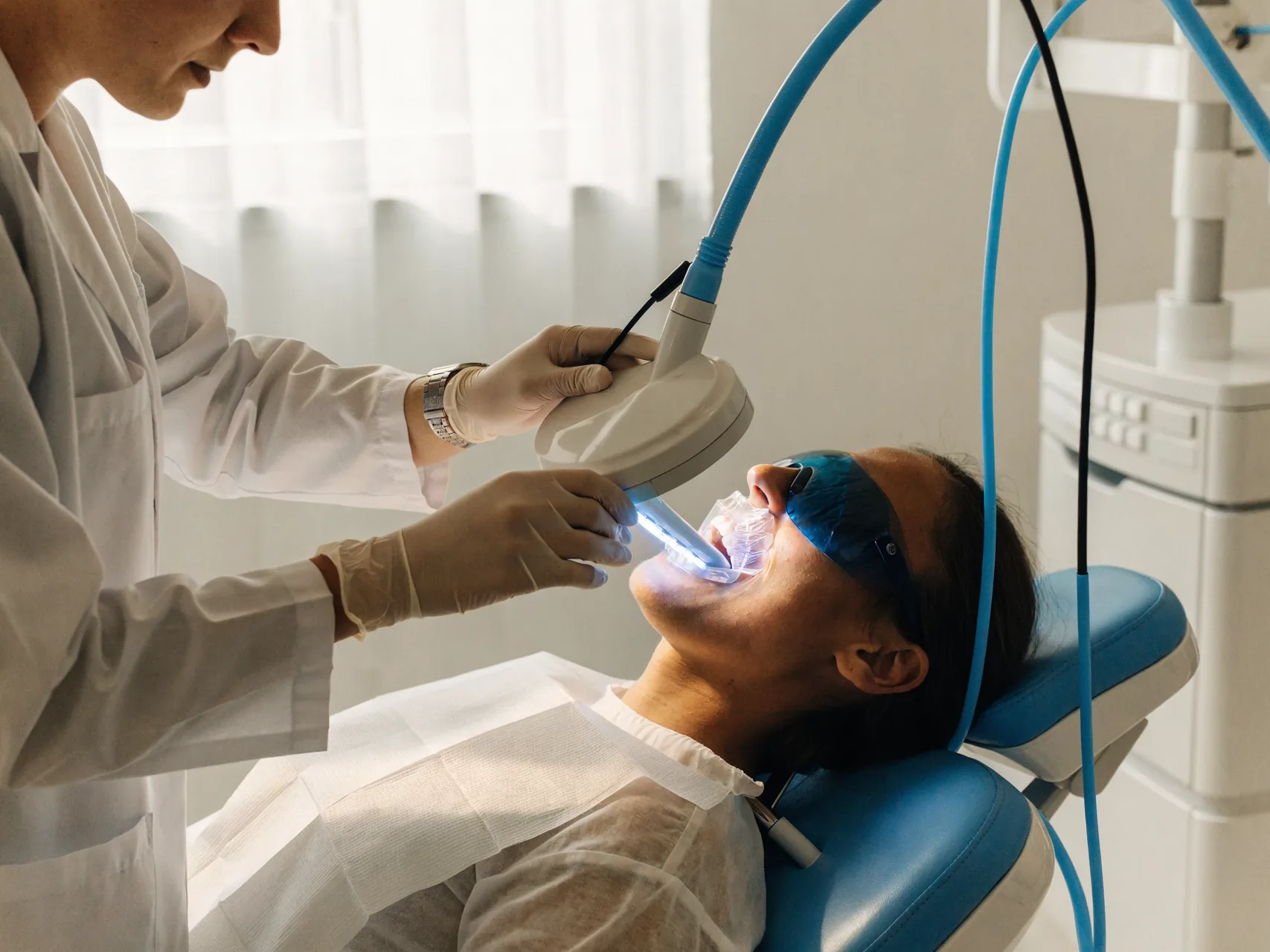
The clinician or appropriately authorised dental professional applies and controls the whitening material in a clinical setting. Soft tissues and eyes are protected as required by the system. The professional monitors placement, exposure and symptoms, removes material and records the response. Some systems use a light; others do not. The presence of a lamp does not by itself prove a better, safer or longer-lasting result.
Chairside delivery concentrates the active stage into a clinical appointment. That may suit a patient who values direct supervision, cannot reliably use trays, has a near-term event or wants the clinician to stop immediately if a problem develops. It can also create a more intense exposure in a shorter period, so sensitivity history and soft-tissue protection matter. The correct protocol depends on the product, jurisdiction and patient; there is no responsible universal concentration or appointment length for a public page to prescribe.
Dentist-supervised take-home whitening
After assessment, the provider supplies an approved gel and trays with written instructions. Custom trays are designed to fit the patient's teeth and control where the material sits. The patient performs repeated applications at home and returns or communicates for review under the agreed pathway. Concentration, wear time, frequency, total course and stop rules are prescribed for the individual and product.
Take-home treatment offers gradual control and can make it easier to pause or adjust use when sensitivity develops. It also transfers important tasks to the patient: placing the correct amount, keeping the tray clean, following storage instructions, avoiding unauthorised sharing, observing symptoms and attending review. A custom tray is not automatically suitable forever; dental work, tooth movement, wear or damage can change its fit.
Direct-to-consumer or over-the-counter products
Retail strips, paint-on gels, toothpastes and generic trays vary by country, formulation and regulatory status. Some products remove surface stain mainly through abrasives; some contain peroxide intended to alter tooth colour. They do not include the same personal examination, custom fit, prescribing decision or professional review as a dentist-led pathway.
Availability does not establish suitability. A patient may unknowingly whiten around decay, recession, a cracked tooth or mismatched restorations. Generic trays can allow material to contact soft tissues. An online seller may be outside the patient's regulatory jurisdiction. If considering a retail product, check the legal source, full ingredient and concentration information, instructions, warnings, expiry, batch identification and a route for adverse-event reporting. Do not use industrial chemicals, hair products, cleaning agents or unlabelled gels in the mouth.
A comparison that does not invent numbers
| Decision factor | Dentist-led in-clinic pathway | Dentist-supervised take-home pathway |
|---|---|---|
| Initial diagnosis | Required before elective care | Required before gel and trays are prescribed |
| Delivery | Material applied and monitored in the clinical setting | Prescribed material applied by the patient according to written instructions |
| Control during application | Professional can observe placement and stop the session | Patient must follow dose, wear and stop instructions outside the clinic |
| Pace | More of the active treatment occurs during appointments | Change develops over repeated applications |
| Sensitivity management | Symptoms can be assessed during the appointment; later symptoms still need a contact route | Use can often be paused pending advice, but the patient must recognise and report symptoms |
| Soft-tissue control | Isolation or barriers are managed in clinic | Tray fit, gel quantity and technique influence soft-tissue contact |
| Compliance burden | Attendance and aftercare still matter | Repeated correct use, storage, cleaning and review are central |
| Restorations | Crowns, veneers, composite and implant restorations do not bleach like natural teeth | The same colour mismatch limitation applies |
| Maintenance | Requires behaviour and reassessment; no fixed lifespan | Trays may support a future prescribed cycle only after suitability and fit are reconfirmed |
| Evidence to request | Product, clinician, protocol, baseline, consent, discharge and review record | Product, concentration, tray record, instructions, supply record, stop rules and review plan |
This table compares responsibilities, not outcomes. Starting shade, stain cause, enamel and dentine characteristics, restorations, use pattern and measurement method all affect apparent change. Different studies may use different products, colour instruments, photographs, lighting and follow-up periods. A claim of a fixed number of shades is not an individual prediction.
Speed is not the same as final value
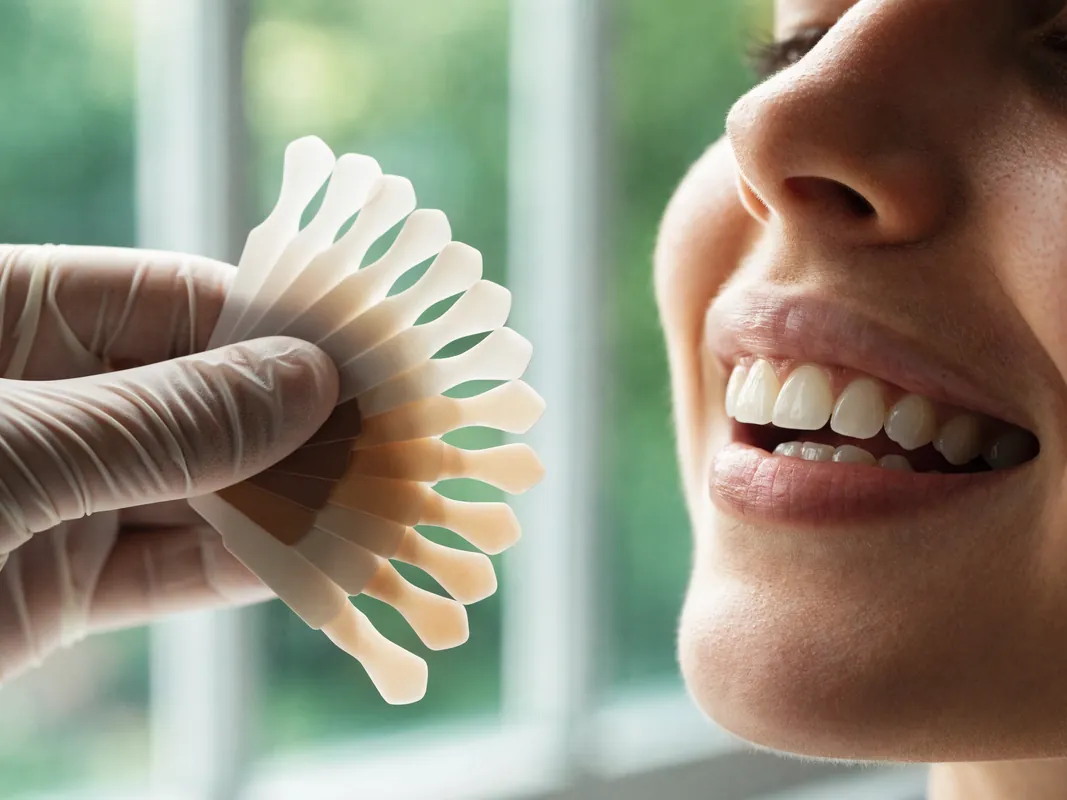
In-clinic whitening is attractive when a patient has a deadline. The clinical appointment can produce a visible change without weeks of home applications. That convenience does not prove that the final stable shade will exceed every supervised home pathway. Teeth can look temporarily lighter immediately after a chairside procedure because of dehydration. Colour should be judged again after rehydration under consistent conditions before irreversible restorations are matched.
Take-home whitening is slower in the ordinary sense that the patient applies material across a prescribed course. The gradual process can be useful when the clinician wants to observe response, adjust the plan or coordinate colour before restorative work. It may be a poor choice for someone who will not follow instructions, cannot handle the tray, has an unsafe home environment for gel storage or is unlikely to report adverse symptoms.
The question is therefore not simply how fast. Ask:
- When must the colour be stable rather than merely look brighter?
- Is the deadline compatible with assessment, treatment, rehydration and review?
- Is restorative shade matching planned afterwards?
- Can the patient use a tray correctly and safely?
- Is direct supervision more valuable than a gradual adjustable course?
- What happens if sensitivity interrupts the intended schedule?
For a wedding, interview or other fixed event, avoid scheduling an untested pathway at the last possible moment. The personal plan should leave space for review and for temporary sensitivity or gum irritation to settle. No provider should guarantee a particular shade by an event date.
Natural teeth and restorations respond differently
Peroxide acts on natural tooth tissue. Existing crowns, veneers, bridges, implant crowns, dentures and most tooth-coloured fillings do not lighten in the same way. Whitening can therefore expose a mismatch that was less obvious before treatment. A patient with a visible front filling may need to decide whether its current colour is acceptable after the natural teeth stabilise.
This makes sequence important. When elective composite, veneers or crowns are being considered, the team should explain whether whitening comes first, how long colour will be allowed to stabilise, when the final shade is selected and which replacement restorations are optional rather than clinically required. Replacing a sound restoration solely for colour is an irreversible and financial decision, not an automatic part of bleaching.
Whitening should not be used to manufacture a need for veneers. Equally, veneers should not be described as the universal answer whenever bleaching is uncertain. Depending on diagnosis and patient priorities, reasonable options may include no treatment, professional cleaning, monitored whitening, microabrasion for selected superficial defects, resin infiltration for selected lesions, additive composite, replacement of a defective restoration, internal bleaching of a suitable non-vital tooth, veneer treatment or another restorative pathway. Each has different tissue cost, maintenance and uncertainty.
Patients considering a broader aesthetic plan can read the separate whitening versus veneers decision guide and the veneers and whitening sequencing guide. Those pages are educational and do not replace a personal diagnosis.
Sensitivity deserves a real plan
Temporary tooth sensitivity and gum irritation are among the most commonly reported adverse effects of whitening. Risk and experience vary. Higher exposure, pre-existing sensitivity, exposed dentine, recession, cracks, restoration margins, gel placement and patient behaviour may matter. A label such as gentle does not remove the need for assessment.
Before treatment, disclose previous whitening reactions, cold or sweet sensitivity, spontaneous pain, reflux or erosion, gum recession, cracked teeth, recent restorations and allergy concerns. The clinician should distinguish ordinary brief sensitivity from symptoms that suggest another diagnosis. If one tooth has persistent or severe pain, do not simply continue bleaching across it.
A written sensitivity plan should identify:
- what discomfort may be expected for the specific product;
- how to reduce, pause or stop use under the provider's instructions;
- whether a desensitising approach is suitable for that patient;
- which symptoms require a dental examination;
- who to contact when treatment is being used away from the clinic;
- what to do if material contacts or burns the gum;
- how an interrupted course will be reviewed rather than automatically restarted.
Do not self-prescribe painkillers or desensitising products merely because an internet guide mentions them. Medicines and oral-care products have contraindications and use instructions. Ask a qualified clinician or pharmacist who can assess the individual context. A provider should not use local anaesthesia simply to hide warning discomfort during whitening material application; symptoms can signal soft-tissue exposure or another problem requiring correction.
In-clinic supervision: what it adds and what it cannot add
Direct professional control can improve application accuracy, soft-tissue protection, immediate observation and documentation. The provider can confirm the product, isolate tissues as indicated, inspect for leakage, respond to discomfort and compare the result with a recorded baseline. These are meaningful process advantages.
Supervision cannot guarantee a specific colour, zero sensitivity, permanent stability or absence of relapse. It does not make an inappropriate diagnosis appropriate. A branded light, celebrity photograph or before-and-after image does not prove that the clinician has assessed the patient correctly. The light may be part of a manufacturer's validated protocol, but the provider should explain its purpose and evidence without treating it as a universal superiority claim.
Ask who is performing each step and whether that person is legally authorised in the treatment jurisdiction. In the UK, tooth whitening is considered dentistry, and the GDC position statement sets out restrictions around supply and first use for products within specified peroxide ranges. Rules elsewhere differ. A beauty salon, hotel room, mobile kiosk or social-media seller should not be assumed lawful or clinically safe because the service is described as cosmetic.
Take-home supervision: what quality looks like
A proper dentist-supervised home pathway is more than receiving syringes and a generic tray. It should have a traceable assessment, a fitting or digital workflow, product details, written prescription or directions, demonstration, contact route and review. The patient should know which teeth are intended to be treated and what outcome is uncertain.
Before leaving with the kit, confirm:
- the legal provider and prescribing clinician;
- the product name, active ingredient, concentration, batch or traceability information where supplied and expiry;
- tray ownership, fit and what to do if it rubs or no longer seats;
- the prescribed amount per tooth, wear pattern and course boundary;
- storage and child-safety instructions;
- whether eating, drinking or smoking restrictions apply during use;
- how to clean and dry the tray without deforming it;
- sensitivity and gum-contact stop rules;
- review timing and the route for unexpected symptoms;
- whether unused product may be retained and under what conditions;
- the rule against sharing trays or gel.
A patient travelling home with gel should check airline, customs and storage practicalities rather than assuming any product can be carried without restriction. The clinical provider should supply accurate product documentation, but transport rules remain separate from dental suitability.
The law and product range matter
Whitening regulation is not globally uniform. A concentration that is lawful in one clinical setting may not be supplied directly to a consumer in another. Product wording may use hydrogen peroxide or the amount released from another compound, so headline percentages are easy to misread. Do not compare two offers solely by the largest number on a sales page.
For UK use, the current GDC statement explains the legal position for products that contain or release hydrogen peroxide, professional supply and the first cycle of use. Patients should verify the latest version because regulations and guidance can change. For treatment in Turkey or another jurisdiction, request the local legal provider, product conformity information and the professional basis for its use. A Turkish clinic's lawful chairside protocol does not automatically authorise a patient to import, resell or use that product unsupervised in the UK.
Product authenticity also needs evidence. Request sealed packaging or traceability where relevant, label language, manufacturer instructions, expiry and safe storage. Avoid decanted, unlabelled syringes from an unknown source. A low price does not prove a product is counterfeit, and a high price does not prove authenticity; documentation is what makes the claim checkable.
Does light activation make in-clinic whitening better?
Some chairside systems use LED, laser or another light as part of the protocol. Marketing often credits the device for the entire colour change. In reality, whitening results depend on the bleaching chemistry, application, starting condition and measurement as well as any system-specific activation.
Ask the provider to identify the device and material, explain the intended role of the light, disclose eye and tissue protection, and distinguish manufacturer instructions from an individual outcome promise. Do not assume that a hotter, brighter or longer exposure is better. Heat and dehydration can affect comfort and immediate appearance. The absence of a light does not mean a professionally supervised pathway is ineffective.
The practical comparison should focus on the complete validated system, clinician control, patient suitability and follow-up rather than a lamp photograph. If a provider claims a guaranteed number of shades because of a device, request the evidence and the measurement method used for that patient.
Whitening toothpaste is not the same treatment
Whitening toothpastes mainly help manage external surface stain through abrasives or other ingredients; some contain peroxide at levels and delivery formats different from professional bleaching. They may help a person maintain a cleaner-looking surface, but they do not recreate every effect of a prescribed tray or chairside gel.
More abrasive is not automatically more effective or safer. Aggressive brushing and abrasive powders can contribute to surface wear, particularly where dentine is exposed. A person with erosion, recession, sensitivity or restorations should ask for product-specific advice. Charcoal colour and gritty texture are not evidence of whitening benefit.
The ADA review notes limited evidence for many do-it-yourself approaches and raises safety concerns about abrasive or acidic household mixtures. Lemon juice, vinegar, baking-soda combinations and unregulated charcoal powders should not be treated as harmless because they are natural. Acid can erode mineral; abrasive particles can wear surfaces. Oil pulling is not an evidence-based substitute for diagnosis or peroxide whitening.
Tetracycline, fluorosis and white spots need nuanced advice
It is inaccurate to say that whitening never affects tetracycline-associated discolouration or that veneers are always required. Some intrinsic stains may respond partially, slowly or unevenly; the extent depends on severity and distribution. A long supervised course may be discussed in selected cases, but no public guide can promise sufficient masking.
Fluorosis and white spots are also not one diagnosis. Lightening surrounding enamel can reduce contrast in some cases and increase contrast in others. The clinician should identify whether the mark reflects fluorosis, demineralisation, developmental change, trauma or another cause before recommending a cosmetic sequence.
The safest option ladder normally begins with diagnosis and the least irreversible reasonable pathway. It may include accepting the colour, cleaning, monitored whitening, lesion-specific treatment or additive restoration before subtractive ceramic treatment is considered. Patient preference matters, but consent should include tissue cost, repairability and uncertainty.

A root-filled or dark single tooth is a separate pathway
A single dark tooth can result from trauma, pulpal changes, previous root-canal treatment, restoration materials, decay or other causes. External full-arch whitening may alter neighbouring teeth without solving the main problem. The tooth should be assessed for symptoms, vitality or endodontic status, cracks, decay, restoration condition and radiographic findings where indicated.
Internal bleaching is performed from within a suitable root-filled tooth under professional control. It has different indications and risks from external whitening, including the need to protect the root filling and monitor for complications. It should not be sold remotely from a photograph. Alternative restorative options may be discussed when internal treatment is unsuitable or insufficient, but they should not be automatic.
Pregnancy, breastfeeding and age boundaries
Elective whitening during pregnancy or breastfeeding is commonly deferred in public clinical guidance. The NHS page advises against whitening in these circumstances. A patient should disclose pregnancy, breastfeeding and relevant health changes to the provider rather than relying on a website to determine eligibility.
Age restrictions are also jurisdiction-specific. The NHS page states that cosmetic whitening is not done for people aged seventeen or younger, while the GDC statement explains UK peroxide restrictions for people under eighteen except for treatment or prevention of disease. Parents should not use adult whitening products on children or teenagers without an appropriate dental diagnosis and lawful professional plan.
Plan around restorations, orthodontics and hygiene
Whitening may fit into a broader sequence, but sequence must follow clinical findings. Active gum inflammation, untreated decay and leaking restorations may require attention first. Professional cleaning can reveal the true baseline by removing deposits and surface stain. Orthodontic attachments, retainers and planned restorative bonding may affect timing and technique.
After orthodontic treatment, the team may wait for tissues and enamel to be assessed before prescribing whitening. If composite bonding or ceramic work is planned, colour stabilisation and bonding considerations should be built into the schedule. The dentist and laboratory should agree who owns final shade communication. A holiday or event itinerary should not compress biological assessment and material steps into a marketing timetable.
For patients considering whitening as part of a trip, the dental treatment timeline guide explains how to separate fixed bookings from clinical decision gates. The returning home after dental tourism guide covers local handover and symptom escalation.
Compare written scope, not package labels
An in-clinic whitening quote and a take-home quote may include different things. One may cover assessment, cleaning, clinical application and review; another may cover scans or impressions, trays, gel, instructions and follow-up. A headline total is not comparable until scope is aligned.
Request an itemised written quotation showing:
- initial examination and any separately justified imaging;
- whether professional cleaning is included or conditional;
- exact whitening pathway and product category;
- tray design and replacement terms where applicable;
- clinical applications or supplied units without promising a fixed result;
- review and sensitivity management;
- optional versus necessary restorative work;
- treatment of an individual non-vital tooth if relevant;
- taxes, currency, deposit and cancellation terms;
- exclusions and conditions that could change scope;
- aftercare, additional gel rules and local follow-up responsibility.
If whitening is bundled with travel, hotel or another dental service, separate the clinical price and legal provider from travel services. Accommodation does not prove clinical quality. A transfer company is not the treatment provider. The contract should show which entity receives each payment and which terms govern each service.
Consent must include uncertainty
Consent is more than a signature. The responsible clinician should explain the diagnosis, proposed pathway, alternatives, likely burdens, material risks, limitations and what happens if the patient stops. Discussion should include temporary sensitivity, soft-tissue irritation, uneven response, restoration mismatch, relapse, the possibility that the desired shade is not achievable and any need to reassess a symptomatic tooth.
Before-and-after photographs can support discussion but are not predictions. Lighting, camera exposure, dehydration, lip position and editing can change appearance. Ask whether images are standardised and whether they show the same patient, conditions and follow-up point. Never consent because an image is labelled guaranteed.
The patient should receive time to ask questions and decline. Whitening is elective. Refusing it should not compromise necessary disease treatment. If a provider pressures the patient to add veneers, crowns or replacement fillings solely because whitening did not reach an advertised shade, pause and obtain a second opinion.
Records worth keeping
Good records allow review, maintenance and continuity. Ask for copies of the relevant assessment and treatment information, including:
- named legal provider and treating professional;
- diagnosis or reason for whitening and baseline oral-health findings;
- baseline shade method and photographs if taken with consent;
- existing visible restorations and mismatch discussion;
- product, active ingredient, concentration and traceability where supplied;
- application dates or prescribed home-use instructions;
- tray scan, impression or fit record where applicable;
- adverse symptoms, modifications and review notes;
- post-treatment shade assessment after an appropriate stabilisation period;
- maintenance plan and product-storage information;
- complaint and clinical-contact routes.
Do not post identifiable health images publicly merely to obtain a sales quote. Use the provider's secure route and read its privacy notice. Ask who receives the information, where it is stored, how long it is retained and how to request access or correction.
Travel changes the risk-management plan
Whitening is less invasive than surgery, but travel still separates the patient from the treating provider. A patient receiving chairside whitening shortly before a flight should know whom to contact if pain or soft-tissue injury develops. A patient carrying a home kit needs lawful supply, storage and review arrangements. Neither should assume a local dentist will provide free remedial care for treatment prescribed elsewhere.
Before travelling, identify a home dentist or urgent dental route. Share the product and treatment record if assessment is needed. Remote messages may help triage, but photographs cannot rule out decay, pulpal disease, a crack or chemical injury. The written plan should state when an in-person examination is required and which party pays for it.
Travel convenience should not drive irreversible care. If whitening produces a colour mismatch with an old restoration, replacement can usually be considered later after review rather than being rushed before departure. The absence of spare holiday days is not a clinical indication.
Maintenance is individual, not a calendar promise
Whitening is not permanent because natural teeth continue to age and acquire stain. Diet, smoking, oral hygiene, surface characteristics and previous treatment influence appearance. That does not mean every patient needs automatic annual whitening or unlimited gel use.
A maintenance discussion may cover routine oral hygiene, stain-causing habits, professional cleaning when indicated and reassessment before another bleaching cycle. The provider should confirm that teeth, gums, restorations and tray fit remain suitable. Old gel should not be used beyond storage or expiry instructions. More frequent exposure is not automatically better.
If the patient is satisfied, no cosmetic retreatment is required. A stable, healthy result that does not match a social-media filter can still be a successful patient-centred outcome. The aim should be an informed choice, not an indefinitely escalating shade target.
Warning signs and urgent care
Brief sensitivity can occur, but severe, localised, worsening or persistent symptoms need assessment. Stop using the product and follow the named provider's instructions if there is significant pain, a suspected gum burn, swelling, blistering, ulceration, a cracked tooth, a loose restoration or an allergic-type reaction. Do not keep applying gel to prove compliance.
Facial swelling, difficulty breathing or swallowing, collapse or other signs of a medical emergency require urgent emergency help under local guidance. In the UK, use NHS emergency pathways such as NHS 111 or emergency services as appropriate. A marketing WhatsApp account is not an emergency service.
A practical selection worksheet
Use this worksheet with the clinician rather than asking which method is best in the abstract:
| Question | Your evidence |
|---|---|
| What is causing the colour concern? | Examination, history and defined tests |
| Are teeth and gums healthy enough for elective whitening? | Dated clinical findings |
| Which teeth are natural and which are restorations? | Tooth-by-tooth record |
| What result is realistic and what remains uncertain? | Written explanation without a fixed shade promise |
| Why is chairside or take-home delivery proposed? | Patient-specific reason |
| What product and legal supply route apply? | Label, provider and current jurisdiction |
| How will sensitivity and gum exposure be managed? | Stop rules and contact route |
| How will colour be measured and allowed to stabilise? | Baseline and review method |
| Is later restorative work optional or necessary? | Separate indication and quote |
| What if the planned course is interrupted? | Review and contingency |
| Who owns follow-up after travel? | Named provider and local route |
| What records will be supplied? | Written handover list |
The stronger plan is the one that answers these questions clearly, not the one with the brightest device photograph.
Red flags in whitening advertising
Pause when an advert or salesperson claims:
- a guaranteed number of shades for everyone;
- permanent whitening or zero relapse;
- zero sensitivity or completely risk-free treatment;
- one product works for every stain and restoration;
- veneers are automatically required when whitening is uncertain;
- a lamp proves superiority without identifying the material and evidence;
- an examination is unnecessary because the service is cosmetic;
- a non-dental venue can provide the same regulated care;
- unlabelled gel is stronger and therefore better;
- every crown or filling must be replaced as part of a package;
- a remote photograph is enough to approve treatment;
- immediate additional applications should continue despite significant pain.
Independent verification is more valuable than reassurance. Check the professional register, legal provider, product information and written scope. If the answers remain vague, do not pay merely to preserve a promotional price.
Sources and evidence limits
This guide uses patient guidance from the [NHS](https://www.nhs.uk/tests-and-treatments/teeth-whitening/), the [ADA oral-health topic on whitening](https://www.ada.org/resources/ada-library/oral-health-topics/whitening), the [GDC legal position for tooth whitening](https://www.gdc-uk.org/standards-guidance/standards-and-guidance/working-within-the-law/what-is-the-legal-position/lists/what-is-the-legal-position/c94ba990-9a91-4d7e-9445-83cb533a7bbd) and an NHS teaching-hospital [adult tooth-whitening information page](https://www.leedsth.nhs.uk/patients/resources/tooth-whitening-information-for-adult-patients/). Sources describe populations, products and regulatory contexts; they do not predict an individual's response.
Product formulations, professional rules and legal limits can change. Verify the current label, manufacturer instructions and local regulator before treatment. This page is education, not a diagnosis, prescription, quotation or claim that one whitening pathway is universally superior.
Final decision rule
Choose neither in-clinic nor take-home whitening from a headline alone. First establish the cause of discolouration and oral-health status. Then compare two documented pathways on lawful supply, clinical supervision, patient responsibility, sensitivity control, restoration mismatch, review, maintenance, records and total scope. Chairside treatment may be convenient and closely observed. Dentist-supervised home treatment may be gradual and adjustable. Either can be inappropriate when diagnosis, consent or follow-up is missing.
The best outcome is not the largest shade claim. It is a proportionate, reversible where possible, lawfully supplied and well-documented plan that respects the patient's teeth, preferences and right to stop.