A neutral decision guide for comparing a named UK veneer proposal with a named Turkey proposal using tooth-by-tooth evidence, accountable clinicians, records and workable aftercare.
“Dental veneers in Turkey or the UK?” sounds like a country comparison, but country is not the clinical unit of decision. The useful comparison is between two named legal providers, two named responsible clinicians and two tooth-by-tooth proposals. Neither destination can diagnose decay, gum disease, a crack, enamel quality, tooth position, bite loading or the cause of a colour concern. Neither country label proves how much tooth tissue will be altered, who will design the restorations, what records will be supplied or how a problem will be assessed after fitting.
This guide does not rank, endorse or recommend either destination. It does not claim that UK and Turkish veneer care are equivalent, and it does not assume that one is cheaper, faster, safer or more aesthetic. A defensible decision may favour a particular UK proposal, a particular Turkey proposal, a more conservative alternative, or no elective treatment. The reason must come from patient-specific evidence and workable continuity—not a flag, a material name, a social-media transformation or a bundled travel offer.
The broader Turkey versus UK private dental comparison covers cross-border and domestic care at a general level. This page owns a narrower intent: how to compare two actual veneer proposals without losing sight of diagnosis, tooth preservation, function, laboratory control, records, contract terms and UK aftercare. The dental veneer service guide explains the treatment category, while the veneer quotation guide explains what a per-tooth figure may or may not contain. Use those pages for their distinct questions rather than treating several pages as votes for a destination.
This is educational decision support, not a diagnosis, clinical recommendation, legal opinion, insurance interpretation, quotation or outcome promise. A suitably qualified dentist who has sufficient information and examines the patient owns clinical decisions. Official registers, regulatory information, insurance terms and travel advice can change; recheck them with the exact provider, clinician, policy and travel date.
Start With the Concern, Not a Veneer Count
A request for “a new smile” can hide several different concerns: colour, isolated stains, chips, worn edges, spacing, crowding, proportions, existing restorations, gum display, tooth position, a bite problem or anxiety about appearance. Those concerns do not all lead to the same treatment. Before comparing destinations, write down what bothers you, what you wish to keep, what degree of change you would accept and what irreversible change you would refuse.
Ask both clinicians to convert the concern into findings. For every visible tooth, record whether it is healthy, restored, decayed, cracked, worn, discoloured, root-treated, mobile, affected by gum disease, poorly positioned, painful, sensitive or uncertain pending further assessment. Record existing fillings, crowns, veneers and previous trauma. A uniform smile proposal is not a substitute for this tooth-level map.
A remote photograph may help communicate appearance. It cannot reveal every surface, margin, crack, restoration, periodontal pocket, occlusal contact, pulpal condition or radiographic finding. A remote proposal should say what remains provisional and which decisions cannot be made until examination. If a sales conversation moves directly from photographs to a fixed number of veneers, ask where diagnosis, alternatives and the in-person decision gate are documented.
The patient’s goal also needs definition. “White,” “natural,” “straight,” “symmetrical” and “young” are subjective. Ask how preferences will be recorded without presenting a digital image as certainty. Discuss the limits created by anatomy, tooth position, gum levels, facial movement, speech, function, underlying colour and the desire to preserve tissue. The patient should be able to decline a design or pause before irreversible preparation.
Preserve Healthy and Restorable Teeth Before Comparing Countries
Veneer treatment can involve irreversible tooth alteration. The American Dental Association’s patient information explains that enamel may be removed and that underlying disease should be treated before veneers. NHS information also distinguishes veneers from other dental treatments and notes that fitting some veneers involves removing some of the front surface. The exact preparation varies, but “cosmetic” does not make the decision biologically trivial.
For each proposed tooth, ask:
- What diagnosis or appearance concern is being addressed?
- Is the tooth healthy and restorable?
- Is there active decay, gum inflammation, periodontal instability, a crack, pain or an endodontic concern?
- What existing restoration will remain under or next to the veneer?
- How much sound enamel is expected to remain available for bonding?
- What preparation is intended, and what finding could make it more extensive?
- Would a crown, onlay or another restoration be proposed instead, and why?
- What happens if the tooth cannot support the planned veneer after examination?
- Can the goal be met by monitoring, prevention or a less invasive option?
“Restorable” is a clinical judgment, not a visual label. A heavily restored, cracked or root-treated tooth may require a different discussion from a minimally restored vital tooth. Conversely, a tooth should not be given a crown merely to make a group look uniform if a veneer, additive restoration, repair or no treatment could preserve more tissue. Ask the clinician to explain the strongest reasonable preservation pathway, its uncertainty and maintenance burden.
Do not allow a destination schedule to drive tooth removal. If disease control, periodontal care, endodontic assessment, orthodontic movement or observation is needed, sequence it according to clinical criteria. A flight or hotel booking does not make a tooth ready for preparation.
Compare Whitening, Orthodontic, Composite and No-Treatment Alternatives
A veneer is one option, not the default answer to every visible difference. Both proposals should document reasonable alternatives and the consequence of doing nothing now. The relevant alternatives depend on diagnosis, so a generic list is only the start of a consent discussion.
For a mainly colour-based concern, professional assessment may lead to cleaning, management of disease, whitening, replacement of one defective restoration, a targeted restorative option, acceptance of natural variation or another pathway. Whitening changes natural tooth colour differently from ceramic or composite restorations. If whitening is considered, ask whether it should occur before final shade selection and how existing restorations affect the plan.
For spacing, rotation, crowding or protrusion, orthodontic assessment may address tooth position rather than masking it with wider, bulkier or more heavily prepared restorations. Orthodontic care has its own burdens and uncertainties, but it should not be omitted solely because a restorative route appears quicker. Ask whether tooth movement could improve alignment, gingival relationships or available space while preserving enamel.
For an isolated chip, worn edge, small shape discrepancy or limited space, direct composite, polishing, recontouring, repair or observation may be relevant. Composite can be more additive in selected cases and can often be repaired, but it has its own wear, staining, surface, fracture and maintenance considerations. Ceramic and composite should be compared as different systems, not as “good” and “bad” tiers.
For gum-level or display concerns, periodontal diagnosis comes before cosmetic reshaping. Inflammation, recession, tissue thickness, bone level, tooth position and biological width may change what is appropriate. A gum procedure should not be added merely to make a digital design fit. Ask who owns the periodontal decision and how tissue stability will be reviewed before final restorative margins are accepted.
No treatment is a legitimate option for an appearance concern that does not threaten health or function. The clinician should explain what may happen with monitoring and what signs would justify reassessment. Valid consent is weakened when the only options presented are one veneer material, a crown or a larger package.
Veneer Type Is Not a Complete Treatment Plan
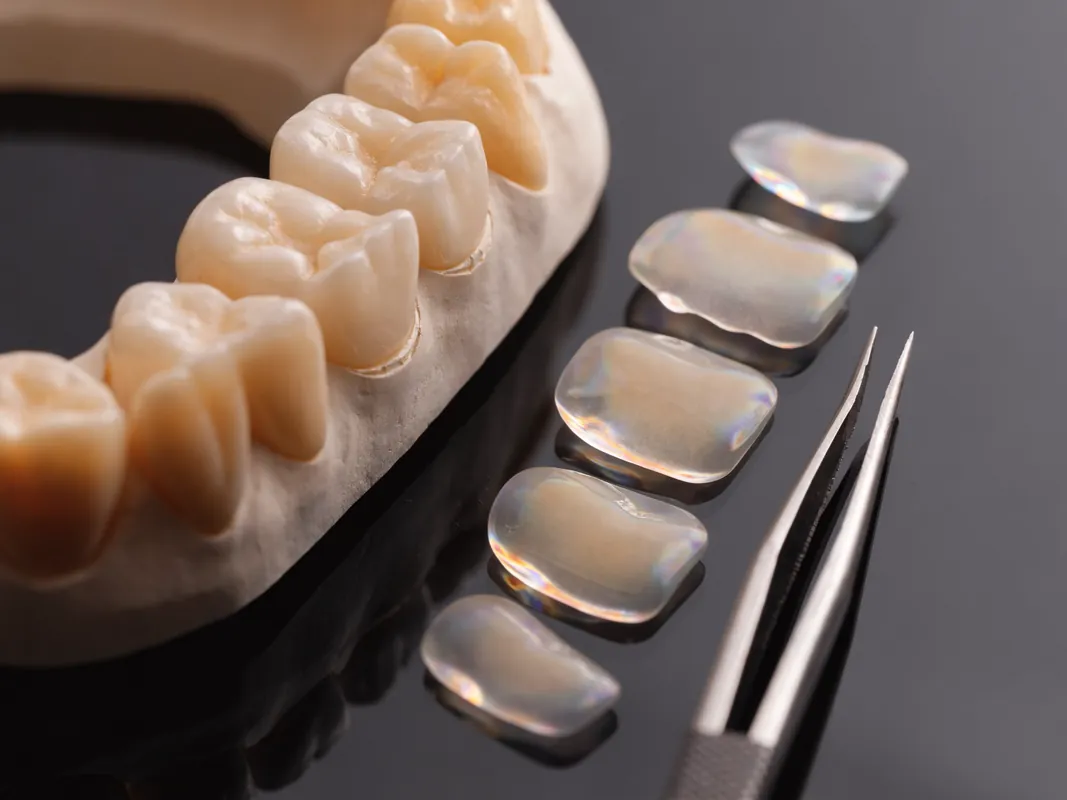
“Veneer” can describe different materials, fabrication methods, preparation designs and bonding situations. A proposal should name the restoration category for each tooth and explain why it fits the findings. It should not rely on a trademark or a broad word such as porcelain, ceramic, composite, pressed, layered, milled or no-prep as proof of suitability.
Key distinctions include:
- directly placed composite versus indirectly fabricated restoration;
- full facial coverage versus a partial additive form;
- preparation intended to remain mainly in enamel versus exposure of other substrates;
- incisal coverage versus a design without it;
- existing composite, dentine or another restoration at the bonding surface;
- masking a dark substrate versus preserving translucency;
- a new veneer versus repair or replacement of existing work;
- a veneer versus a crown when structural support is different.
Peer-reviewed reviews indexed in PubMed show that preparation design and bonding substrate are clinically relevant questions and that the literature has limits. The point is not to extract a universal survival promise. It is to require the responsible clinician to explain the intended preparation, substrate, material class, bonding strategy, risk factors and maintenance in your case.
“No-prep” should not be understood as a guarantee that no tooth alteration will occur. Contacts, margins, contours, finishing and space may still require modification. An additive restoration also needs sufficient space and a contour that can be cleaned and functions with the opposing teeth. Ask for the planned change in writing and what would cause the plan to change after direct assessment.
At the other extreme, preparation should not be normalised merely because a thicker or more opaque restoration was selected in advance. Ask whether position, colour, existing restorations or design demands are driving tissue removal. A diagnostic design or mock-up can support communication, but it does not authorise preparation by itself.
Function, Occlusion and Parafunction Are Part of Veneer Planning
Veneers are visible restorations, but they still function in a bite. The clinician should assess contacts when the teeth meet, guidance during movement, edge position, overbite, overjet, wear pattern, missing posterior support, existing restorations, jaw symptoms and habits such as clenching or grinding. The purpose is not to promise that one design will eliminate every risk. It is to recognise function before changing tooth shape.
Ask how the proposed length, thickness and edge position relate to speech and jaw movement. A digital front-view image cannot show every functional contact. If the proposal changes several teeth, ask how the new shapes are tested and how the patient can comment before definitive fitting. If there is substantial wear, ask what caused it and whether the cause is still active.
Parafunction does not automatically rule veneers in or out. It may affect material, design, preparation, protection, expectations and maintenance. A protective appliance may be discussed, but it is not a guarantee against fracture, wear or debonding. Ask who fits and reviews it, how it interacts with the restorations and what happens if the bite changes.
If a clinician proposes altering healthy opposing teeth to make space or adjust the bite, request a clear rationale, alternatives and consent. Such a decision should not be hidden in “bite adjustment.” Record which teeth may be altered and why. Consider an independent opinion when a broad elective plan depends on irreversible adjustment beyond the teeth initially discussed.
The Named Legal Provider and Responsible Clinician Come Before Country
For a UK proposal, verify the treating dentist in the General Dental Council register at https://olr.gdc-uk.org/SearchRegister. Verify the service through the regulator applicable to the UK nation and provider type. In England, the Care Quality Commission’s dentist search at https://www.cqc.org.uk/care-services/find-dentist identifies services and responsible organisations. CQC is not the regulator for every part of the UK, so do not apply an England-only check to Scotland, Wales or Northern Ireland without identifying the correct route.
For a Turkey proposal, request the exact legal facility name and treatment address. Check current Ministry of Health information for authorised international-health-tourism providers at https://saglikturizmi.saglik.gov.tr/EN%2C69063/healthcare-providers-authorized-by-the-ministry.html and the HealthTürkiye facility list at https://www.healthturkiye.com/hospitals-list. Check the named dentist through the Turkish Dental Association search at https://tdb.org.tr/dishekimi_arama.php. Ask the provider to explain any spelling, address or identity mismatch rather than guessing.
An official listing helps establish identity or current status. It does not prove that a veneer proposal is necessary, conservative or suitable. Verify the proposal separately. For both countries, obtain:
- exact legal treatment-provider name;
- full treatment address;
- named dentist responsible for diagnosis and overall plan;
- named dentist expected to prepare and fit each restoration;
- any other responsible clinician, with role;
- laboratory legal name and location;
- who holds the record;
- who receives payment;
- provider complaint route and external route;
- any intermediary, travel supplier or coordinator as a separate entity.
A website, coordinator, laboratory, hotel or transport supplier does not become the treating provider by participating in the journey. If the seller and provider differ, require a role map before payment.
Consent Must Be Specific to the Final Plan
Consent is not a signature collected at booking. It is a continuing discussion with a clinician who can explain the patient-specific benefits, material risks, uncertainties, alternatives and consequences of no treatment. GDC Principle Three at https://standards.gdc-uk.org/pages/principle3/principle3 provides a useful patient-facing framework for valid consent. It governs UK registrants; it does not automatically regulate a clinician practising only in Türkiye. The principle remains valuable as a checklist for questions.
Veneer consent should address, where relevant:
- the diagnosis and goal for each tooth;
- alternatives, including no treatment;
- expected preparation and irreversibility;
- possible sensitivity or pulpal consequences;
- gum and margin considerations;
- fracture, chipping, debonding, wear, roughness or staining concerns;
- colour and shape limits;
- uncertainty in masking the underlying substrate;
- repair versus replacement possibilities;
- functional and bite considerations;
- maintenance and future intervention;
- what happens if the examination changes the plan;
- which changes require new consent and a revised quote.
The patient must be able to understand the discussion. If interpretation is needed, identify who provides it and how clinical nuance is protected. Do not rely on marketing copy as translation of consent. Do not bundle health-data permission, travel terms, marketing permission and clinical consent into one acceptance.
If the responsible clinician changes, the patient should know before irreversible care and have an opportunity to ask questions. If the tooth count, restoration type, preparation, material or gum procedure changes, request updated written information and time to decide. A travel deadline does not cancel consent rights.
Separate Diagnostic Preview, Provisional and Definitive Restoration
A digital image, wax-up, printed model, mock-up, provisional restoration, try-in and definitively bonded veneer are different things. Each has different evidential value and limits. A computer preview can support communication about broad proportions or preferences, but it does not prove tissue thickness, material response, function or the exact final appearance.
A diagnostic mock-up may help the patient experience approximate contours or speech changes before preparation, depending on the case. Ask whether it is additive, what records were used and what cannot be simulated. Do not assume that accepting a preview authorises removal of tooth tissue.
Provisional restorations, when used, can protect prepared surfaces, support tissue form and allow limited evaluation. They are not the final material, final bond or a guarantee of final appearance. Ask how long they are expected to be used without adopting a universal timetable, what restrictions apply, what to do if one loosens or fractures, and who can assess it locally.
A final try-in should allow clinically appropriate checks of seating, margins, contacts, contour, shade relationship, phonetics and patient preference before definitive bonding. Some aspects change when the restoration is bonded; the clinician should explain those limits. The patient should not be pressured to approve an unacceptable or unexplained change because a flight is booked.
Document who has authority to change the design, who communicates with the laboratory and which version is final. If changes are requested, record them. A photograph sent through a chat is not a complete design-control record.
Laboratory, Shade and Material Traceability
Country and material label do not make laboratory work equivalent. Ask each provider to identify the actual laboratory, the person responsible for the clinical prescription, the material category for each restoration, the manufacturing method, shade and characterisation records, and the quality-control or adjustment workflow. If work is subcontracted, ask where and by whom.
The clinical dentist remains responsible for prescription, suitability, fit and consent even when a laboratory manufactures the restoration. A technician’s artistic reputation does not replace clinical diagnosis. Conversely, an on-site laboratory does not automatically prove quality, and an external laboratory does not automatically imply less individual work. Evaluate the actual records and workflow.
A useful laboratory and shade file may include:
- tooth identifiers and restoration type;
- preparation and margin information;
- scan or impression record;
- photographs taken with documented lighting or reference where used;
- requested base shade, value, translucency and characterisation;
- underlying tooth or core colour where relevant;
- material category and product identification sufficient for the provider’s record;
- manufacturing and finishing information relevant to future repair;
- try-in observations and approved changes;
- final fitting and bonding record.
Do not assume a product family named in a message is what will be supplied. Ask what document will be placed in the clinical record and what you will receive. A brand name alone does not describe preparation, thickness, substrate, bonding, contour, laboratory execution or clinician skill. It also does not guarantee shade stability or service life.
Shade selection should consider the natural teeth that remain visible, existing restorations and any planned whitening. Ask how changes in lighting, dehydration and photographs affect perception. “Bright” is not a specification. Ask the dentist to record the agreed range and the limits of matching across different substrates.
Records Must Support UK Continuity
The decision to travel changes the importance of portable records. Before choosing a Turkey proposal, ask a UK dentist whether they are willing to review you after return and what information they would need. Do not assume they will maintain, repair or replace another provider’s work. Their willingness, availability and fees must be confirmed independently.
For either proposal, arrange to receive:
- pre-treatment findings and diagnosis;
- tooth chart and existing restorations;
- relevant photographs, scans and imaging;
- treatment alternatives discussed;
- final consented plan;
- preparation and operative notes;
- material and laboratory records;
- bonding materials or protocol information clinically relevant to repair;
- final shade and restoration map;
- occlusal findings and adjustments;
- post-fitting review findings;
- maintenance and cleaning advice;
- warning signs and escalation contacts;
- complaint and records-request contacts.
GDC Principle Four at https://standards.gdc-uk.org/pages/principle4/principle4 addresses maintaining and protecting patient information for UK registrants. It can also help a travelling patient frame questions about accuracy, security and continuity. Agree how records will be transferred, in what language and format, and with whose consent.
The returning-home aftercare guide provides a detailed handover worksheet. Use it before treatment, not only after a chip, sensitivity or bite concern appears.
Compare Equivalent Scope, Not Headline Totals
A UK quote and a Turkey quote are comparable only after their scopes are normalised. A shared word such as “veneer” does not establish the same tooth count, preparation, material category, laboratory work, provisional care, reviews, records or responsibility. A lower total may omit stages; a higher total may contain items that do not apply. The task is not to prove which country costs less. It is to make every line visible.
Create a tooth-by-tooth comparison:
| Scope field | UK proposal | Turkey proposal | Evidence needed |
|---|---|---|---|
| Legal provider and payee | Record | Record | Register, contract, invoice |
| Responsible clinician | Record | Record | Name, status, role |
| Diagnosis per tooth | Record | Record | Examination-based plan |
| Preservation alternatives | Record | Record | Written options and reasoning |
| Restoration type | Record | Record | Tooth map and prescription |
| Preparation approach | Record | Record | Intended design and change gate |
| Existing substrate | Record | Record | Clinical findings |
| Function and bite | Record | Record | Assessment and design response |
| Laboratory | Record | Record | Legal name, location, workflow |
| Material record | Record | Record | Category and traceability commitment |
| Mock-up or provisional | Record | Record | Purpose, limits, responsibility |
| Try-in and approval | Record | Record | Decision and change process |
| Fitting and review | Record | Record | Included clinical stages stated precisely |
| Records supplied | Record | Record | Format, language, delivery point |
| Local aftercare | Record | Record | Named route and independent fee |
| Exclusions and contingencies | Record | Record | Revised-plan and cancellation terms |
Keep flights, accommodation, local transport, meals, companion expenses, missed work, insurance, possible extension and return travel outside the clinical scope unless the contract clearly identifies a separate supplier and price. Travel services do not become dental quality evidence because they appear on the same invoice.
Do not publish or rely on a fixed saving. Exchange rates, tooth count, alternatives, material, provider, laboratory, travel, aftercare and contingency can change the personal total. A decision should remain financially workable if the clinical plan becomes smaller, larger, staged or unsuitable after examination.

UK Local Continuity Is More Than Being Near Home
A UK provider may offer geographic continuity, but proximity alone does not prove that appointments, records, repair arrangements or clinician continuity are adequate. Ask the UK proposal the same questions about named clinician, laboratory, preparation, alternatives, records, complaints and commercial terms. Do not use “UK regulated” as a shortcut for reviewing the actual plan.
For a Turkey proposal, local UK continuity requires advance coordination. Identify:
- a UK dentist willing to perform baseline examination or independent review;
- what records they can share with consent;
- what care they may consider after return;
- what they will not take responsibility for;
- their availability for routine and urgent assessment;
- likely local fees;
- how the overseas provider will answer clinical questions and send records;
- who decides whether repair, replacement or monitoring is appropriate.
Remote contact with the original provider can support information exchange, but it cannot palpate tissue, check a margin, test a tooth, assess occlusion or take new imaging where clinically needed. A person with worsening symptoms should obtain suitable local assessment rather than wait for a remote commercial decision.
Aftercare should distinguish routine prevention, hygiene, review, minor polishing, repair, suspected caries, pulpal symptoms, periodontal issues, debonding, fracture, bite concerns and dissatisfaction with appearance. The responsible clinician should explain which signs need prompt review and which require urgent care.
Travel Planning Must Follow Clinical Gates
Do not book a non-changeable trip around a marketing timetable. Ask what can be decided remotely, what requires direct examination, which stages are irreversible, what criteria allow the next stage, what could delay fitting and what happens if the patient declines a revised plan. The answer should be patient-specific and should not promise a universal completion window.
Travel planning should include the exact facility address, airport and terminal, accommodation address, every appointment location, mobility requirements, companion needs and a route contingency. Keep a plan for extended stay or return without definitive completion if the responsible clinician decides that proceeding is inappropriate.
The NHS treatment-abroad checklist at https://www.nhs.uk/using-the-nhs/healthcare-abroad/going-abroad-for-treatment/treatment-abroad-checklist/ advises patients to consider provider information, risks, complications, aftercare, insurance and possible extra travel. The NHS page on going abroad for medical treatment at https://www.nhs.uk/using-the-nhs/healthcare-abroad/going-abroad-for-treatment/going-abroad-for-medical-treatment/ explains that a GHIC or EHIC does not cover travel for planned treatment and stresses aftercare, complaints and suitable insurance. Check current wording and your exact circumstances.
GOV.UK Türkiye travel advice at https://www.gov.uk/foreign-travel-advice/turkey covers live entry, safety and health information for British travellers. It does not assess a dental provider. Check it near departure and subscribe to updates where appropriate.
Weather, tourism and accommodation preference can affect comfort, but they do not improve bonding, accelerate tissue response or certify a treatment outcome. Follow the treating clinician’s instructions and use live travel information rather than a destination slogan.
Insurance and Funding Must Be Confirmed in Writing
Do not assume that UK dental insurance, private medical insurance, travel insurance, GHIC, EHIC or an employer benefit covers elective veneer treatment in Türkiye, a complication, an extended stay or remedial travel. Policies and eligibility differ. Tell the insurer the purpose of travel, provider, treatment and relevant medical information, then obtain written confirmation of coverage, exclusions, excess, authorisation, claims evidence and assistance contacts.
The NHS treatment-abroad information states important boundaries for planned treatment and public funding. Türkiye is outside the European planned-treatment routes described on those pages. Elective cosmetic dentistry may also sit outside ordinary benefits. This article does not determine eligibility or interpret a policy.
Ask how an insurer distinguishes:
- planned treatment itself;
- unrelated emergency healthcare during travel;
- a complication connected to planned care;
- cancellation caused by a clinical change;
- extra accommodation or rebooking;
- treatment needed after return;
- a pre-existing condition;
- loss, damage or delay unrelated to dentistry.
Keep policy documents and insurer responses with the clinical evidence file. A salesperson’s assurance is not an insurer decision.
Contract, Payment and Change Control
The quotation, treatment contract, consent records, laboratory prescription, travel terms and payment request should identify consistent parties and scope. Confirm who receives each payment and which obligation it settles. If an intermediary collects money, ask how the legal treatment provider’s obligations are created and documented. If travel suppliers receive separate payments, keep those contracts separate.
Before paying, obtain written answers for:
- deposit and balance conditions;
- what happens if examination changes the tooth count or restoration type;
- what happens if disease requires prior treatment;
- the consequence of declining a revised plan;
- who pays for new scans, provisional care or laboratory remake where applicable;
- cancellation and refund rules;
- change of clinician or facility;
- laboratory delay;
- extended stay or repeat travel;
- assessment, repair and replacement decision processes;
- local care and evidence requirements;
- governing law and complaint route.
Do not treat a commercial remedy term as proof that the treatment is suitable. Read exclusions, maintenance duties, decision-maker, evidence burden, remedy, geography and practical travel consequences. This guide verifies no repair, replacement, refund or travel promise.
Do not sign blank or untranslated documents. Keep the version accepted. Ask for time to review material changes. Clinical consent and contractual acceptance are related but different; neither should be hidden inside a general booking click.
Complaints and Accountability Are Country- and Provider-Specific
For a UK provider, obtain its complaint policy and use the current route appropriate to private or NHS care, the provider type and UK nation. GDC Principle Five at https://standards.gdc-uk.org/pages/principle5/principle5 sets complaint-handling expectations for GDC registrants. The Dental Complaints Service at https://dcs.gdc-uk.org/ provides information about private dental complaints in the UK. Verify eligibility and process rather than assuming every dispute belongs there.
For a Turkey provider, obtain the provider’s written complaint procedure and current external route. The Türkiye Ministry of Health patient-rights portal is at https://hastahaklari.saglik.gov.tr/. The current international-health-tourism regulation is published in the Official Gazette at https://www.resmigazete.gov.tr/eskiler/2025/04/20250426-2.htm. These sources provide context; they do not decide an individual complaint or interpret a contract.
Separate clinical complaints from disputes about a coordinator, hotel, transport, payment service or insurer. Several entities may require parallel notices. Preserve invoices, contracts, consent forms, records, photographs, correspondence and independent clinical findings. Obtain legal or professional advice when necessary.
A Neutral Evidence Matrix
Use “verified,” “partly verified,” “not supplied” and “not applicable.” Do not use destination star ratings.
| Decision gate | Named UK proposal | Named Turkey proposal |
|---|---|---|
| Legal provider and facility verified | Record evidence | Record evidence |
| Responsible dentist verified | Record evidence | Record evidence |
| Concern converted into diagnosis | Record evidence | Record evidence |
| Every tooth mapped | Record evidence | Record evidence |
| Preservation alternatives discussed | Record evidence | Record evidence |
| Preparation and substrate explained | Record evidence | Record evidence |
| Function and occlusion assessed | Record evidence | Record evidence |
| Laboratory and material traceable | Record evidence | Record evidence |
| Preview, provisional and final distinct | Record evidence | Record evidence |
| Consent and change control usable | Record evidence | Record evidence |
| Itemised equivalent-scope quote | Record evidence | Record evidence |
| Records portable | Record evidence | Record evidence |
| UK local aftercare workable | Record evidence | Record evidence |
| Travel and insurance contingency workable | Record evidence | Record evidence |
| Complaint routes identified | Record evidence | Record evidence |
Do not total the matrix while a clinically decisive field is missing. Convenience or price cannot compensate for an unidentified provider, unnecessary preparation, weak consent or absent aftercare. Detailed records also cannot make an impractical travel plan safe. Both the clinical and operational files must work.

When a Named UK Veneer Proposal May Fit
A UK proposal may fit when the provider and dentist are verified, diagnosis and alternatives are clear, preparation is justified tooth by tooth, function is addressed, the laboratory and material record are traceable, the patient understands the design limits, the quote is itemised, records are portable and ongoing care is practical. The reason is the strength of that proposal, not a general statement about UK dentistry.
Remaining near home may matter to a patient who values easier in-person continuity or cannot accept travel uncertainty. That preference is legitimate. Verify actual appointment access, responsible clinician continuity, out-of-hours and urgent routes, laboratory schedule and contract terms rather than assuming proximity answers them.
When a Named Turkey Veneer Proposal May Fit
A Turkey proposal may fit under the same clinical evidence standard, with additional proof that cross-border records, travel, insurance, local UK review and contingency are workable. The exact legal provider, dentist, facility and laboratory must be identified. The reason is the verified proposal and a manageable continuity plan, not a general statement about Türkiye.
Travel may be acceptable to a patient who understands the uncertainty and has realistic change options. Accommodation or transport convenience can inform logistics, but keep those suppliers and terms separate from clinical quality.
When Neither Veneer Proposal Is Ready
Pause when diagnosis is absent, teeth are treated as identical units, disease has not been stabilised, preservation alternatives are missing, preparation is unexplained, the responsible dentist is unnamed, the laboratory is untraceable, a digital preview is presented as a result guarantee, the bite is ignored, the quote cannot be normalised, records will not be supplied or aftercare is only a chat promise.
Also pause when the patient feels rushed, cannot understand the documents, is asked to approve a broader plan on arrival without reflection, or cannot fund travel and clinical contingencies. A pause is not a destination verdict. It is a conclusion that the evidence is incomplete.
Red Flags in a UK or Turkey Veneer Proposal
- Country, city or price is presented as proof of quality.
- A fixed veneer count is prescribed from photographs alone.
- Healthy teeth are not differentiated from restored or uncertain teeth.
- Whitening, orthodontics, composite, repair and no treatment are omitted.
- Veneers and crowns are described as interchangeable cosmetic shells.
- “No-prep” is used as an absolute promise.
- Preparation depth or tissue preservation cannot be explained.
- Gum disease, decay, cracks, pain or endodontic findings are not addressed.
- Function, occlusion and parafunction are absent from the plan.
- The dentist who prepares and fits the teeth is unnamed.
- The legal provider differs from the invoice without explanation.
- A material trademark replaces a full prescription and traceability record.
- The laboratory and design-change process are hidden.
- A digital preview is marketed as a certain final appearance.
- Provisional and final restorations are blurred.
- Shade approval is rushed because travel is booked.
- The quote combines clinical and travel services without identifying suppliers.
- A universal saving or completion timetable is promised.
- UK aftercare is assumed rather than agreed.
- Insurance is described as covered without written insurer confirmation.
- Repair, refund or repeat-travel language lacks full contract terms.
- The complaint route belongs to a coordinator rather than the treatment provider.
Frequently Asked Questions
1. Are veneers in Turkey or the UK the better choice?
There is no country-wide answer. Compare exact providers, dentists and tooth-level proposals. Verify diagnosis, alternatives, preparation, function, laboratory records, itemised scope, consent, aftercare, contract and complaints. Add travel and insurance only after the clinical plan is coherent. A particular UK proposal may fit one patient, a particular Turkey proposal another, and neither may fit someone whose concern can be managed more conservatively.
2. Does this guide say veneer quality is equivalent in both countries?
No. Country labels cannot establish equivalence or difference. A shared material word or similar photograph does not show identical diagnosis, preparation, substrate, bonding, laboratory work, function, maintenance or clinician responsibility. Assess each provider and proposal on its own evidence. This guide deliberately makes no destination-level clinical quality or outcome claim.
3. Can photographs confirm how many veneers I need?
No fixed count should be accepted from photographs alone. Images can communicate appearance but do not show all disease, restorability, bite contacts, cracks, gum findings, pulpal status or substrate. Ask what remains provisional until examination and whether additional records are justified. A clinician should explain every proposed tooth and why a conservative alternative would not meet the goal.
4. Should my teeth be whitened before veneers?
That depends on diagnosis, which teeth remain natural, existing restorations, the desired shade and the planned sequence. Whitening may be relevant for a colour concern or to establish the colour of visible natural teeth before final matching, but it is not suitable for every patient or every stain. Ask the dentist to explain timing, limits and how whitening could affect the shade plan.
5. Could orthodontics avoid veneers?
For concerns driven by spacing, rotation, crowding, protrusion or tooth position, orthodontic assessment may offer a different way to address the cause while preserving tissue. It has its own burdens, limitations and maintenance. The point is not that orthodontics always replaces veneers, but that it should be discussed when position is central to the appearance or bite concern.
6. Could composite bonding be an alternative?
Direct composite may be relevant for selected chips, edge changes, shape discrepancies or spaces, sometimes with less tissue alteration. It can need maintenance and may wear, roughen, stain, chip or fracture. Compare repairability, appearance, function, expected maintenance, preparation and future options with ceramic and no treatment. Suitability requires examination.
7. Is no treatment a reasonable option?
Yes, when the concern is elective and monitoring does not create an unacceptable health risk. Ask what would happen with observation, prevention and review, and what change would justify treatment later. The ability to decline is part of valid consent. No treatment does not mean no dental care; disease, pain or instability still requires appropriate assessment.
8. Are veneers reversible?
Do not assume they are. Some veneer pathways involve enamel removal or other irreversible alteration. Even an additive plan may change contacts, contours or future maintenance. Ask what will be altered on each tooth, what remains natural, whether replacement may be needed later and what alternatives avoid preparation. The ADA and NHS patient sources listed below support asking these questions.
9. What does no-prep veneer mean?
It is a marketing or design description that still needs a tooth-specific explanation. Space, contour, contacts, margins and finishing may require change, and an overcontoured restoration can create appearance or cleaning problems. Ask the dentist to state the intended preparation and what findings could change it. Do not interpret “no-prep” as a universal promise of no alteration.
10. How are veneers different from crowns?
They cover different amounts and surfaces of a tooth and may be chosen for different structural situations. A crown should not be substituted merely to create uniformity. Ask whether each tooth needs partial facial coverage, a full-coverage restoration, repair, another indirect restoration or no restoration. The decision should follow remaining structure, disease, existing work, function and prognosis.
11. Why does enamel preservation matter?
Preparation changes the available bonding substrate and the biological cost of treatment. Peer-reviewed veneer literature treats preparation design and substrate as important variables, while also showing limits in available evidence. Ask how much enamel is expected to remain, where other substrates are present and why the proposed material and bonding approach fit. Do not convert population evidence into an individual guarantee.
12. Does grinding rule out veneers?
Not automatically, but it can affect risk assessment, design, material, bite planning, protection and maintenance. The clinician should assess wear patterns and functional contacts and discuss alternatives. An appliance may be considered, but it does not guarantee against damage. Ask how it will be fitted and reviewed and what signs require reassessment.
13. What is the difference between a preview and a final veneer?
A digital preview is a communication image. A mock-up may give limited information about approximate form. A provisional may protect prepared teeth or support evaluation. A try-in assesses the actual restoration before definitive bonding. None is identical to the final bonded result. Ask what each stage can and cannot demonstrate and retain the approved change record.
14. Must the laboratory be inside the clinic?
No. Location alone does not establish quality. An on-site laboratory is not automatic evidence of control, and an external laboratory is not automatic evidence of weak customisation. Verify the actual laboratory, prescription, material, records, communication, try-in, adjustment and clinician accountability. The treating dentist remains responsible for clinical suitability and fitting.
15. What material document should I receive?
Ask for a record that identifies the material category and product information maintained for your restorations, linked to tooth numbers and the laboratory prescription. Also request relevant shade, manufacturing and fitting information. A brand name in a sales message is insufficient because it does not describe substrate, thickness, preparation, bonding, contour or the product actually supplied.
16. How should I compare UK and Turkey quotations?
Normalise them tooth by tooth. Match diagnosis, restoration type, preparation, material category, laboratory stage, mock-up or provisional, try-in, fitting, review, records, exclusions and contingencies. Keep travel and accommodation separate. Add likely local aftercare and return burden. If the scopes are different, headline totals do not answer which plan is appropriate or financially workable.
17. Is a lower quote evidence of lower quality?
Not by itself, just as a higher quote is not proof of stronger care. Price can differ for many reasons, and missing scope can distort comparison. Investigate the provider, clinician, diagnosis, preparation, laboratory, records, aftercare and terms. This guide does not publish fixed savings or infer quality from a country or total.
18. Will my UK dentist maintain veneers fitted abroad?
Do not assume so. Ask a UK dentist before travel whether they are willing to review you, what records they require, which care they may consider and what fees apply. They may not accept responsibility for another provider’s work. Agree how the overseas dentist will supply records and answer clinical questions with your consent.
19. What records should I bring back to the UK?
Request findings, diagnosis, tooth chart, photographs or scans, relevant imaging, consented plan, preparation notes, laboratory and material records, shade map, fitting and bonding record, occlusal adjustments, review findings, maintenance advice, warning signs and named contacts. Ask the UK dentist in advance whether additional information would help continuity.
20. Does a GHIC cover veneer treatment in Türkiye?
Do not assume it does. NHS treatment-abroad information explains that GHIC and EHIC do not cover travelling for planned treatment, and Türkiye falls outside the European planned-treatment routes described there. Check current official guidance, insurance and your exact circumstances. This article does not determine public funding or policy coverage.
21. Will travel insurance cover a veneer complication?
Only the insurer can answer for a specific policy. Disclose the planned treatment and relevant medical information. Ask in writing about planned care, connected complications, cancellation, extended stay, return travel, local treatment and exclusions. Keep the response. A clinic or coordinator cannot bind an insurer unless formally authorised to do so.
22. What happens if the plan changes after I arrive?
The dentist should explain the new finding, alternatives, consequences of waiting or declining, preparation implications, revised scope, revised quotation and travel effect. You need understandable information and time before consenting. Ask what happens to deposits and travel services if you do not accept the change. A changed plan can be clinically appropriate; pressure or unexplained expansion is a warning sign.
23. Where do I complain about UK or Turkey veneer care?
Start with the legal provider’s written complaint process, then use the external route relevant to the provider, country, UK nation and service type. Separate clinical care from travel, intermediary, insurer or payment disputes. Keep records and obtain independent advice when needed. The source list provides current starting points but does not decide jurisdiction for an individual case.
24. What is the final decision rule?
Choose neither destination until the legal provider and responsible dentist are verified; every proposed tooth has a diagnosis and preservation rationale; whitening, orthodontic, composite and no-treatment alternatives are addressed; preparation, substrate, function and laboratory records are clear; consent and change control work; quotes have equivalent scope; UK aftercare and records are arranged; and travel, insurance, contract and complaint contingencies are acceptable.
Primary and Authoritative Sources
Sources reviewed on 29 August 2026:
- American Dental Association, veneer patient information: https://www.mouthhealthy.org/all-topics-a-z/veneers
- NHS, dental treatments and veneers: https://www.nhs.uk/live-well/healthy-teeth-and-gums/dental-treatments/
- General Dental Council, register search: https://olr.gdc-uk.org/SearchRegister
- General Dental Council, going abroad for dental treatment: https://www.gdc-uk.org/standards-guidance/information-for-patients-public/going-abroad-for-dental-treatment
- GDC Principle Three, valid consent: https://standards.gdc-uk.org/pages/principle3/principle3
- GDC Principle Four, patient information and records: https://standards.gdc-uk.org/pages/principle4/principle4
- GDC Principle Five, complaints: https://standards.gdc-uk.org/pages/principle5/principle5
- Dental Complaints Service, private UK dental complaints: https://dcs.gdc-uk.org/
- Care Quality Commission, find a dentist in England: https://www.cqc.org.uk/care-services/find-dentist
- Türkiye Ministry of Health, authorised international-health-tourism providers: https://saglikturizmi.saglik.gov.tr/EN%2C69063/healthcare-providers-authorized-by-the-ministry.html
- HealthTürkiye, facility list: https://www.healthturkiye.com/hospitals-list
- Turkish Dental Association, dentist search: https://tdb.org.tr/dishekimi_arama.php
- Türkiye Ministry of Health, patient-rights portal: https://hastahaklari.saglik.gov.tr/
- Official Gazette, international-health-tourism regulation: https://www.resmigazete.gov.tr/eskiler/2025/04/20250426-2.htm
- NHS, going abroad for medical treatment: https://www.nhs.uk/using-the-nhs/healthcare-abroad/going-abroad-for-treatment/going-abroad-for-medical-treatment/
- NHS, treatment-abroad checklist: https://www.nhs.uk/using-the-nhs/healthcare-abroad/going-abroad-for-treatment/treatment-abroad-checklist/
- GOV.UK, Türkiye travel advice: https://www.gov.uk/foreign-travel-advice/turkey
- PubMed, incisal coverage and ceramic laminate veneer preparation systematic review: https://pubmed.ncbi.nlm.nih.gov/27328640/
- PubMed, porcelain laminate veneer preparation-design systematic review: https://pubmed.ncbi.nlm.nih.gov/29144878/
- Journal of Prosthetic Dentistry, veneer bonding substrate systematic review: https://doi.org/10.1016/j.prosdent.2024.03.019
Rules, registers, complaint routes, insurance terms, travel advice and evidence can change. Recheck the current source with the exact provider, clinician, policy, treatment and travel date. Research evidence describes studied groups and methods; it does not guarantee an individual restoration, appearance or service life.
Final Decision Rule
Do not choose UK or Turkey veneers from a headline total, material label, timeline, destination image or before-and-after photograph. Proceed only when an accountable clinician has examined the patient; the diagnosis and alternatives protect restorable teeth; preparation, substrate, function, material, laboratory, provisional and final stages are explicit; the patient understands and controls material changes; the itemised quotes can be compared on equivalent scope; records and UK aftercare are portable; and travel, insurance, contract, payment and complaint routes remain workable if the expected plan changes.