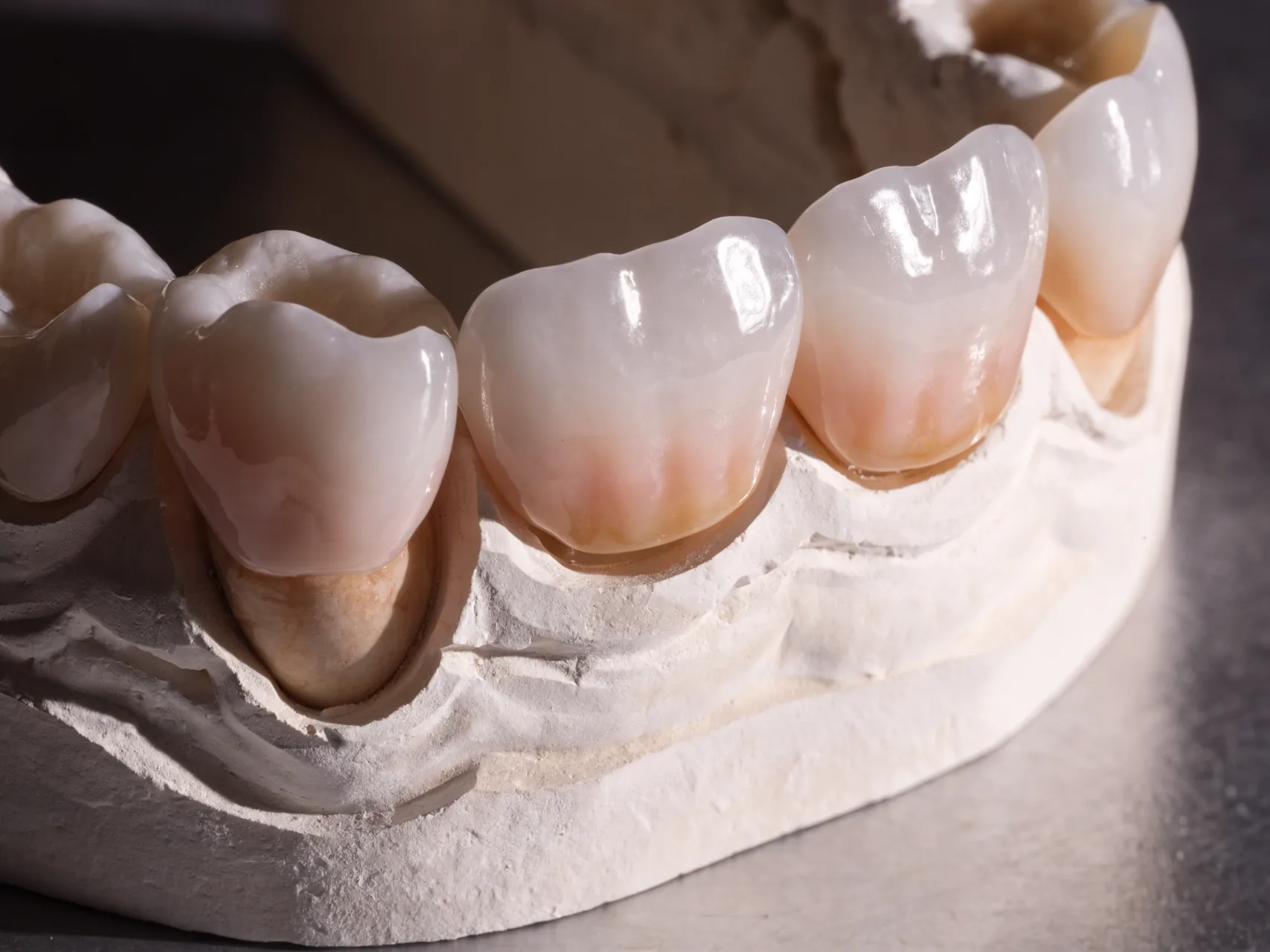
People searching for crowns and bridges in Turkey are often comparing a broad restorative proposal: several damaged teeth may be listed for crowns, one or more gaps may be listed for bridges, and the work may extend across much of a smile or bite. The treatment names sound familiar, but a long list of units is not a diagnosis. A credible plan must explain what is wrong at each tooth and gap, why each irreversible step is proposed, which less invasive options were considered, how the restorations will work and be cleaned, and what happens if clinical findings change after arrival.
This is a source-led decision guide, not a remote recommendation. It publishes no fixed price, timetable or outcome. Those details belong to a dated, patient-specific proposal from the named legal treatment provider after an appropriate assessment by the named treating clinician. A photograph, panoramic image, online message or package title cannot by itself determine whether a tooth needs a crown, whether a neighbouring tooth should support a bridge, whether an implant is appropriate, or how many units belong in a restoration.
The page owns one clear question: how should a person assess a combined crown-and-bridge full-restoration proposal before accepting irreversible dentistry or planning travel? It does not assume that every worn tooth needs full coverage, that every gap needs replacement, that every bridge should use natural teeth, or that one ceramic is best everywhere. The aim is to turn broad sales language into a tooth-by-tooth, gap-by-gap, material-by-material and responsibility-by-responsibility written plan.
Answer First: What Should a Credible Proposal Contain?
Before payment or travel, a credible proposal should identify:
- the legal entity responsible for clinical treatment;
- the named clinician responsible for diagnosis and the named clinician responsible for the definitive restorative prescription;
- which records have actually been reviewed and which findings remain unknown;
- a tooth-by-tooth prognosis rather than a total unit count alone;
- a gap-by-gap replacement decision, including the option of no immediate replacement where relevant;
- the alternatives considered for every proposed crown and bridge;
- the proposed support design for each bridge and the clinical limits that could change it;
- how gum health, decay risk, root condition and previous treatment affect the plan;
- how bite, available space, speech and appearance will be assessed;
- the intended provisional and definitive stages, clearly distinguished;
- the proposed material for each restoration and the reason, without a universal-material claim;
- how margins, contacts, connector areas and pontics can be cleaned;
- the laboratory prescription and the records that will identify the finished work;
- an itemised quotation with exclusions and a written method for approving changes;
- a travel contingency if a clinical or laboratory gate is not met;
- routine maintenance, local handover and urgent-care routes after returning home.
Missing information does not automatically prove poor treatment. It shows what is unresolved. The answer should come from the responsible clinician and appear in the clinical record, consent discussion and quotation rather than remaining in informal messages.
Understand the Components Before Comparing a Package
A crown is an indirect restoration that covers all or part of a prepared tooth. It may be considered when a tooth needs structural protection, form correction or restoration after substantial tissue loss, but the word crown does not state why full coverage is necessary. A tooth may instead be suitable for monitoring, repair, a direct restoration, an inlay, an onlay, an adhesive approach or another option. The diagnosis and remaining tooth structure matter more than the product name.
A fixed bridge replaces one or more missing teeth with artificial replacement units called pontics. A conventional tooth-supported bridge uses prepared abutment teeth. A resin-bonded bridge uses an adhesive retainer and generally aims to preserve more tooth tissue in selected situations. An implant-supported crown or bridge uses implants rather than natural-tooth abutments. These designs do not share the same preparation, biological risks, technical risks, cleaning tasks or repair pathways.
The American Dental Association's [patient information on crowns](https://www.mouthhealthy.org/all-topics-a-z/crowns) and [bridges](https://www.mouthhealthy.org/all-topics-a-z/bridges) provides useful definitions, but a definition does not establish suitability. The practical task is to map each proposed unit to the tooth or gap it addresses and then ask what evidence supports that choice.
Do not treat a twelve-unit or twenty-unit quotation as twelve or twenty identical decisions. A crown on a heavily restored molar, a crown placed mainly to alter colour, a bridge abutment, a pontic, and an implant-supported unit have different purposes. The written plan should label them separately.
Tooth Preservation Comes Before Unit Counting
Full coverage requires irreversible tooth preparation. Removed enamel and dentine do not grow back. That does not make crowns inappropriate; it means the reason for each crown should be specific and the less invasive alternatives should be discussed before treatment. A large restorative proposal should never begin with a target number of units and work backwards to reasons.
For every tooth listed for a crown, ask:
- What is the diagnosis and current symptom status?
- How much sound tooth structure remains?
- Is there active decay, a crack, wear, an old restoration or a root-canal issue?
- What is the gum and bone support around the tooth?
- Is full coverage needed for structure, or mainly proposed for appearance?
- Could repair, direct composite, partial coverage, monitoring, orthodontic movement or no treatment reasonably meet the objective?
- What additional tissue would the proposed preparation remove?
- What could make the tooth unsuitable as a bridge abutment?
- What is the contingency if the prognosis changes during treatment?
The recent systematic review on [remaining tooth structure in restored root-treated teeth](https://pmc.ncbi.nlm.nih.gov/articles/PMC12604680/) emphasises the importance of the amount and configuration of remaining coronal tissue. It should not be converted into a remote threshold or a promise for one person. It supports the broader principle that tooth preservation and the actual remaining structure belong in the decision.
A mixed plan can be more responsible than visual uniformity. One tooth may need a crown, another may suit a partial-coverage restoration, another may be repaired, and another may need no intervention. Matching every visible tooth to one preparation type is not automatically coordinated care.
Build a Tooth-by-Tooth and Gap-by-Gap Diagnostic Map
A full-restoration proposal needs a map, not only a smile image. The map should use stable tooth notation and identify existing teeth, missing spaces, restorations, suspected disease, proposed treatment, alternatives, uncertainties and responsible decision makers. It should be updated when direct findings differ from remote records.
For each existing tooth, the map can record:
- whether the tooth is symptom-free or symptomatic;
- visible and radiographic findings where available and clinically justified;
- periodontal support and cleansability;
- pulp or root-canal status where relevant;
- cracks, fractures, wear or remaining restorative material;
- the proposed restoration and preparation category;
- whether the tooth is proposed as a bridge abutment;
- the clinician's prognosis and the factors that could change it;
- alternatives and the no-treatment consequence.
For each gap, the map can record:
- why the tooth or teeth are missing;
- whether replacement is necessary for the person's goals and function;
- space, bite and neighbouring-tooth condition;
- conventional bridge, resin-bonded bridge, implant-supported, removable, orthodontic and no-treatment options where relevant;
- the proposed support and pontic design;
- hygiene access and maintenance requirements;
- anatomical or diagnostic questions still unresolved.
Remote records may help triage questions, but direct examination owns the diagnosis. A high-resolution photograph may show appearance and some surface features. It does not reveal every margin, crack, periodontal pocket, root condition, pulp status or functional contact. A panoramic image can show broad structures, but it does not answer every tooth-specific question. The proposal should state these boundaries plainly.
Disease Control Is a Gate, Not a Footnote
Crowns and bridges do not treat active gum disease, uncontrolled decay or every source of pain. Restorative work may need to follow disease assessment and appropriate stabilisation. The order and extent are patient-specific, but the plan should identify active conditions rather than covering them with a restorative label.
Ask how the clinician has assessed:
- plaque control and the person's ability to clean the proposed design;
- gingival inflammation and periodontal support;
- active decay and future caries risk;
- dry mouth, diet and medicines that may affect oral health;
- tooth mobility and occlusal trauma where relevant;
- symptoms suggesting pulpal, endodontic, joint or muscular causes;
- smoking or other factors relevant to healing and maintenance;
- parafunctional habits such as clenching or grinding;
- existing restorations with open, overhanging or inaccessible margins.
If active disease is found after arrival, the clinical plan may need to pause, reduce scope, stage care or change entirely. The quotation and itinerary should allow that possibility. A non-refundable flight or laboratory slot should not force a clinician to proceed through an unresolved disease-control gate.
Periodontal stability is particularly important when teeth are being linked as bridge supports. A bridge can also create new cleaning demands around retainers and under pontics. The patient's demonstrated ability to manage those areas should influence design and consent before the definitive restoration is made.
Compare the Reasonable Options for Each Tooth and Gap
The correct comparison is not simply crown versus bridge. A combined case can contain several separate decisions:
| Clinical question | Options that may be relevant after assessment | Key trade-offs to document |
|---|---|---|
| Damaged tooth with no gap | Repair, direct restoration, partial coverage, full crown, monitoring | Tissue removal, structural need, margin location, repairability |
| Single missing tooth | No immediate replacement, removable option, resin-bonded bridge, conventional bridge, implant-supported crown, orthodontic space management | Surgery, neighbouring-tooth preparation, space, cleaning, maintenance |
| Several adjacent missing teeth | Removable option, tooth-supported bridge, implant-supported bridge, separate implant crowns, other staged designs | Support distribution, span, anatomy, repair pathway, hygiene |
| Existing poor bridge | Monitor, repair, recement where appropriate, remake, redesign, alternative support | Cause of failure, abutment prognosis, material and design |
| Broad wear or failing restorations | Stabilisation, additive direct care, selective indirect care, phased rehabilitation | Cause control, bite, reversibility, maintenance, scope |
A conventional bridge may be reasonable when adjacent teeth already need substantial restoration and can provide appropriate support. It may be less attractive when it would require extensive preparation of otherwise sound neighbours. A resin-bonded bridge may preserve more tissue in selected sites, yet its design, available enamel, bite and debonding implications still require clinician-owned assessment. The 2024 [systematic review of full-ceramic resin-bonded fixed dental prostheses](https://pubmed.ncbi.nlm.nih.gov/38706266/) describes varied designs and outcomes, not a universal indication.
An implant-supported option avoids using natural teeth as conventional bridge abutments, but it introduces surgical, anatomical, healing, component and peri-implant maintenance questions. Read the dental implant service guide for the implant-specific decision framework. An implant is not automatically preferable, and a bridge is not automatically the lesser choice.

Abutment, Span and Cantilever Limits Belong to the Clinician
A bridge works as a connected load-bearing system. The condition, number, position and distribution of supports interact with the length and shape of the span, the bite, material, connector design, pontic form and opposing dentition. These factors cannot be reduced to a marketing rule such as one support per missing tooth or a universal maximum number of pontics.
For a tooth-supported bridge, ask the named treating clinician to document:
- why each proposed abutment is suitable;
- periodontal and structural findings for each abutment;
- whether an abutment is vital or root-treated and why that matters in the plan;
- the proposed retainer and preparation design;
- how the supports are distributed around the gap;
- the intended span and whether a cantilever is proposed;
- functional loads and opposing contacts considered;
- connector and material constraints owned by the clinical and laboratory prescription;
- the contingency if one abutment proves unsuitable;
- how loss of one support could affect the connected restoration.
The [systematic review of fixed restorations on vital and non-vital teeth](https://pubmed.ncbi.nlm.nih.gov/37455556/) reports differences and important limitations across the available evidence. It does not create a rule that a root-treated tooth can or cannot support a bridge. The responsible clinician must interpret the individual tooth, its remaining structure, endodontic status, support and the overall design.
Cantilever designs require their own explanation. A cantilever can be appropriate in selected conventional, resin-bonded or implant-supported contexts, but the word alone does not establish safety. Ask what loads, support, connector, material, cleaning and fallback considerations apply to this exact design.
Natural-Tooth and Implant Support Are Different Systems
Natural teeth and implants behave differently under load and have different biological interfaces. A plan should not casually connect them or discuss them as interchangeable anchors. If a proposal combines natural-tooth and implant support in one connected restoration, ask for the specific clinical rationale, alternatives and evidence. Do not infer that mixed support is required simply because both are present in the mouth.
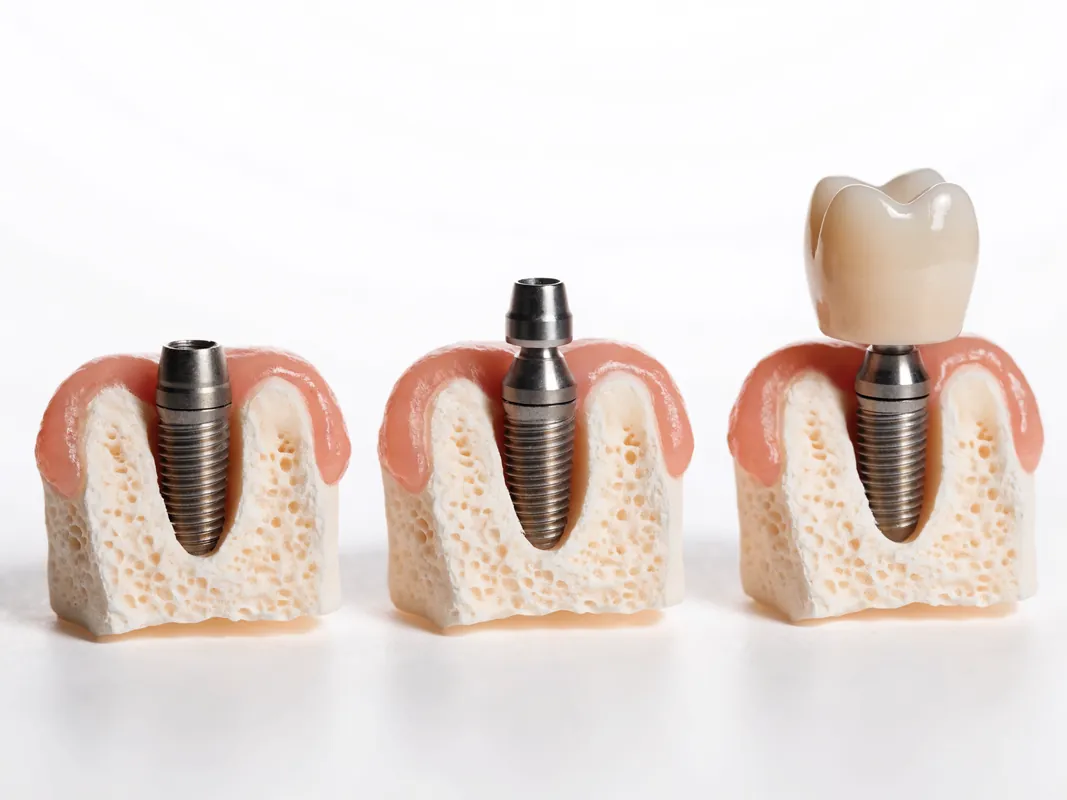
An implant-supported bridge also requires a restorative-led site plan. Implant positions should support the intended prosthesis, cleaning access and repair strategy; the final bridge should not be treated as an afterthought to surgery. The proposal should identify implant system and connection information, restorative components, retention method, laboratory role and future access to compatible parts.
For an implant option, separate these questions:
- Is implant placement clinically appropriate at all?
- Which site and distribution are proposed, and why?
- What imaging is justified for the unanswered anatomical question?
- Is grafting or another staged procedure a possibility rather than an assumed inclusion?
- What loading approach is proposed, and what conditions own that decision?
- Is the first restoration provisional or definitive?
- How will the patient clean around the support and pontics?
- Who can service the components after the patient returns home?
The related multiple implants and bridge decision guide examines those implant-specific support questions in more depth. This page keeps the broader focus on a mixed full-restoration proposal.
Imaging Must Be Selected to Answer a Clinical Question
No single image proves that a crown, bridge or implant is appropriate. Bitewing, periapical, panoramic and three-dimensional imaging provide different information and should be selected according to the person's clinical findings and the diagnostic question. The [American Dental Association radiographic imaging guidance](https://www.ada.org/resources/practice/practice-management/radiographic-imaging) emphasises justified, individual selection and documenting interpretation.
Before accepting new imaging, ask:
- who requested it and who will interpret it;
- what specific question it is intended to answer;
- whether recent diagnostic-quality records can be reviewed first;
- how the result could change the proposed tooth map or gap design;
- what the image cannot determine without examination;
- how the file and report will be shared with the patient;
- whether three-dimensional imaging is being used for an implant-specific question rather than as a routine package feature.
Imaging is one part of the record. Periodontal charting, sensibility or endodontic assessment, occlusal examination, photographs, scans, models, medical history and direct inspection may be relevant, but the clinician chooses what is appropriate. A checklist should not become a demand for unnecessary tests.
If the treatment proposal was prepared before direct assessment, it should remain explicitly provisional. The plan should list the kinds of findings that could reduce, enlarge or change the scope, and the patient should retain the right to reconsider rather than being treated as already committed.
Full-Restoration Planning Includes Function, Not Only Colour
When several crowns and bridges are proposed together, their contacts and contours can alter how the teeth meet, how the jaw moves, how food is managed and how speech feels. A visually aligned digital image does not establish a stable or comfortable bite. The functional assessment and decisions remain clinician-owned.
The plan should explain how the clinician will evaluate:
- current bite and jaw relationship;
- available restorative space;
- tooth wear and its likely causes;
- existing guidance and contacts during jaw movement;
- opposing natural teeth, removable prostheses or implant restorations;
- clenching, grinding, muscle symptoms or joint concerns where relevant;
- phonetics and tooth display where anterior restorations are involved;
- whether the proposed change is additive, subtractive or both;
- how a provisional stage will be reviewed before finalising broad changes.
A broad rehabilitation may involve changes to vertical dimension or tooth form, but no web page can prescribe those changes. If the proposal uses terms such as bite raise, full-mouth rehabilitation or occlusal correction, ask what records and findings support the change, what the provisional test is intended to learn, and what happens if symptoms or function do not adapt as expected.
The recent [systematic review of minimally invasive approaches for worn dentition](https://pubmed.ncbi.nlm.nih.gov/39670301/) includes direct and indirect concepts and notes evidence limitations. It supports discussing alternatives; it does not establish one material or method for every worn dentition.
Material Selection Is a Prescription, Not a Tier Name
Zirconia, metal-ceramic, glass-ceramic, resin-based materials and other restorative systems have different indications, optical behaviours, preparation requirements, connector constraints, repair considerations and evidence bases. The term premium ceramic does not identify a material or explain why it suits a specific crown or bridge.
For each restoration, request a written material prescription that states:
- the material category and, where relevant, product or system information;
- monolithic, layered or other construction where applicable;
- the clinical and laboratory reason for the choice;
- whether the restoration is a single crown, bridge retainer, pontic or implant-supported component;
- preparation, space, connector and support considerations owned by the responsible professionals;
- shade and surface-finish instructions;
- known repair and replacement considerations;
- compatibility with any implant components;
- what material or design change requires renewed consent and a revised quotation.
The 2024 [systematic review and meta-analysis of zirconia-based tooth-supported bridges](https://pubmed.ncbi.nlm.nih.gov/39369882/) found that material comparisons depend on construction and complication type and highlighted evidence gaps, including for some newer designs. It should not be converted into a claim that zirconia, metal-ceramic or any alternative is universally best.
The zirconia crowns guide explains material-specific questions. In a combined restoration, the more important discipline is to avoid one blanket material claim across teeth, bridges, front sites, back sites and implant-supported units without a written rationale.
Margins, Contacts, Pontics and Cleanability Are Design Requirements
A restoration must be maintainable, not merely look finished on the day of fitting. Crown margins, emergence contours, contact points, connector areas and the tissue-facing form of pontics affect plaque retention, food trapping, access for cleaning and tissue response. Cleanability should be designed and demonstrated before final acceptance.
Ask the proposal to describe:
- where crown and retainer margins are intended to sit and why;
- how over-contour and inaccessible areas will be avoided and assessed;
- how contacts will be evaluated for food trapping and floss passage;
- what pontic form is proposed for each gap;
- how the patient will clean under each pontic and around each abutment;
- whether interdental brushes, floss threaders or other tools are expected;
- whether the patient can physically use those tools;
- how gum inflammation or bleeding changes the plan;
- which professional maintenance visits are expected and who can provide them locally.
The cleaning method should be shown with the actual provisional or definitive design, not only described generically. If a person cannot pass the recommended aid or cannot see and reach the area, that is a design and support problem to resolve. A promise that fixed teeth clean like natural teeth is too broad; connected restorations usually create specific access tasks.
Bridge cleaning also affects the support teeth. Decay, periodontal problems, loss of vitality, loss of retention, material fracture and other biological or technical events are different complications. A repairable technical event should not be described as equivalent to biological loss, and the maintenance plan should address both categories.
Appearance, Shade and Digital Records Have Limits
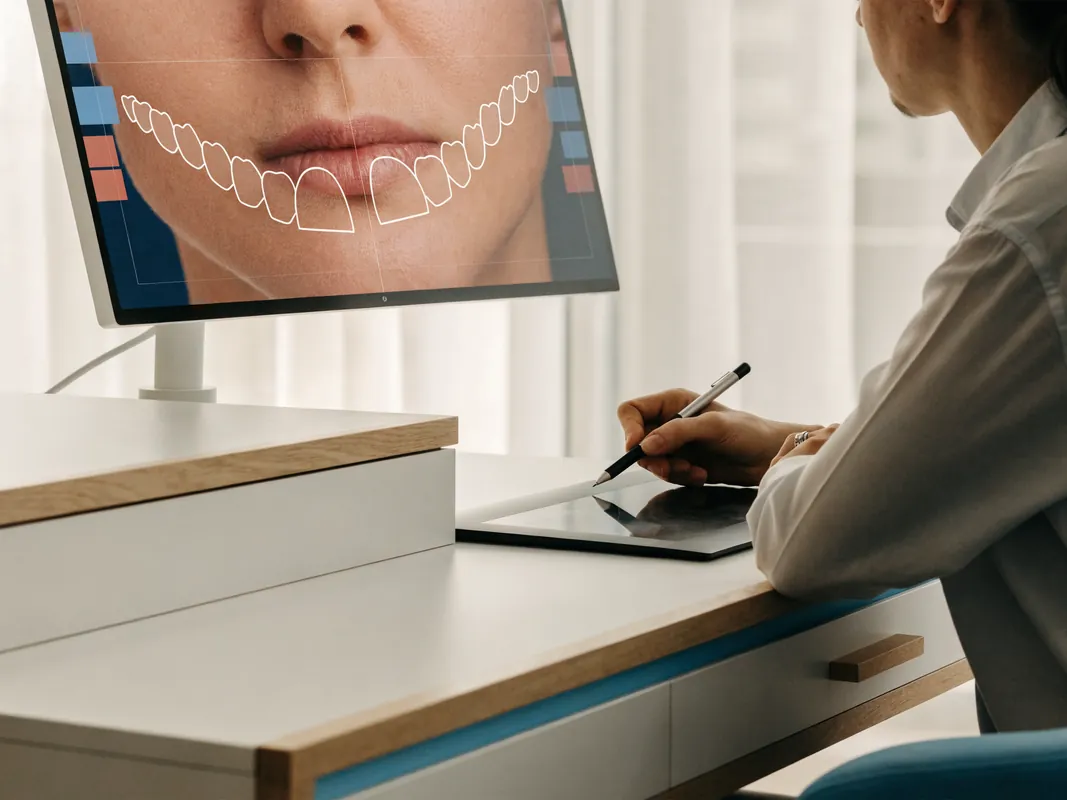
Photographs, scans, wax-ups, digital designs and physical mock-ups can support communication about length, proportion, edge position, shade and relationship to the face. They do not guarantee that the final restoration will look identical under every light or that tissues, speech and function will behave exactly as a preview suggests.
For a large visible restoration, ask:
- which images and scans are diagnostic records and which are presentation aids;
- whether the reference shade is recorded before preparation and temporary materials;
- how untouched teeth, existing restorations and replacement units affect the shade plan;
- whether a material's opacity or translucency limits the objective;
- who approves the laboratory prescription and any change;
- what the patient is asked to approve at provisional and definitive stages;
- how photographic consent and privacy are handled;
- whether marketing use is separate from consent to create clinical records.
The patient should be able to decline marketing use without affecting care. Clinical photographs, scans and models should be stored and shared as health records under the responsible provider's rules. GDC [Principle Four on records](https://standards.gdc-uk.org/pages/principle4/principle4) lists photographs, models, laboratory prescriptions and statements of conformity among records where available and emphasises complete, accurate documentation.
Shade language should remain realistic. A bridge with connected units, an opaque core, a dark underlying tooth or different surrounding materials may present optical constraints. The written conversation should distinguish an objective from an assured match.
Laboratory Prescription and Traceability Must Travel With the Case
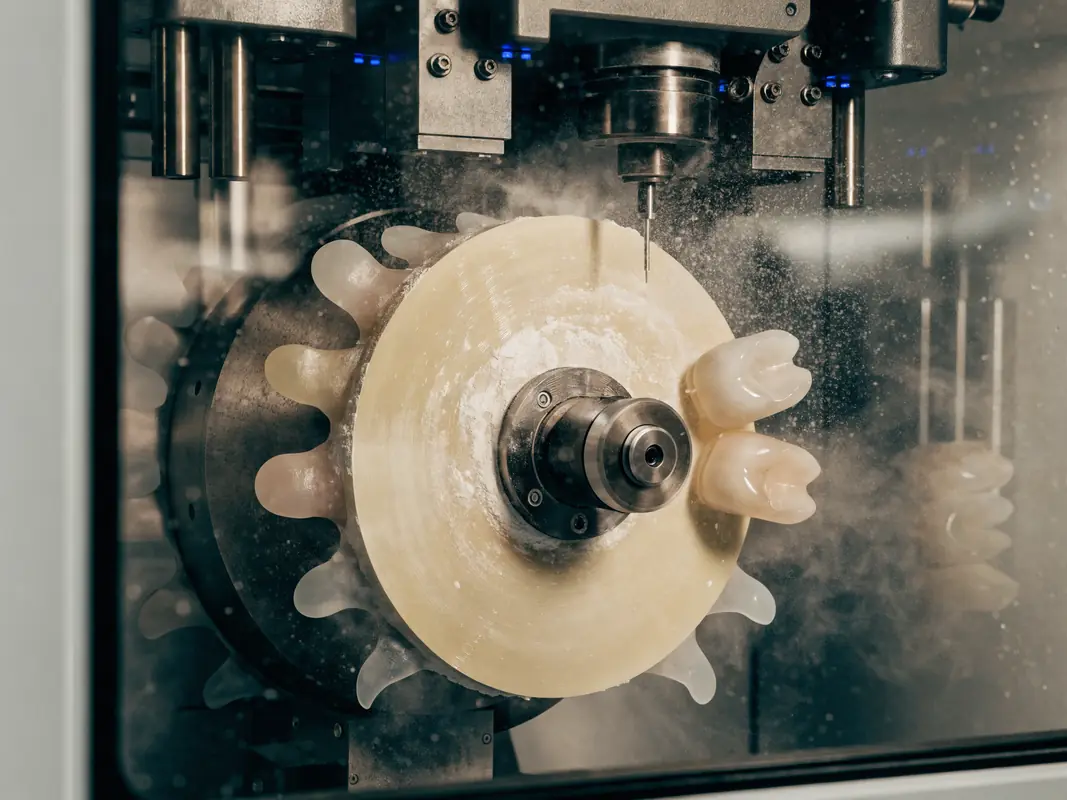
A laboratory makes restorations to a clinical prescription; it does not replace diagnosis, consent or clinical approval. The handoff between clinician and laboratory should be traceable, especially when several crowns and bridge units are produced together or when care is later transferred to another country.
Request copies or a patient handover summary identifying, where applicable:
- the prescribing clinician and legal treatment provider;
- the laboratory or manufacturing party;
- tooth numbers and restoration types;
- crown, retainer, pontic and implant-supported units;
- material and construction details;
- shade, contour and surface instructions;
- scans, impressions, jaw records and relevant dates;
- implant system, connection and component references for implant-supported work;
- lot, UDI or other traceability information where assigned;
- laboratory prescription, statement of conformity or applicable custom-device documentation;
- fit, adjustment and cementation or screw-retention records relevant to future care.
Do not assume that a brand logo or material card is the full handover. Future repair may require exact information about what is connected, how it was retained, which tools and parts are compatible and who fabricated the restoration. The local dentist may not be willing or equipped to service an unfamiliar system without records.
The records should be supplied in usable form and in a language that the receiving clinician can understand. If a document will only be available after fitting, list it in the pre-treatment handover schedule so it is not forgotten at departure.
Separate Assessment, Preparation, Provisional and Definitive Stages
A remote conversation, in-person assessment, tooth preparation, impression or scan, provisional fitting, laboratory try-in and definitive fitting are not interchangeable milestones. A full-restoration itinerary should label each stage and the clinical gate that allows it to proceed.
A useful pathway may include:
- record collection and preliminary questions;
- direct examination and diagnosis;
- disease-control or stabilisation where required;
- written alternatives, consent and provisional quotation confirmation;
- tooth preparation or other irreversible treatment only after consent;
- records for provisional and laboratory work;
- provisional assessment of fit, function, speech, appearance and cleanability;
- any indicated biological review or healing interval;
- updated definitive prescription;
- try-in or verification steps appropriate to the design;
- definitive fitting only after clinical acceptance;
- handover, maintenance instructions and aftercare route.
Not every case requires every stage as a separate appointment, and some cases require more. The named treating clinician owns the sequence. The dental treatment timeline and visits guide explains why an itinerary should follow clinical gates rather than dictate them.
The quotation should state which stages are included, which are conditional and what happens if the case cannot progress within the planned trip. A temporary restoration and a final restoration should never be described as the same deliverable.
Provisional Restorations Are a Decision Gate
A provisional crown or bridge protects prepared teeth and can support assessment, but its exact purpose depends on the case. In broader restorative work it may also provide information about contours, contacts, speech, appearance, bite and cleaning access. It is not proof that the definitive restoration will be identical, and it is not necessarily designed for indefinite use.
The provisional plan should state:
- which teeth and gaps it covers;
- whether it is chairside, laboratory-made or otherwise fabricated;
- the intended clinical purpose;
- limitations on function or care;
- what the patient should monitor;
- how loss, fracture, movement, sensitivity or tissue irritation will be handled;
- which findings will be reviewed before the definitive prescription;
- whether a revised provisional is possible if significant design changes are needed;
- who pays for changes that arise from a changed elective objective versus a new clinical finding.
A broad provisional should be assessed rather than merely endured until a flight. Persistent pain, inability to clean, an unstable bite, repeated fracture, major speech difficulty or tissue injury should be evaluated before copying the design into definitive work. The fallback may be adjustment, redesign, further diagnosis, staged completion or pausing treatment.
The patient should know whether leaving with a provisional is an anticipated stage or an unplanned contingency. Both require written instructions, an emergency contact boundary and a local handover option.
Definitive Fitting Is More Than Cementation
The definitive appointment should include clinical checks appropriate to the restoration before irreversible acceptance. The exact protocol is clinician-owned, but a patient can ask how the responsible clinician will assess identity, fit, margins, contacts, bite, appearance, cleanability and the supporting teeth or implants.
Useful questions include:
- Is each restoration and tooth number verified against the prescription?
- Have the supporting teeth and tissues been reassessed?
- Can margins and contacts be clinically evaluated?
- Can the patient clean under every pontic and around every connector?
- Are static and moving contacts reviewed in the context of the complete case?
- Are shade and form being evaluated under appropriate conditions and within documented limits?
- Is the restoration still provisional at this point, or is definitive retention proposed?
- What findings would stop fitting and return the work for modification?
- Which baseline photographs, images or bite records are retained?
- What instructions and records will be supplied before departure?
The patient's approval of appearance is only one part of acceptance. It does not transfer responsibility for technical or biological assessment to the patient. Conversely, consent is ongoing; a patient can ask for clarification or decline a changed elective plan before it proceeds.
Avoid signing a completion statement that inaccurately says all concerns are resolved. Record any unresolved symptom, adjustment, planned review or pending document. A date of fitting is the beginning of maintenance, not evidence that the restoration will never require care.
Consent Must Cover Irreversibility and Change Control
Valid consent is an ongoing conversation, not a signature collected at booking. GDC [Principle Three](https://standards.gdc-uk.org/pages/principle3/principle3) emphasises ongoing communication and documentation. For care abroad, the local legal and professional framework may differ, so identify which entity and professionals are responsible and how complaints, records and remedial questions are handled.
The consent discussion for a combined crown-and-bridge restoration should distinguish:
- diagnosis from a cosmetic preference;
- tooth-preserving alternatives from full coverage;
- conventional, adhesive, implant-supported, removable and no-treatment options where relevant;
- risks to the pulp, tooth structure, gums, support and bridge abutments;
- technical events such as debonding, loss of retention, wear, chipping or fracture;
- the possibility that a tooth or site proves unsuitable after further assessment;
- provisional and definitive stages;
- material and appearance limitations;
- cleaning, maintenance and future repair requirements;
- travel-related limits on review and remedial access;
- costs, exclusions and responsibility for approved changes.
If the plan changes, ask for the new finding, alternatives, risks, material or staging implications and price change in writing. Renewed consent should occur before the changed irreversible step. A broad clause allowing any clinically necessary change is not a substitute for a patient-specific conversation where the patient can decide.
Require an Itemised Written Quotation
A total package figure does not reveal what will be delivered or what happens when the plan changes. The itemised quotation should match the tooth and gap map and separate clinical care from non-clinical travel services.
Request line items for:
- assessment and diagnostic records;
- disease-control or stabilisation stages;
- each crown by tooth number and material category;
- each bridge retainer and pontic, with the complete span identified;
- implant surgery and implant-supported restorative components where relevant;
- provisional restorations;
- laboratory try-ins or verification stages where applicable;
- definitive fitting and initial adjustments;
- medicines or sedation only if clinically prescribed and separately consented;
- records, component information and handover documents;
- planned reviews and maintenance;
- exclusions, conditional procedures and cancellation terms;
- taxes or other charges where applicable;
- separate travel, accommodation or transfer services, if chosen.
The quotation should say what happens financially if a proposed abutment cannot be used, a bridge design changes, a crown becomes a partial-coverage option, an implant stage is deferred, more time is needed, or treatment stops after assessment. It should define who approves a variation and when payment becomes due.
No fixed price, timetable or outcome belongs on this general guide. Patient-specific figures require current assessment and a dated written quotation from the responsible provider. Compare like with like: a low total can reflect fewer diagnostic stages, different materials, provisional rather than definitive work, missing aftercare or omitted contingencies.
Plan Travel Around Clinical Uncertainty
Dental travel adds distance between the patient, treating provider, laboratory and home dentist. It does not change biological or technical decision gates. The GDC's [guidance on going abroad for dental treatment](https://www.gdc-uk.org/standards-guidance/information-for-patients-public/going-abroad-for-dental-treatment) advises patients to research regulation, treatment responsibility, qualifications, aftercare, complaints and the consequences of further travel.
Before booking, ask for:
- which assessment can genuinely occur before travel and which requires arrival;
- the minimum records needed before a meaningful provisional plan;
- the number and purpose of proposed visits without treating them as guaranteed completion dates;
- laboratory dependencies and review time;
- the fallback if pain, disease, fit, tissue condition or a changed diagnosis prevents progression;
- what type of restoration the patient may travel home with at each possible stopping point;
- who provides urgent advice and who performs direct local assessment;
- who funds extra travel, accommodation or remedial work under the written terms;
- how records will reach a home dentist;
- whether the home dentist has agreed to provide the requested maintenance.
Keep clinical care and travel purchases contractually distinct. A hotel or flight benefit should not make an irreversible dental decision appear time-limited. Build flexible travel where possible and do not schedule an important departure immediately after a complex fitting without understanding the review plan.
The returning home after dental tourism guide provides a record-transfer and escalation checklist. It cannot replace local examination when symptoms arise.
Aftercare Requires a Named Responsibility Map
Aftercare is not one generic support promise. It includes routine review, hygiene, diagnosis of new symptoms, technical adjustment, laboratory repair, management of supporting teeth or implants, and emergency care. Different people may own different tasks.
A written responsibility map should identify:
| Need | Questions to resolve before treatment |
|---|---|
| Routine hygiene | Who provides professional cleaning and monitors margins, gums and pontics? |
| Supporting-tooth review | Who checks decay, periodontal condition, vitality or root-treated teeth? |
| Implant maintenance | Who monitors tissues and components if implants support part of the case? |
| Bite or contact adjustment | Which clinician can assess the complete design rather than one unit in isolation? |
| Technical repair | Who can identify the material, laboratory design and compatible components? |
| Urgent symptoms | Which local service provides direct assessment? |
| Records | Who sends the treatment summary, images, material and component information? |
| Complaint or remedial request | Which legal entity receives it and what evidence is required? |
Ask a local dentist before travel whether they are willing to review and maintain the proposed work. A local clinician is not automatically responsible for another provider's treatment, and an unfamiliar multi-unit restoration may require records or expertise that are not immediately available.
Aftercare terms should distinguish professional fees, laboratory fees, travel costs and the limits of any commercial warranty. A warranty is not a substitute for diagnosis and does not remove biological or technical uncertainty.
Maintenance Is Part of the Restoration, Not an Optional Extra
Crowns and bridges still require daily plaque control and periodic professional assessment. The natural tooth remains susceptible to biological problems; connected and implant-supported designs have their own maintenance needs. A restoration can remain present while still requiring treatment, repair or adjustment, so survival and problem-free function are not the same outcome.
The plan should provide individual instructions for:
- brushing around crown and retainer margins;
- cleaning beneath pontics;
- selecting and correctly using interdental aids;
- managing areas that trap food;
- monitoring bleeding, swelling, soreness or mobility;
- caring for provisional work;
- avoiding self-adjustment or household adhesives;
- protecting the work if clenching or grinding is diagnosed and a device is prescribed;
- attending professional reviews based on individual need;
- bringing the material and component record to a new clinician.
Evidence on fixed prostheses includes both biological and technical complications. The long-term observational [study of tooth- and implant-supported fixed restorations](https://pubmed.ncbi.nlm.nih.gov/39177417/) reports several categories across a particular cohort. It is not a forecast for an individual. Its practical lesson is to ask separately about the health of supports and the serviceability of the prosthesis.
Do not wait for the entire bridge to become loose before seeking advice. A localised cleaning problem, repeated food trapping, bleeding margin, change in bite or small fracture can warrant assessment even when the restoration remains fixed.
Red Flags in a Crown-and-Bridge Proposal
Pause and request clarification if a proposal:
- sets a unit count before giving a tooth-by-tooth diagnosis;
- recommends full coverage for sound teeth without recording conservative alternatives;
- describes every gap as requiring the same bridge design;
- states that one material is universally strongest, best or maintenance-free;
- claims an image alone confirms all diagnoses;
- gives a universal bridge span, abutment or cantilever rule without case findings;
- removes maintainable teeth mainly to simplify a package;
- calls provisional work final or treats a provisional date as guaranteed completion;
- does not identify the legal provider, treating clinicians or laboratory role;
- cannot explain how the patient will clean beneath each pontic;
- omits bridge support, retainer and pontic units from the written map;
- bundles clinical care with travel in a way that hides exclusions;
- requests consent to unspecified changes in advance;
- refuses access to records, material details or component information;
- promises an assured aesthetic, functional or longevity outcome;
- uses urgency, a discount or a booked flight as the reason to proceed clinically;
- offers only remote reassurance when direct assessment is needed;
- has no local handover or urgent-care boundary.
A red flag is a prompt for evidence, not an online diagnosis of misconduct. Resolve it through the named clinician, formal records, an independent opinion or a decision not to proceed.
Questions to Ask the Named Treating Clinician
Take a written checklist and record the answers:
- What is the diagnosis for each tooth and gap?
- Which teeth can be preserved without full coverage?
- Why does each proposed crown require its preparation design?
- Which bridge options were considered for each gap?
- Why is each natural tooth or implant suitable as a support?
- What findings own the bridge span, connector and cantilever decision?
- What happens if an abutment is unsuitable after preparation or new imaging?
- How have gum health, decay risk, root status and cleaning ability been assessed?
- What function, bite and speech records are needed?
- Which material is prescribed for each unit and why?
- Which stages are provisional and which are definitive?
- What must be true before definitive fitting proceeds?
- How will I clean each margin, connector and pontic?
- Which biological and technical complications have been discussed?
- Who is the named legal treatment provider, clinician and laboratory?
- Which documents and device or component records will I receive?
- What is included, excluded and conditional in the itemised quotation?
- How is a changed plan re-consented and re-priced?
- What is the travel fallback if a clinical gate is not met?
- Who provides routine, urgent and remedial care after I return home?
Clear answers should be consistent across the treatment map, consent form, laboratory prescription, quotation and discharge record. If one document says crown, another says veneer and the invoice lists a generic unit, ask for reconciliation before treatment.
Red Flags After Preparation or Fitting
Some sensitivity or awareness can occur after restorative procedures, but a web page cannot determine whether a symptom is expected. Contact the treating provider and seek appropriate direct assessment for persistent or worsening pain, swelling, fever, discharge, a bad taste, inability to bite, a restoration that feels mobile, a fracture, repeated food trapping, gum injury, a change in sensation, or a provisional that will not stay in place.
Urgent assessment is particularly important for rapidly increasing swelling, signs of spreading infection, uncontrolled bleeding, significant trauma or a sudden inability to function. Severe swelling affecting breathing or swallowing, collapse, major facial injury or another life-threatening concern requires the current local emergency route.
Do not file a restoration, force floss through an inaccessible contact, recement work with household adhesive or assume antibiotics solve a mechanical or diagnostic problem. Keep any detached fragment or restoration, avoid losing component information, and take the records to the assessing clinician.
If a technical event occurs, ask for the cause to be assessed before repeating the same design. Loss of retention, material fracture, an abutment problem, decay, periodontal disease and a bite-related issue require different responses. Repair, remake and biological treatment should not be combined into a vague warranty conversation.
Evidence Limits
Research on crowns and fixed bridges contains different populations, materials, tooth positions, support conditions, preparation designs, bridge spans, opposing dentitions, maintenance patterns and follow-up methods. A restoration remaining in place is different from having no complication. A pooled estimate is not a patient-specific promise, and older material categories may not describe a current product exactly.
The 2024 material review, vital versus non-vital support review, resin-bonded bridge review, worn-dentition review and long-term cohort used in this guide answer different questions. They cannot be merged into a league table that chooses a material or support system for an individual. Clinical expertise, the patient's findings and preferences, and the responsible clinician's judgement remain part of evidence-based care.
Official patient information also has limits. It explains concepts and questions but does not diagnose a tooth or establish the legal obligations of a provider in another jurisdiction. Verify current professional registration, provider identity, complaints route and documentation with the appropriate authorities before relying on a marketing statement.
Official and Primary Sources
These official and primary sources were checked on 29 August 2026. Guidance and source pages can change, so recheck the current version before making a decision.
- American Dental Association, crowns: https://www.mouthhealthy.org/all-topics-a-z/crowns
- American Dental Association, bridges: https://www.mouthhealthy.org/all-topics-a-z/bridges
- American Dental Association, radiographic imaging: https://www.ada.org/resources/practice/practice-management/radiographic-imaging
- NHS, overview of dental treatments including crowns: https://www.nhs.uk/live-well/healthy-teeth-and-gums/dental-treatments/
- University Hospitals of North Midlands NHS, crowns and bridges patient guide: https://www.uhnm.nhs.uk/media/jnumshbr/agenda-item-07e-reapproved-crowns-and-bridges.pdf
- Systematic review, zirconia-based and metal-ceramic tooth-supported fixed prostheses: https://pubmed.ncbi.nlm.nih.gov/39369882/
- Systematic review, fixed restorations on vital and non-vital teeth: https://pubmed.ncbi.nlm.nih.gov/37455556/
- Systematic review, full-ceramic resin-bonded fixed prostheses: https://pubmed.ncbi.nlm.nih.gov/38706266/
- Systematic review, minimally invasive worn-dentition concepts: https://pubmed.ncbi.nlm.nih.gov/39670301/
- Long-term observational study, tooth- and implant-supported fixed restorations: https://pubmed.ncbi.nlm.nih.gov/39177417/
- Systematic review, remaining structure in restored root-treated teeth: https://pmc.ncbi.nlm.nih.gov/articles/PMC12604680/
- General Dental Council Principle Two, communication and written plans: https://standards.gdc-uk.org/pages/principle2/principle2
- General Dental Council Principle Three, ongoing consent: https://standards.gdc-uk.org/pages/principle3/principle3
- General Dental Council Principle Four, complete records: https://standards.gdc-uk.org/pages/principle4/principle4
- General Dental Council, going abroad for dental treatment: https://www.gdc-uk.org/standards-guidance/information-for-patients-public/going-abroad-for-dental-treatment
Final Decision Rule
Proceed only when every proposed crown and bridge unit maps to a diagnosis; suitable teeth are preserved where the evidence supports it; conventional, adhesive, implant-supported, removable and no-treatment options have been considered where relevant; the clinician owns the abutment, span and material decisions; function and cleanability are demonstrated; provisional and definitive stages are distinct; consent and price changes are documented; records and traceability can travel; and aftercare still works when the patient is home. A coordinated restoration is a documented clinical system, not a uniform unit count.