Whitening and veneers are often marketed as two ways to buy a whiter smile. Clinically, they are not equivalent products. Tooth whitening is a bleaching treatment intended to alter the colour of suitable natural tooth tissue. A veneer is a bonded restoration that covers part of a tooth and may change colour, contour, texture, length or apparent position. One does not simply represent a stronger version of the other.
The useful question is therefore not “Which treatment is best?” It is “What is causing the appearance that concerns me, and what is the least destructive reasonable option that can address it?” A person who dislikes an even yellow tone across healthy natural teeth presents a different decision from a person with one dark non-vital tooth, patchy developmental opacity, worn edges, large visible fillings, active erosion, gum inflammation or a bite problem. A photograph may start that discussion, but it cannot establish the diagnosis or confirm suitability.
This guide is educational information for adults comparing teeth whitening vs veneers, including people considering treatment abroad. It is not a diagnosis, prescription, personal suitability decision or result promise. The named treating dentist must examine the mouth, diagnose relevant disease and discolouration, explain reasonable alternatives, obtain valid consent and remain responsible for clinical care. A coordinator can organise an enquiry but must not make those decisions.
WeCare is not the treating dental provider. Its role is limited to enquiry and referral coordination and, if separately agreed in writing, non-clinical travel logistics. Before sharing health records or paying, identify the named legal provider, named treating dentist, clinic address, professional registration route, clinical contact, complaint process and aftercare responsibility. Verify those details independently.
Start with the complaint, not the treatment name
“I want whiter teeth” may contain several different goals. Ask the patient to identify what they actually notice without converting every concern into a veneer plan. Is the whole smile darker than desired? Is one tooth different from its neighbours? Are there surface deposits, internal bands, white patches, translucent edges or restorations of another colour? Is the concern really shape, wear, spacing, crowding, gum display or an uneven gum line? Does the appearance change only in certain light or photographs?
The answer matters because bleaching changes neither tooth position nor missing structure. It does not close a space, restore a fractured edge, correct active tooth wear or move a rotated tooth. Conversely, placing a restoration solely to cover a colour concern may remove or permanently commit sound tissue when a less invasive colour treatment, professional cleaning, repair or no treatment could have met the goal.
A useful consultation separates at least five dimensions:
- colour, including hue, value, chroma and colour variation between teeth;
- translucency and opacity, including white, brown or grey areas and the way underlying dentine shows through enamel;
- surface condition, including plaque, calculus, stain, cracks, erosion, abrasion and existing restorations;
- shape and position, including length, width, edge wear, spacing, rotation and tooth display;
- biological and functional health, including caries, pulp status, gum inflammation, recession, sensitivity, jaw function and the bite.
Write down the priority. If the only acceptable outcome requires changes to shape and position as well as colour, whitening alone cannot provide it. If the concern is colour in intact teeth and the patient values maximum tissue preservation, restorative coverage should not be presented as the automatic starting point.
Colour, shape and structure are different diagnoses
The American Dental Association describes discolouration as extrinsic, intrinsic or a combination. Extrinsic stain accumulates on the enamel surface and may be influenced by tobacco, pigmented food or drink, oral hygiene and other exposures. Some surface stain may respond to cleaning or abrasive stain-removal products rather than chemical bleaching. Intrinsic discolouration lies within enamel or dentine and may relate to development, ageing, previous trauma, pulpal change, caries, restorative materials, medicine exposure or other causes. The pattern and cause can affect both response and risk.
A single dark tooth needs particular caution. It can reflect previous trauma, loss of pulp vitality, internal resorption, a restoration, caries or another condition that should not be disguised before diagnosis. A new unexplained colour change, pain, swelling or tenderness belongs in a clinical assessment, not an online cosmetic comparison. The clinician may use history, examination, sensibility testing and clinically justified imaging where appropriate.
White or brown patches also require diagnosis. Developmental enamel differences, fluorosis, post-orthodontic demineralisation, early caries and surface dehydration can look similar in a photograph while requiring different management. Bleaching may change the contrast rather than remove the underlying feature. Microabrasion, resin infiltration, remineralisation, direct composite or observation may be relevant in selected cases. None should be prescribed solely from a social-media image.
Shape and structure questions are separate. A chipped incisal edge may be repairable with direct composite. A space may be accepted, restored additively or considered for orthodontic movement. Short-looking teeth may reflect wear, gum position, tooth position or natural anatomy. Restoring them without understanding the cause can create bulk, cleaning difficulty or functional conflict. Diagnosis should explain which dimension each proposed treatment is intended to change.
A dental examination comes before bleaching or preparation
The General Dental Council states that tooth whitening is dental treatment and, in the UK, should follow a proper assessment by a registered dentist and the dentist's prescription. Rules differ by jurisdiction, but the patient-protection principle is portable: bleaching is not a salon service and veneer preparation is not a purchase that can be responsibly authorised by a coordinator.
The examination should be proportionate to the concern and proposal. It may include:
- a current medical, dental and medicine history, including allergies and previous reactions;
- the history and pattern of the colour change;
- active caries, leaking restorations, cracks, exposed dentine or pulp-related symptoms;
- periodontal and gingival health, recession and the ability to clean proposed margins;
- existing fillings, crowns, veneers, bridges, implant crowns and dentures visible in the smile;
- tooth vitality where clinically indicated, especially for an isolated colour change or trauma history;
- wear, erosion, clenching, grinding and functional contacts;
- photographs and a reproducible baseline shade record;
- the patient's priorities, acceptable trade-offs, budget and willingness to maintain restorations;
- whether further tests, imaging or referral are clinically justified.
Remote photographs can support triage and help identify questions. They do not show all caries, marginal leakage, cracks, pulp status, periodontal pockets, occlusal contacts or the cause of sensitivity. Any remote opinion must remain provisional until the named dentist has completed the required assessment. The final plan may change; if it does, reasons, alternatives, risks and revised costs should be explained before consent is renewed.
Preserve enamel and restorable teeth
Elective aesthetic planning should follow a preservation ladder. First ask whether no treatment is acceptable. Then consider prevention, stain removal, repair, whitening or another non-restorative approach where clinically appropriate. Consider additive direct composite, orthodontic movement or limited restorative treatment before broader tooth coverage. A veneer becomes reasonable only when its intended benefits justify its biological cost and the less destructive alternatives have been discussed.
Enamel is not a renewable material. Veneer preparation varies with the tooth, proposed change, material and restorative design. Some veneers can be mainly additive; others require removal of enamel and sometimes exposure of dentine. Labelling a case “minimal-prep” or “no-prep” does not prove that it is appropriate, reversible or harmless. Added bulk can affect contour, emergence, speech, cleaning and the gum response. Preparation that extends into dentine changes the bonding context and future restorative options.
Systematic reviews of ceramic veneers report that the substrate matters and that enamel preservation is associated with fewer complications than extensive dentine exposure. That evidence does not guarantee the result of an individual restoration. It does support a practical consent question: how much enamel is expected to remain on each surface, why is any preparation required, and could the same goal be achieved with less intervention?
Existing natural teeth should not be treated as disposable supports for a standard smile design. A plan should be tooth-specific. One tooth may need only polish or repair, another may be suitable for whitening, and a structurally compromised neighbour may need a different restoration. Requiring the same treatment on every visible tooth for visual uniformity can create unnecessary irreversible work.
What whitening can change
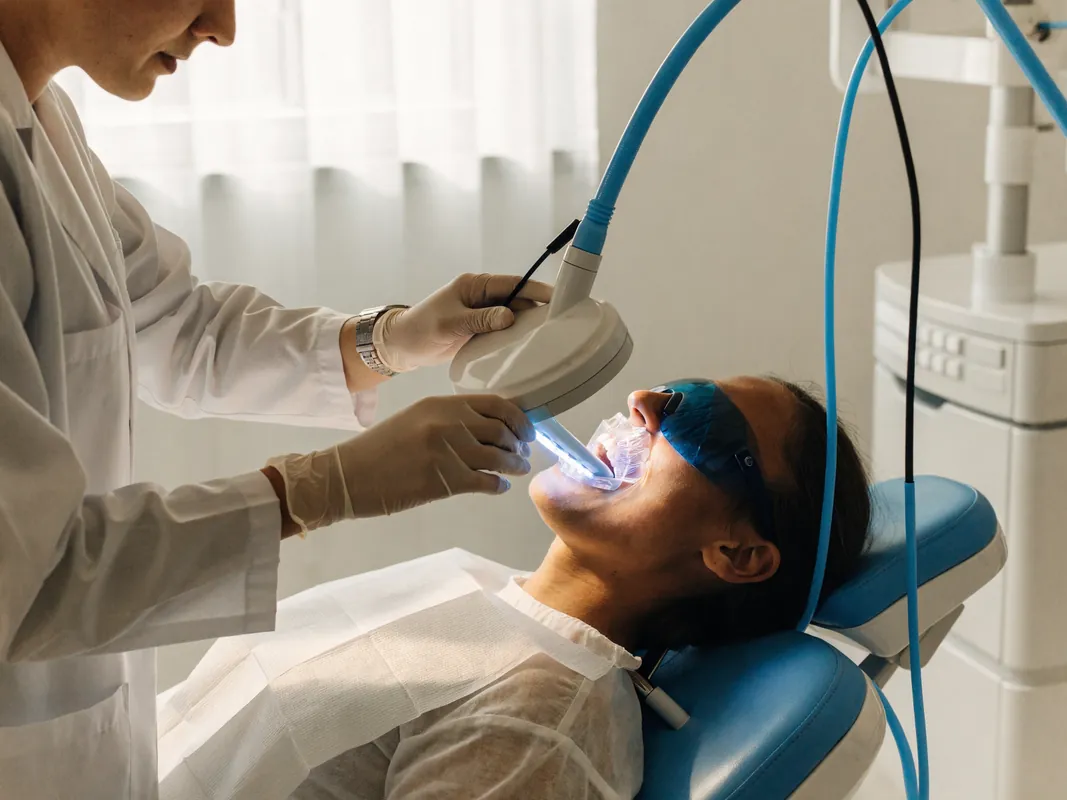
Chemical tooth whitening uses peroxide-based agents to alter coloured molecules within suitable natural tooth tissue. It can change the overall colour of natural teeth and may reduce the visual prominence of some intrinsic or extrinsic discolouration. The degree and pattern of response vary. Starting shade, cause of discolouration, tooth structure, product, concentration, contact method, adherence and individual biology all influence what is observed.
Whitening does not create a selected porcelain opacity or a guaranteed shade. It does not copy a filtered photograph. It may leave teeth with different responses, particularly where there are mixed causes, bands, white patches, previous trauma or existing restorations. A clinician should describe the intended direction of change and the uncertainty rather than promise a number of shade tabs.
The 2018 Cochrane review of home bleaching found low- to very-low-certainty short-term evidence that the studied products whitened teeth compared with placebo. It could not establish the superiority of a particular composition, concentration, application method or duration. This is a useful warning against brand rankings and universal protocols. A named dentist should choose or prescribe an approach for the examined patient and provide product-specific instructions.
Surface stain removal and bleaching should also be distinguished. A professional cleaning may remove some external deposits without changing the intrinsic colour of the tooth. Whitening toothpaste generally works mainly through stain removal rather than producing the same internal colour change as prescribed bleaching. Aggressive abrasive use can create other problems. Ask what mechanism is being proposed and what diagnosis supports it.
What whitening cannot change
Whitening cannot rebuild an edge, thicken worn tooth tissue, alter a tooth's physical width, close a gap, move a rotated tooth or replace a defective restoration. It cannot make every type of white opacity disappear. It cannot make an existing crown, veneer, filling or implant crown bleach like the surrounding natural enamel. It cannot treat decay, gum disease, pulpal disease or erosion.
These limits are not failures of whitening; they define its indication. If colour is the only concern, a colour-directed treatment may be sufficient. If the real concern is structural, the clinician should identify a structural or positional alternative. If both colour and structure matter, the plan may combine treatments, but every component must have its own diagnosis and consent.
Avoid the false choice that every person must select either full whitening or multiple veneers. Other possibilities may include cleaning, repair of one filling, direct composite on one edge, resin infiltration for a selected lesion, enamel microabrasion in a selected case, orthodontics, replacement of a defective restoration, a single-tooth internal bleaching pathway after endodontic assessment, observation or no treatment. Suitability is clinician-owned.
Existing restorations do not whiten with natural teeth
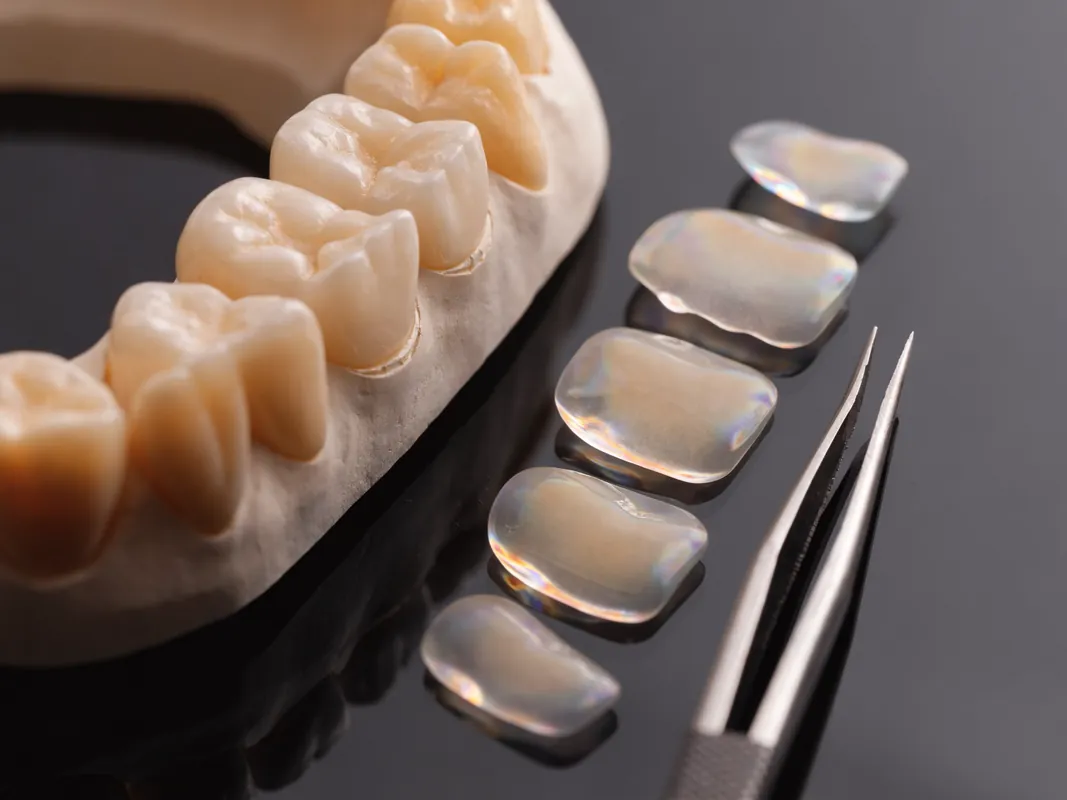
The ADA explicitly notes that bleaching affects natural teeth, not tooth-coloured restorations such as crowns or implant restorations. NHS patient information similarly warns that fillings and veneers already present will not change colour. This creates a predictable planning issue: natural teeth can become lighter while restorations remain at their previous shade, making a mismatch more visible.
Before whitening, map every visible restoration. Record its material where known, age, margin condition, current shade relationship and whether it is clinically acceptable. Do not promise that all restorations must be replaced. Some may remain acceptable after the natural teeth settle; others may become visually mismatched or may already need repair for clinical reasons. Replacement should be a separate decision with its own benefits, tissue cost, risks and quotation.
If definitive composite or ceramic work is contemplated, sequencing matters. Whitening may be considered first so the patient can see the response of natural teeth before choosing a restorative shade. However, shade does not necessarily stabilise immediately, and laboratory and bonding decisions may need an individual interval. Experimental reviews also indicate that bleaching can temporarily affect adhesive bond strength. The named restorative dentist must decide when measurement, preparation and bonding are appropriate for the product and substrate; this page does not impose a universal waiting period.
Keep original restoration records if available. For crowns, veneers and implant restorations, request the material, manufacturer or system, shade information, laboratory prescription, photographs and date. Traceability helps a future clinician understand why a mismatch developed and what can be changed without automatically replacing sound work.
Whitening candidacy and contraindications are clinician-owned
An online list cannot clear a person for bleaching. The dentist must consider the cause of discolouration, active oral disease, existing restorations, cracks, exposed roots, recession, current sensitivity, allergies, pregnancy or breastfeeding questions, age and the applicable law, as well as the exact product and method. The relevant restrictions and product instructions differ by jurisdiction and formulation.
The word “contraindication” should not be used as a sales shortcut. It may describe a reason not to use a particular product, a reason to manage disease first, a need to modify the method or a reason to select another treatment. The clinician should explain which concern applies and whether it is temporary, product-specific or fundamental. A coordinator should not advise a patient to ignore a concern because a trip is booked.
Ask the dentist to document:
- the diagnosis or aesthetic indication;
- why the chosen bleaching approach is reasonable;
- which findings increase risk or limit response;
- which teeth and restorations are included or excluded;
- what outcome range is realistic without promising a shade;
- how sensitivity or soft-tissue irritation will be managed;
- what would cause the treatment to pause or stop;
- how existing restorations may affect appearance;
- when reassessment is required;
- what alternative and no-treatment options remain available.
Do not use someone else's tray, unlabelled gel or a product supplied through an unidentified social account. A tray or product intended for one person may not fit another mouth or correspond to the same diagnosis. Product identity, concentration, batch where relevant, instructions and responsible prescriber should be traceable.
Sensitivity and soft-tissue irritation are real consent issues
Tooth sensitivity and gingival irritation are among the most commonly reported adverse effects of bleaching. The ADA and the Cochrane review describe them as common concerns; their occurrence and intensity vary with the patient and protocol. This makes “no sensitivity” an inappropriate promise. A previous history of sensitivity, recession, cracked teeth, exposed dentine, defective restorations or other pain should be evaluated before treatment.
The clinician should distinguish expected possible symptoms from a warning sign. Ask how the product should be used, what contact with gums should be avoided, what to do if sensitivity begins, when to stop and whom to contact. Do not apply more gel, extend contact or repeat sessions to chase a marketed shade. Do not take medicines merely because an advertisement suggests a routine; the responsible clinician or prescriber must consider medical history, allergies, interactions and the actual symptom.
Pain may also reveal a condition unrelated to bleaching. Persistent spontaneous pain, pain on biting, swelling, a bad taste, a fracture or an isolated dark tooth may require urgent or restorative assessment. Masking the appearance does not treat the cause. If a symptom does not follow the explained course or is worsening, seek local clinical review rather than relying on remote reassurance.
Gum health comes before aesthetic treatment
Inflamed, bleeding or receding gums can change both risk and appearance. Bleaching gel contacting soft tissue may irritate it. Veneer margins placed in an unhealthy or difficult-to-clean environment can complicate maintenance and interpretation of later symptoms. The clinician should assess periodontal health and stabilise relevant disease before elective aesthetic work.
Gum position also influences how teeth look. A tooth may appear short because of gingival coverage rather than a lack of ceramic. A dark triangle may reflect loss of papilla support rather than a colour problem. Recession may reveal a darker root surface that responds differently from enamel and may be sensitive. These findings need their own diagnosis; enlarging or brightening a restoration does not automatically solve them.
Ask how every proposed veneer margin will be located, finished, cleaned and monitored. The design should permit home care and professional review. If gum contouring or periodontal treatment is discussed, that is a separate clinical decision requiring diagnosis, consent and healing assessment. A package should not bundle it automatically with veneers.
Veneers are restorative treatment with irreversible consequences
A veneer is a restoration bonded to the front and sometimes the incisal part of a tooth. It may be made from ceramic or resin composite and may address selected problems of colour, form, surface, wear or spacing. It is not simply “permanent whitening.” It introduces material interfaces, margins, bonding and future maintenance.
The NHS Manchester University Dental Hospital patient leaflet explains that a dentist may need to remove tooth surface to make space for a veneer and lists potential risks of crowns, veneers and bridges. The amount varies; some cases can be more additive. When tooth tissue is intentionally removed, it does not grow back. Even an additive veneer commits the patient to monitoring a bonded restoration and may change surface, contour or future treatment choices.
Consent should include the possibility of sensitivity, marginal staining, gum response, colour mismatch, wear of opposing teeth, chipping, fracture, debonding, caries at margins, pulp complications, repair, replacement and a need for different treatment later. Systematic reviews report high survival in studied groups but also complications and heterogeneous study designs. Population evidence cannot guarantee an individual restoration or justify a fixed lifespan promise.
The decision must consider the remaining enamel, existing restorations, tooth vitality, occlusal load, parafunction, hygiene, diet, gum health, material and design. A thin restoration on a favourable enamel substrate is not the same proposition as masking a very dark tooth with extensive preparation or bonding mainly to dentine.
Compare additive and non-veneer alternatives
Before approving veneers, require a written comparison of realistic alternatives. For a colour-only complaint, whitening or no treatment may be relevant. For a small chip or shape discrepancy, polishing, recontouring or direct composite may preserve more tissue. For spacing or rotation, orthodontic assessment may address position rather than disguising it with wider or bulkier restorations. For localised opacity, microabrasion or resin infiltration may be considered after diagnosis. For a defective filling, repair or replacement of that restoration may be enough.
Direct composite and ceramic veneers have different trade-offs. Composite can sometimes be added or repaired more directly and may require less removal, but it can stain, wear, roughen or need maintenance. Ceramic can offer different optical and surface properties but involves laboratory or manufacturing steps, bonding and material-specific repair considerations. Neither material is universally superior. The clinician should relate the choice to the tooth, intended change, functional load, repairability, maintenance and patient preference.
Orthodontics is not automatically more conservative in every situation, and veneers are not automatically faster or more appropriate. Each option carries burdens, limits and uncertainties. The point is to compare diagnoses and trade-offs honestly, including the option to leave a healthy appearance unchanged.
Function, bite and tooth wear can change the decision
An attractive preview is not a functional examination. Veneers can change edge position, guidance, tooth thickness and contacts. If there is active tooth wear, clenching, grinding, jaw pain, limited opening, unstable contacts or repeated fracture, the clinician should diagnose the pattern before adding material. Covering worn teeth without addressing the cause may hide progression or transfer load elsewhere.
The assessment should record current edge relationships, contacts in movement, wear facets, fractures and any history of failed restorations. A patient who clenches does not automatically need or automatically fail to qualify for veneers. The finding changes the risk discussion, design and maintenance plan. Claims that one material is “strongest” do not replace analysis of how the restoration will be loaded.
Whitening does not correct function, but sensitivity during or after bleaching can be confused with pre-existing crack, recession or pulp symptoms. Establishing a symptom baseline helps the clinician recognise change. Record which teeth are sensitive, what triggers it, how long it lasts and whether there is biting pain before treatment begins.
If the bite or tooth position contributes to the appearance, orthodontic, restorative and periodontal opinions may need to be coordinated. The plan should name who owns each decision. The patient should not discover after preparation that the desired tooth position could not be achieved within safe contours.

Sequence whitening before definitive shade decisions when appropriate
In a combined plan, natural teeth are often considered for whitening before the final shade of new restorations is selected. The logic is straightforward: existing restorations do not bleach, so the colour of the natural teeth may need to be established before matching a veneer, crown or composite. That sequence is not a universal rule. It depends on diagnosis, which teeth are being restored, urgency, product, sensitivity, restorative substrate and the intended optical result.
Shade measurement immediately after bleaching can be misleading because hydration and ongoing colour change may affect appearance. Adhesive procedures performed too soon may also face product- and substrate-dependent bonding considerations. A systematic review and meta-analysis of laboratory studies found reduced bond strength to enamel and dentine after vital bleaching, with the effect changing over time. Laboratory evidence cannot dictate one clinical interval for every case; it supports clinician-owned sequencing rather than same-trip marketing promises.
The written sequence should answer:
- Which natural teeth are candidates for whitening and why?
- Which teeth contain restorations that will not change colour?
- How will the baseline be photographed and measured?
- What response would lead to stopping with whitening alone?
- What response would justify considering repair, composite or a veneer?
- When will shade be reassessed, and what clinical evidence informs that decision?
- When can bonding be performed for the chosen product and substrate?
- What happens if the natural teeth respond unevenly or the target preference changes?
A clinician may decide that whitening is inappropriate, that it should be completed locally before travel, or that a restorative problem needs treatment first. The itinerary must follow the clinical plan, not force the plan into prepaid travel dates.
Shade is more than a label on a tab
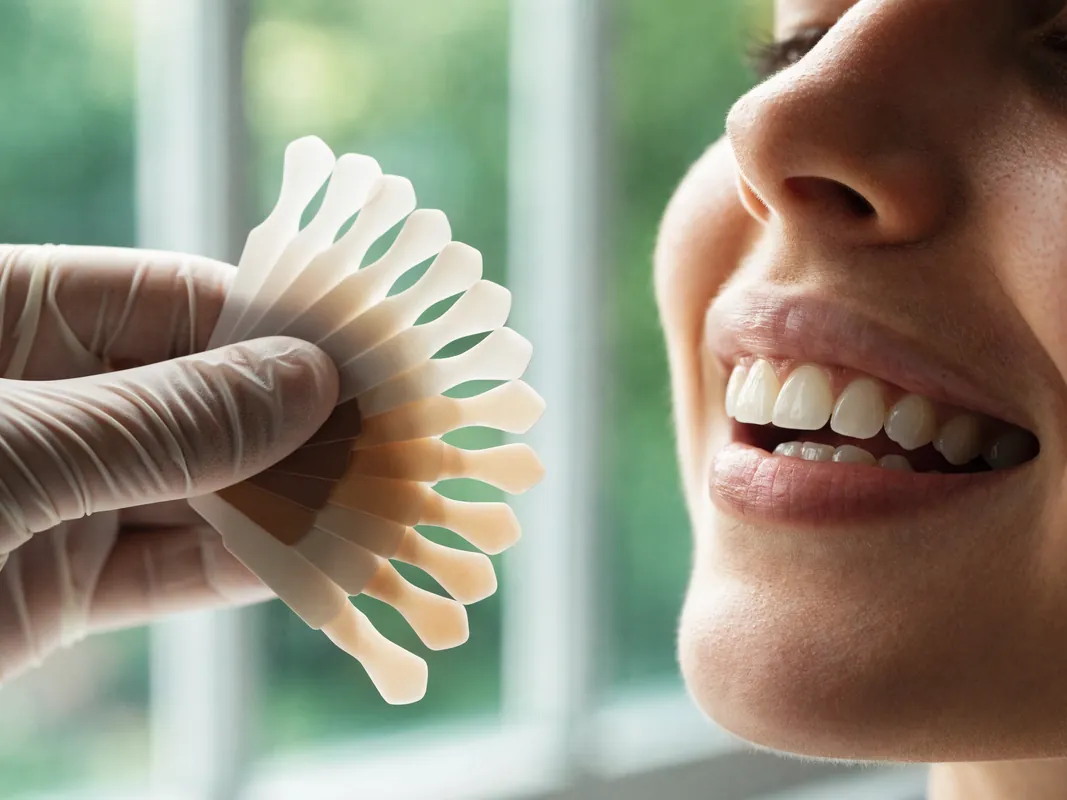
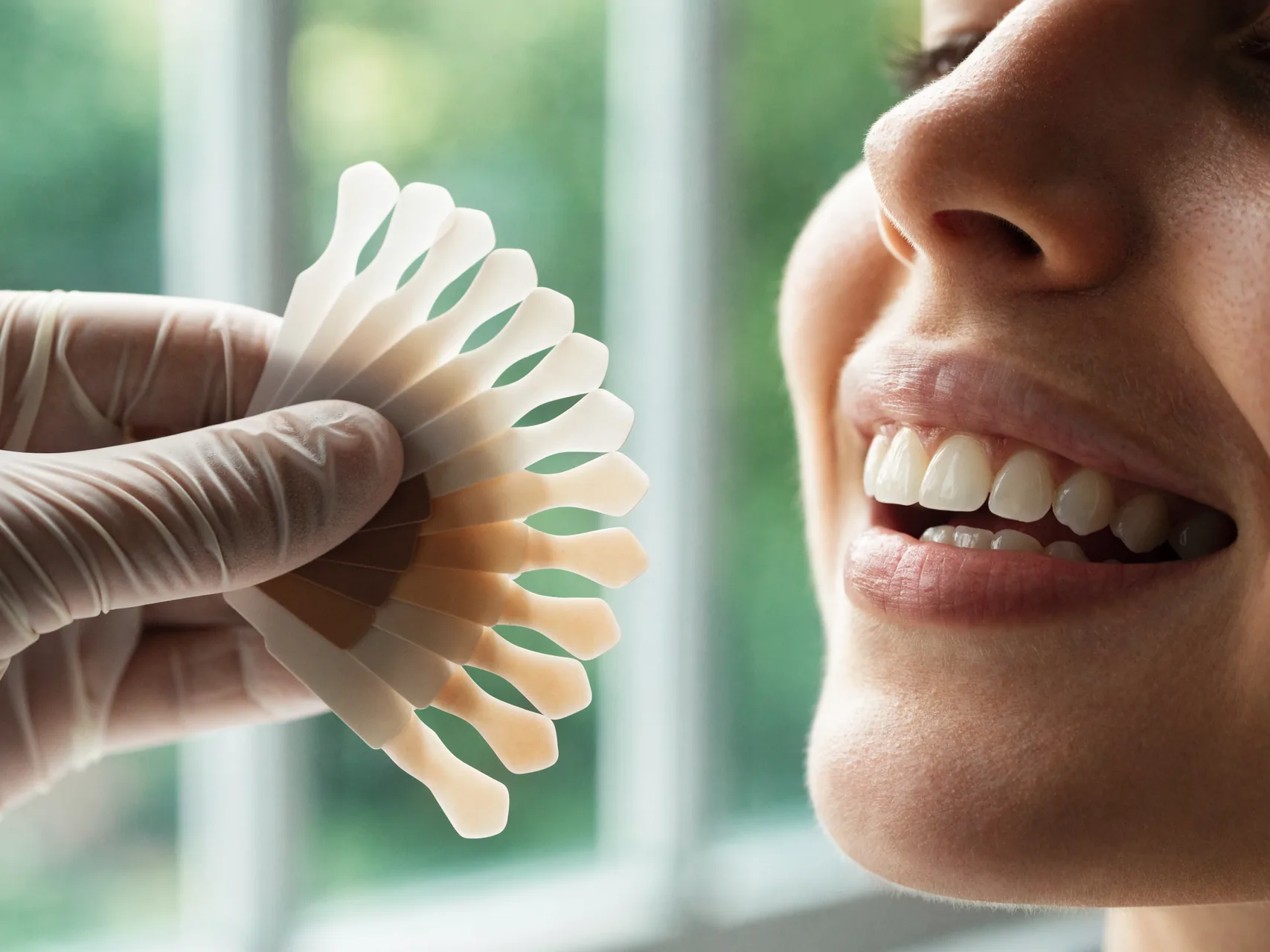
Tooth appearance includes value, chroma, hue, translucency, fluorescence, surface texture, lustre, thickness and the colour of the underlying tooth and cement. Lighting, camera settings, lipstick, clothing, dehydration and surrounding colours can alter perception. A shade name in a message is therefore not a complete prescription and cannot guarantee that a restoration will look the same in every setting.
Create a traceable shade record under controlled conditions where possible. It may include calibrated photographs, shade tabs in the same image, device readings, notes about lighting and hydration, the patient's agreed preference, stump or substrate shade for translucent restorations, try-in observations and the laboratory prescription. Record who selected the shade and when in relation to any whitening.
The patient should see a realistic range, not only an edited “after” image. Very high-value opaque restorations may require different preparation or material choices to mask a dark substrate, and those choices can affect enamel preservation and appearance. A natural-looking result can also mean different things to different people. The named clinician and dental technician should translate preferences into a feasible plan without promising visual identity to a reference photograph.
If only some visible teeth will be restored, discuss how natural neighbours may change with ageing or future whitening while ceramics and composites behave differently. Maintenance may involve whitening natural teeth, polishing or repairing composite, or replacing a restoration; none should be assumed on a fixed schedule.
Mock-ups, previews, provisionals and final restorations have different jobs
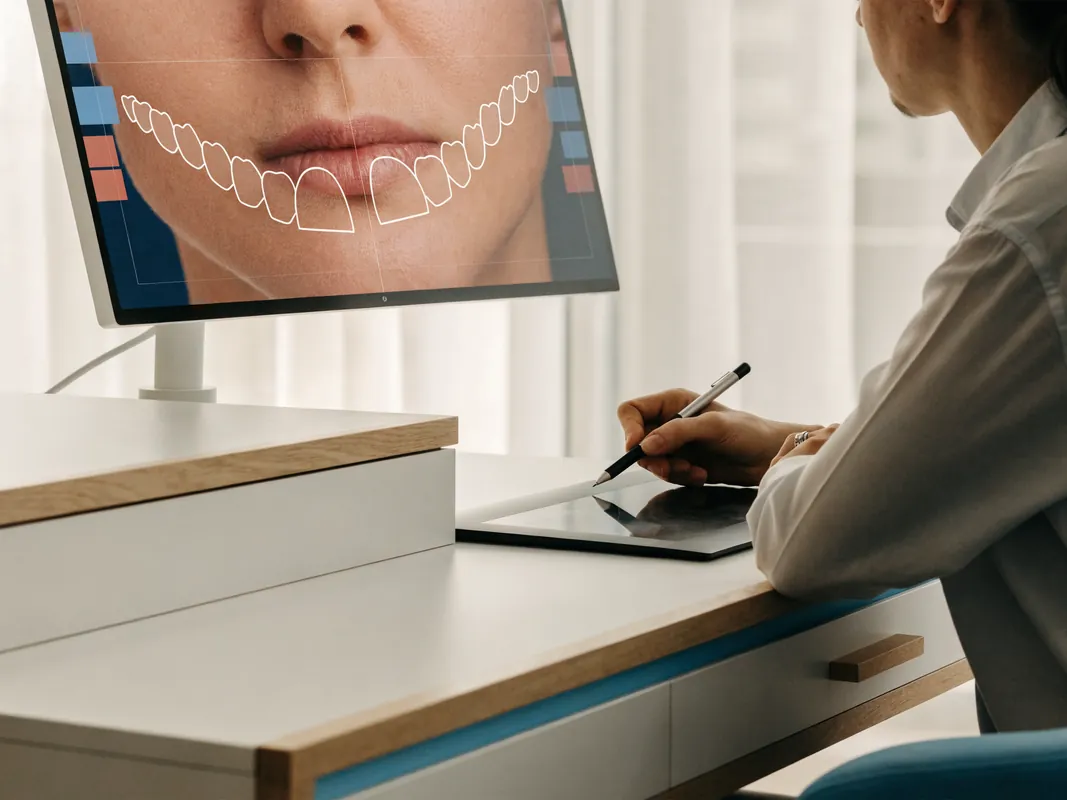
A digital simulation is a communication tool. It can help discuss length, proportion and broad arrangement, but it is not a clinical result. Screen colour and two-dimensional photographs do not reproduce tissue, translucency, speech, bite or the way a surface emerges from the gum. Ask what the image is intended to demonstrate and what it cannot predict.
A physical mock-up may allow a patient to preview proposed volume and shape before irreversible preparation. Its accuracy depends on records, transfer and the existing tooth position. It may not reproduce final material optics or margins. If a mock-up reveals excessive bulk, speech difficulty, cleaning problems or an unwanted look, the plan should be reconsidered rather than treating the preview as a sales formality.
Provisional restorations may protect prepared teeth, support gums, test shape or provide information for the laboratory. They are not proof that final ceramics will be identical, and a very short observation cannot reveal every functional or biological issue. The plan should say what is being evaluated, how feedback will be recorded and what findings could change the final design.
Before final bonding, consent should be reconfirmed. The patient should understand what can still be altered, what cannot be judged until after bonding, and what accepting the final restoration means. Do not allow airport departure, laboratory pressure or a package deadline to replace this decision point.
Material choice is clinician-owned and must be traceable
“Porcelain veneer” and “composite veneer” are broad labels. Ceramic families, resin composites, adhesive systems and cements have different optical, mechanical, bonding and repair characteristics. The appropriate combination depends on the remaining tooth structure, desired change, preparation, thickness, substrate shade, functional load and clinician's justified plan.
No single material is the best choice for every patient. A marketing brand, country of manufacture or laboratory title does not prove suitability. Ask for the material category, manufacturer and product identifier in the final record where available, together with the laboratory prescription and statement of conformity where applicable. Keep the batch or lot information if the provider records it.
Traceability is important if a veneer chips, debonds, changes appearance or needs repair elsewhere. A local dentist needs to know what surface and material are present and what was used to bond it. The GDC's record standard identifies photographs, models, laboratory prescriptions and statements of conformity as parts of the patient record where available. A provider outside the UK follows its jurisdiction, but the standard is a useful benchmark for questions.
For whitening, retain the product name, active ingredient, concentration, lot where recorded, prescription, tray information and instructions. Do not accept decanted or unlabelled gel. If an adverse effect occurs, knowing exactly what was used helps clinical review.
Consent must remain active throughout the sequence
Valid consent is a conversation and continuing process. GDC Principle 3 requires GDC registrants to explain relevant options and possible costs, check understanding, document discussion and renew consent if the plan or estimated cost changes. It does not regulate every overseas provider, but it offers a clear patient-facing benchmark.
For whitening, consent should address the diagnosis, uncertain degree of response, possible uneven colour, existing restorations, sensitivity, gum irritation, product use, stopping rules, recurrence of discolouration and alternatives. For veneers, it should address tissue removal, restoration design, material, margins, optical limits, functional risk, biological complications, maintenance, repair and replacement. In a combined plan, the decision to proceed to veneers should remain open after the whitening response is reviewed.
Ask for changes to be documented before treatment continues. Examples include adding more teeth, changing from composite to ceramic, increasing preparation, altering the selected shade, replacing extra restorations, adding gum treatment or modifying the travel plan. The patient should receive the revised clinical reason, alternatives, risks and cost. A signature obtained before these changes does not eliminate the need for renewed discussion.
Consent is also the right to decline or pause. Deposit terms should be clear, but financial pressure must not be presented as a clinical reason to proceed. The no-treatment and local-treatment options should remain visible.
Build a diagnostic and photographic baseline
A good baseline makes later decisions auditable. It distinguishes a pre-existing crack, recession or colour mismatch from a change after treatment. It helps another clinician understand the plan and reduces reliance on memory or filtered social-media images.
Request copies of relevant records, which may include:
- medical and medicine history and documented allergies;
- the complaint and agreed priorities in the patient's own words;
- charting of caries, restorations, cracks and missing or non-vital teeth;
- periodontal findings and gum photographs where relevant;
- pre-treatment shade records and calibrated clinical photographs;
- sensibility tests and clinically justified radiographs where relevant;
- tooth-wear and functional findings;
- scans, impressions, models, wax-ups or mock-up records;
- the options, risks, uncertainties and no-treatment discussion;
- the whitening product, prescription and instructions;
- the tooth-by-tooth preparation and restoration plan;
- laboratory prescriptions, material identifiers and conformity documents where available;
- consent records, final photographs, invoices and aftercare instructions.
Do not send sensitive health information to an unidentified personal account. Confirm the controller or provider, purpose, secure route, access and retention information before sharing. Keep copies. A booking coordinator should receive only what is necessary for the defined coordination task.
Demand an itemised written quotation
An itemised quotation is a decision tool, not merely a total. It should separate clinical examination, tests, cleaning, whitening, tray or product, each restoration by tooth, provisional work, laboratory work, repair or replacement of existing restorations, imaging, medicines if prescribed, reviews and aftercare. It should state what is provisional and what could change after examination.
For every line, ask who provides it, where it occurs, which material is proposed, whether the fee is fixed or estimated, what is excluded and what happens if it is not clinically required. Clarify cancellation, refund, remake, repair and complaint terms. A commercial warranty is not a clinical outcome guarantee; read its conditions, maintenance requirements, travel obligations and exclusions.
Travel services must be separate and explicit. Do not infer flights, hotel category, room basis, number of nights, companion places, airport transport or clinic journeys from a clinical page. If travel coordination is offered, obtain the legal supplier, route, dates, inclusions, exclusions and cancellation terms in writing. Compare the no-travel and local-care options as part of the real cost.
Budget for future care, not only the first procedure. Natural teeth can change shade. Whitening may be repeated only after reassessment. Composite can require polishing or repair. Ceramic veneers can chip, debond or need replacement. Gum disease, caries, trauma and wear can affect any plan. No provider can responsibly set one lifetime cost for an individual without knowing future findings.
Plan travel around clinical decision gates
Cross-border aesthetic care adds handover and timing risks. GDC and NHS information for people considering dental treatment abroad advises checking qualifications, regulation, indemnity or insurance, treatment details, costs, risks, aftercare and complaint routes. The central question is who provides clinical responsibility when the patient returns home.
Do not book a short itinerary on the assumption that assessment, whitening, shade stabilisation, preparation, laboratory work, try-in and final bonding can safely fit a standard sequence. The dentist must decide which stages are needed and when. Whitening can be completed locally before travel if appropriate; diagnostic records can be shared securely; a veneer plan can be deferred if findings differ; final work may require more than one visit. There is no universal timetable.
Before travel, identify a local dentist willing to assess routine or urgent concerns. Do not assume an NHS or private dentist must maintain or repair work planned elsewhere. Give the local clinician access to relevant records and ask the overseas provider for a direct clinical contact. Confirm who pays for local review, imaging, temporary repair, remake or return travel.
Leave flexibility for a changed or cancelled clinical plan. A flight and hotel reservation do not make an elective procedure suitable. Travel insurance may exclude planned treatment and its complications; check the policy with the insurer. Carry medicines in accordance with prescriber and transport guidance and do not change prescribed medicine for cosmetic treatment without the responsible professional.
Aftercare must cover natural teeth and restorations
Whitening aftercare should use the product-specific written instructions from the responsible dentist. It should explain storage, application, cleaning of trays where relevant, what to do with sensitivity or soft-tissue irritation, stopping rules and the review route. Do not continue or intensify use because the initial colour differs from an online example.
Veneer aftercare includes ordinary prevention, cleaning around margins, periodontal review, caries control and assessment of function. Ask how to clean between teeth and at the gum line, what signs suggest a margin or bonding problem, whether a protective appliance is indicated after individual assessment, and how that appliance will be reviewed. A generic maintenance schedule should not replace risk-based care.
If natural teeth are whitened around existing veneers, the restorations will not lighten. Repeated self-directed bleaching can therefore increase mismatch or sensitivity without changing the veneer. Reassessment should determine whether further whitening is reasonable and whether any restoration needs repair or replacement for clinical or aesthetic reasons.
Remote review can help communicate a concern but cannot test vitality, examine a margin fully, assess periodontal pockets, evaluate occlusion or diagnose all pain. Persistent or worsening symptoms need an examination. Keep regular care for all teeth, not only the restored smile zone.
Red flags that need prompt clinical assessment
Do not wait for a distant provider or coordinator if there is rapidly increasing facial or oral swelling, difficulty breathing or swallowing, uncontrolled bleeding, significant trauma, fever with dental symptoms, spreading redness, eye involvement or serious deterioration. Use the local emergency system. In England, NHS 111 can direct urgent dental care; call 999 or attend A&E when emergency criteria apply.
Seek prompt dental assessment for severe or persistent pain, pain on biting, a newly dark tooth after trauma, pus or a bad taste associated with swelling, a loose or fractured veneer, a sharp edge injuring tissue, a bite that prevents normal closure, progressive gum swelling, persistent spontaneous sensitivity or a restoration that has detached. Keep any detached fragment or restoration safely, do not glue it back and avoid relying on a photograph for diagnosis.
After whitening, stop and contact the responsible clinician if symptoms are outside the explained plan, increasing, localised to one suspicious tooth or associated with soft-tissue injury. The precise action depends on the product, findings and medical context; this guide does not provide a universal home remedy.
Marketing red flags in whitening vs veneers offers
Pause when an offer includes any of the following:
- a guaranteed shade, fixed number of shades or identical celebrity result;
- “no sensitivity,” “no enamel change” or another absolute comfort claim;
- veneers recommended from photographs without examination or alternatives;
- a standard number of veneers for every smile;
- age alone used to select whitening or veneers;
- a fixed lifespan or outcome presented as certain;
- whitening and final bonded restorations compressed into a package without a clinician-owned reassessment gate;
- unnamed dentist, clinic or laboratory;
- branded material presented as proof of diagnosis or competence;
- no discussion of current restorations that will not whiten;
- no tooth-by-tooth plan or enamel-preservation explanation;
- travel benefits used to pressure consent;
- no local aftercare, direct clinical contact, records or complaint route.
A high price does not prove quality, and a low price does not prove poor care. Compare identities, diagnosis, records, clinical reasoning, tissue cost, material traceability, consent, aftercare and contractual terms.
Questions to ask the named dentist
- What exactly is causing the colour or appearance I dislike?
- Is this colour, structure, position, gum display or a combination?
- Is there active disease, sensitivity, trauma or pulp concern to manage first?
- Which teeth are natural and which contain restorations that will not whiten?
- What is the least destructive reasonable option for each tooth?
- Could cleaning, repair, direct composite, orthodontics, microabrasion, infiltration or no treatment address the concern?
- What response to whitening is realistic, and what remains uncertain?
- Which whitening product and protocol are proposed, and why are they suitable for me?
- What sensitivity or gum risks apply, and what are the stopping rules?
- If veneers are proposed, how much enamel is expected to be removed or preserved on each tooth?
- What functional, bite or wear findings affect the plan?
- What are the material and bonding options, risks and repair routes?
- If whitening and restorations are combined, what are the decision gates between them?
- How and when will shade be measured after whitening?
- What can the mock-up or provisional show, and what can it not predict?
- Which details will appear in the laboratory prescription and final material record?
- What complications could require repair, replacement, root treatment or another procedure?
- Who provides local and destination aftercare?
- How can my local dentist contact the treating clinician directly?
- What is included in the itemised quotation and what may change?
- What are the cancellation, complaint and remedial terms?
- What happens if I decline veneers after seeing the whitening response?
A patient decision checklist
Before choosing a treatment
- Define the concern in colour, structure, position, gum and function terms.
- Obtain a clinical examination and diagnosis from the named dentist.
- Map natural teeth and every visible restoration.
- Stabilise relevant caries, gum disease, cracks, pulp problems or erosion.
- Ask for the least destructive reasonable options, including no treatment.
- Record baseline shade, photographs and symptoms.
- Verify provider identity, registration route, clinic and complaint process.
Before whitening
- Confirm product identity, prescription, instructions and suitability.
- Understand that the response and final shade cannot be guaranteed.
- Understand that restorations will not bleach with natural teeth.
- Know sensitivity, irritation, stopping and contact instructions.
- Agree how and when the result will be reassessed.
Before any veneer preparation
- Review the whitening response where whitening formed part of the plan.
- Confirm the tooth-by-tooth indication and alternatives.
- Review preparation, enamel preservation and irreversible consequences.
- Review function, margins, material, shade and optical limitations.
- Use mock-up or provisional information appropriately.
- Receive the itemised plan, quotation and aftercare responsibilities.
- Renew consent for every material change.
Before leaving the provider
- Receive the final diagnosis and treatment record.
- Obtain whitening and restoration product details.
- Obtain photographs, relevant imaging, laboratory prescription and conformity documents where available.
- Check the final invoice, clinical contact and complaint route.
- Receive written aftercare and red-flag guidance.
- Confirm local review and record transfer.
Related evidence-led guides
For more detail, compare the service information at /en/services/teeth-whitening and /en/services/dental-veneers. If shape and function are part of the concern, read /en/services/smile-design. For long-term restoration maintenance, use /en/guides/caring-for-veneers-long-term. These pages support questions for a clinician; they do not establish individual suitability.
Sources, evidence limits and review questions
This guide prioritises regulator, public-health and peer-reviewed evidence. Guidance and products change, so the named clinician should consult current versions and the instructions for the actual material. The main sources used were:
- American Dental Association, Whitening, accessed 29 August 2026: diagnosis of intrinsic and extrinsic discolouration, natural teeth versus restorations, treatment approaches, sensitivity and gingival irritation. https://www.ada.org/resources/ada-library/oral-health-topics/whitening
- General Dental Council, Tooth whitening and illegal practice, accessed 29 August 2026: whitening as dental treatment requiring proper assessment and prescription in the UK. https://www.gdc-uk.org/standards-guidance/information-for-patients-public/tooth-whitening-and-illegal-practice
- General Dental Council, Principle 3, Obtain valid consent, accessed 29 August 2026: options, costs, understanding, continuing consent and documented changes. https://standards.gdc-uk.org/pages/principle3/principle3
- General Dental Council, Principle 4, Maintain and protect patients' information, accessed 29 August 2026: complete records, photographs, models, laboratory prescriptions and conformity statements. https://standards.gdc-uk.org/pages/principle4/principle4
- Leeds Teaching Hospitals NHS Trust, Tooth whitening patient information, reviewed July 2023: incomplete colour change, restorations not whitening and product-related risks. https://flipbooks.leedsth.nhs.uk/LN004769.pdf
- Manchester University NHS Foundation Trust, Risks of crowns, veneers and bridges, patient leaflet: possible tooth-surface removal and the fact that porcelain is not affected by bleaching. https://mft.nhs.uk/app/uploads/sites/3/2018/09/UDH-124.pdf
- Cochrane systematic review of home-based chemically induced bleaching, published 2018: low-certainty short-term evidence, inability to identify a universally superior composition or protocol, and common sensitivity and oral irritation. https://pubmed.ncbi.nlm.nih.gov/30562408/
- American Dental Association evidence page cited systematic review on bleaching and restorative materials: laboratory effects and limits of clinical inference. https://pubmed.ncbi.nlm.nih.gov/15451241/
- Systematic review and meta-analysis of vital bleaching and adhesive bond strength, published 2021: time-dependent laboratory evidence supporting clinician-owned bonding sequence. https://pubmed.ncbi.nlm.nih.gov/34157122/
- Systematic review of long-term survival and complications of porcelain laminate veneers, published 2021: fractures, debonding and study-level outcome evidence rather than individual guarantees. https://pubmed.ncbi.nlm.nih.gov/33807504/
- Systematic review and meta-analysis of veneer substrates, published 2024: enamel preservation and differences associated with dentine or composite substrates. https://pubmed.ncbi.nlm.nih.gov/38604905/
- General Dental Council, Going abroad for dental treatment, accessed 29 August 2026: provider checks, risks, aftercare and complaints. https://www.gdc-uk.org/standards-guidance/information-for-patients-public/going-abroad-for-dental-treatment
- NHS, Treatment abroad checklist, accessed 29 August 2026: planning, provider questions, costs and follow-up. https://www.nhs.uk/using-the-nhs/healthcare-abroad/going-abroad-for-treatment/treatment-abroad-checklist/
- NHS, How to find an NHS dentist in an emergency or out of hours, accessed 29 August 2026: urgent-care pathways. https://www.nhs.uk/nhs-services/dentists/how-to-find-an-nhs-dentist-in-an-emergency/
Evidence does not establish one winner between whitening and veneers. Whitening can be a tissue-preserving option for a suitable colour concern, but response and adverse effects vary and restorations remain unchanged. Veneers can address selected colour and structural concerns, but they introduce irreversible and maintainable restorative consequences. The responsible decision combines diagnosis, patient preference, enamel preservation, function, consent, records, an itemised quotation and workable local aftercare.