Philips Zoom identifies a family, not one whitening prescription
Philips Zoom is used across several professional whitening products rather than one interchangeable treatment. The current United States [Philips professional whitening overview](https://www.usa.philips.com/professionals/dental/whitening) separates an in-office Zoom pathway from take-home DayWhite and NiteWhite formulas. WhiteSpeed combines a named chairside gel with a named LED lamp. DayWhite and NiteWhite are tray-delivered gels for use outside the surgery after the professional steps required by the applicable instructions and law. Other historic Zoom names, kits and accessories may appear in photographs, invoices or older documents. None should be silently treated as the same product.
This page is a neutral product-verification and whitening-decision guide. It does not state that WeCare, a particular clinic, dentist, hygienist, therapist, intermediary or salon stocks, uses, sells, prescribes or is authorised for Philips Zoom. A brand page cannot establish the lawful supply status of a specific gel in Turkey, the United Kingdom, the European Union or another market. That requires current case-specific evidence: exact product name, catalogue or reference identifier, active ingredient and concentration, legal manufacturer shown on the governing document, local label, lot, expiry, storage history, current instructions for use, responsible dental professional and procedure record.
The useful first question is not “Do you have Zoom?” It is “Which exact Zoom product, in which market, under which current instructions, and why is that option reasonable after examining this mouth?” Brand recognition can help organise records. It cannot diagnose the cause of colour, make peroxide suitable, align restorations with natural teeth or promise a shade.
Build an exact product identity before comparing proposals
A written proposal should identify the pathway before it discusses convenience. For in-office treatment, request the exact WhiteSpeed procedure-kit reference, the exact gel label, the stated hydrogen-peroxide concentration, the exact lamp model, the lamp or device identifier, and the instructions governing that combination. Current official United States pages identify the WhiteSpeed LED lamp as [DIS558/01](https://www.usa.philips.com/c-p/DIS558_01/zoom-whitespeed-in-office-whitening-treatment) and show a WhiteSpeed 25% hydrogen-peroxide kit as [DIS557/01](https://www.usa.philips.com/c-p/DIS557_01/whitespeed-in-office-whitening-treatment). Those pages describe a United States catalogue context; they are not proof of what is lawfully supplied or used in another country.
For take-home treatment, record whether the proposal is DayWhite or NiteWhite, the concentration printed on the syringe, whether that percentage refers to hydrogen peroxide or carbamide peroxide, the tray type, and the exact current patient and professional directions. Do not convert one percentage into another by memory when the label and IFU can answer the question. Do not infer that every concentration shown on a United States product selector is available in a European or Turkish configuration.
The identity record should also state whether any sensitivity product, post-care material, tray case, mixing tip or other accessory is included. A bundle photograph is not a contents list. If the final product differs from the quotation, the responsible professional should explain the reason, re-check suitability and update consent before exposure.
Verify the legal manufacturer, market and document revision
Philips is the public-facing mark, while exact legal-manufacturer information can depend on the product and document. A current market document should be read rather than assuming that every Philips-branded item has the same legal manufacturer. For example, the official WhiteSpeed 25% gel document hosted by Philips for a specific regulatory context names Discus Dental, LLC, 1700A South Baker Avenue, Ontario, California, as registrant and manufacturer. The current multilingual DayWhite/NiteWhite instructions hosted by Philips identify Philips Consumer Lifestyle BV, Tussendiepen 4, Drachten, the Netherlands, at the top of that document. These examples demonstrate why the product label and governing IFU matter.
Record the document code, revision or date. The current multilingual DayWhite/NiteWhite document carries code 300014764191 and date 2025/03/28. The Philips-hosted [WhiteSpeed 25% gel instructions](https://www.documents.philips.com/assets/20240412/02535aef788342cda656b150016f7f6a.pdf) and the [WhiteSpeed procedure-kit instructions](https://www.documents.philips.com/assets/20201026/a00ebaf5659242a6ba90ac6000727202.pdf) are separate documents with different purposes and market contexts. A product webpage, patient leaflet, safety-data sheet, lamp manual and gel IFU are not substitutes for one another.
If an older instruction conflicts with the current local label, pause and ask which document legally governs the supplied reference. Save the answer with the record. A document found online can support comparison, but only the exact label-document-market chain shows which restrictions apply to the proposed item.
Separate WhiteSpeed from DayWhite and NiteWhite
WhiteSpeed is an in-office, light-assisted pathway. Official Philips material describes a dual-cylinder WhiteSpeed gel that mixes to 25% hydrogen peroxide and is used with a WhiteSpeed procedure kit and LED accelerator. DayWhite is a take-home family whose name refers to shorter-wear formulations containing hydrogen peroxide in the official documents. NiteWhite is a take-home family based on carbamide-peroxide concentrations, which release a lower percentage of hydrogen peroxide over use. These are different delivery systems with different labels, controls, contact times and foreseeable mistakes.
Do not accept “Zoom gel” as a complete record. A syringe may be a WhiteSpeed chairside gel, a DayWhite take-home gel, a NiteWhite take-home gel, or another product using similar visual branding. The exact active ingredient affects how concentration is understood. The application environment affects who handles the material, how soft tissue is protected, how exposure is stopped and what instructions must be supplied.
The distinction also matters when interpreting evidence. A study or manufacturer claim about the exact WhiteSpeed gel-and-lamp combination cannot establish the performance of DayWhite, NiteWhite, a generic LED, a different peroxide gel or a mixed protocol. Conversely, take-home evidence does not validate an unrecorded in-office substitution.
Verify WhiteSpeed gel and lamp as a matched system
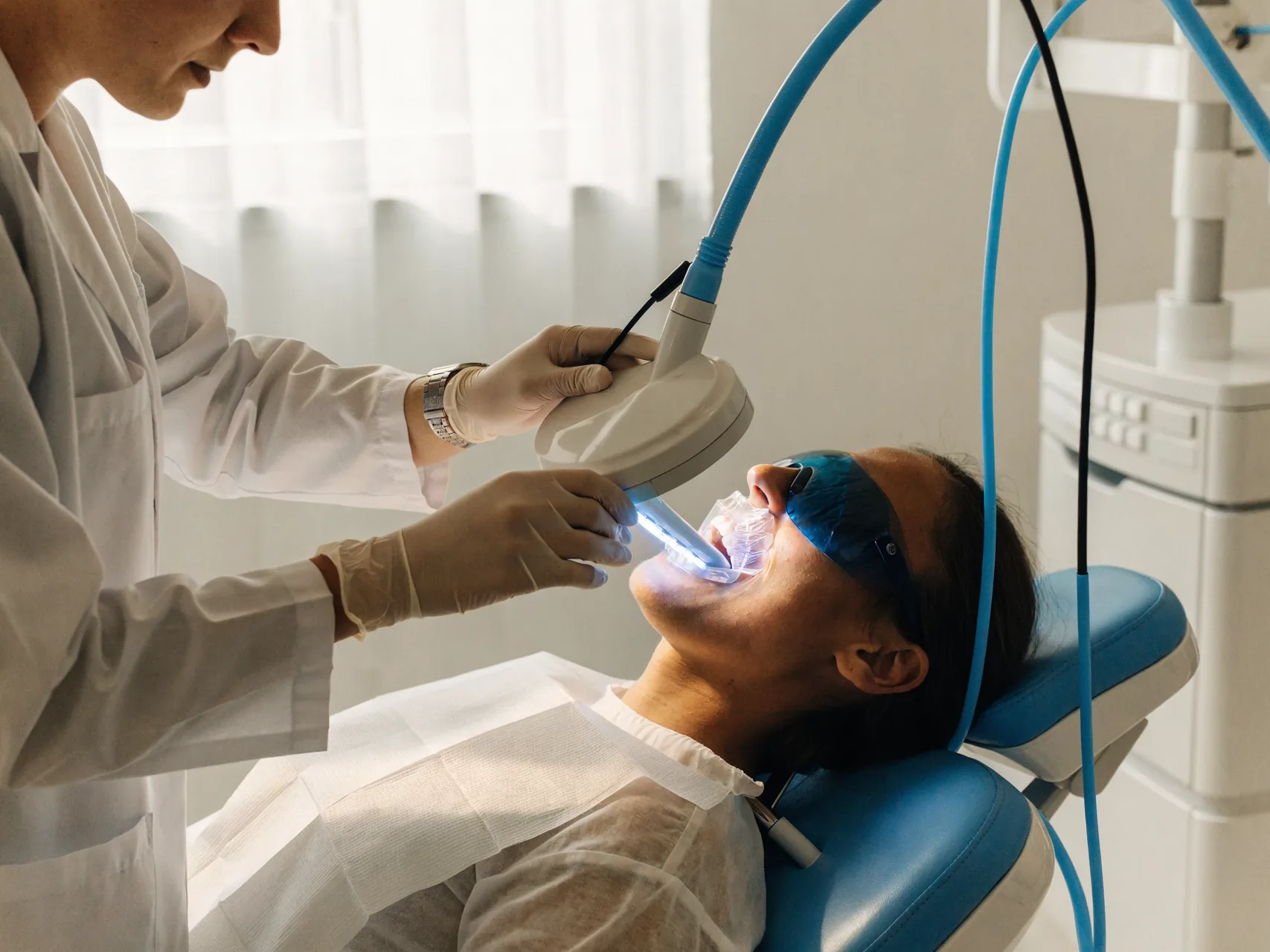
The official [Philips Zoom in-office page](https://www.usa.philips.com/professionals/dental/whitening/in-office-whitening) describes WhiteSpeed as using hydrogen peroxide and intense blue light. Its United States page lists chairside syringes marked 25% HP and identifies an LED output description of 190 mW/cm² across 420–460 nm. These are manufacturer figures for a named configuration, not universal specifications for every lamp carrying a blue light. If the proposal relies on light activation, record the exact lamp model and the exact compatible gel rather than photographing only a glowing handpiece.
The WhiteSpeed gel IFU describes a dual-cylinder syringe: one cylinder contains a higher-concentration peroxide gel and the other a catalyst; mixing produces the labelled 25% hydrogen-peroxide formulation. It describes the syringe as a single-patient item for a procedure and directs users to the procedure-kit instructions for the full workflow. Those details make identity and chain of custody important. A partly used, unlabelled or transferred syringe cannot be verified by colour or viscosity.
Ask how the lamp model, light guide, intensity selection, service status and protective equipment are documented. Lamp settings should come from the exact device instructions and professional decision, not from a patient choosing “strong” or “low” as if intensity were a shade menu. A functioning light does not prove that isolation, gel mixing, exposure control or case selection is correct.
Understand the light-versus-no-light decision
WhiteSpeed is marketed and documented as a light-assisted system, whereas DayWhite and NiteWhite are peroxide tray systems without a chairside activation lamp. That product distinction should not be turned into the broad claim that every light makes every peroxide protocol better. The American Dental Association [whitening review](https://www.ada.org/resources/ada-library/oral-health-topics/whitening) notes that in-office bleaching may use peroxide with or without a light. It also cites systematic evidence showing that light effects, colour change and sensitivity can depend on the system, peroxide concentration and study design.
Philips links research on its exact WhiteSpeed combination. That can inform a comparison of that defined gel and lamp under the studied conditions. It does not prove superiority over every current alternative, predict an individual shade or justify substituting a generic lamp. Ask what clinical objective the light is expected to serve, which evidence matches the exact gel and settings, and whether a no-light or take-home pathway remains reasonable.
Consent should distinguish product mechanics from outcome marketing. A patient can agree to a named light-assisted procedure after hearing alternatives and uncertainties. Consent is weaker when the explanation is simply that a lamp is “advanced” or “powerful.”
Read percentages by active ingredient, not by the biggest number
Hydrogen-peroxide and carbamide-peroxide percentages are not directly interchangeable labels. The older multi-market [Philips DayWhite/NiteWhite instructions](https://www.documents.philips.com/assets/20201027/f9088679bce34ce3b6a8ac61001ccedf.pdf) list DayWhite 6%, 9.5% and 14% hydrogen-peroxide formulations, and NiteWhite 10%, 16% and 22% carbamide-peroxide formulations, while warning that formulation availability varies by country. The same document expresses hydrogen-peroxide equivalents of 3.5%, 5.9% and 8.4% for those three carbamide-peroxide formulations.
The current 2025 multilingual instruction is narrower: it identifies DayWhite 6% HP, NiteWhite 10% CP releasing 3.5% HP, and NiteWhite 16% CP releasing 5.9% HP. This is an important market-and-revision lesson. A United States catalogue can list more strengths than a current European-facing instruction. Do not import the broader list into a local proposal without confirming that the exact strength has current lawful market documentation.
Higher percentage is not a quality rank. Concentration interacts with contact time, tray fit, tissue contact, sensitivity history and the prescribed protocol. The correct comparison is exact product, active ingredient, concentration, exposure instructions, supervision, evidence and patient factors—not the largest printed number.
Confirm current regional availability without inventing inventory
An official global page proves that a product exists in a manufacturer portfolio; it does not prove that a named provider has it, that the same reference is registered for the treatment country, or that a photographed kit is within expiry. Philips itself notes that product or formulation availability varies by country. Current lawful use may also depend on national rules about peroxide concentration, sale, first use and the professional permitted to perform whitening.
Ask the proposed provider for the local product label, catalogue or reference number, supplier trace, lot, expiry, IFU language and legal basis for the professional pathway. Verify the dental professional and facility separately through the relevant public regulator where one exists. A manufacturer “find a dentist” page, training badge or reseller listing should not be converted into a clinical credential or inventory statement.
This guide therefore makes no current Turkish stock claim. If the evidence shows that only another Zoom formulation is locally documented, the quote and consent should use that exact name. If the product cannot be identified, compare a clearly named alternative rather than buying an undefined “Zoom-equivalent” service.
Put diagnosis before whitening or brand choice
Whitening is elective colour modification, but discoloration can be a sign or consequence of different conditions. The ADA review separates extrinsic surface staining from intrinsic colour changes and lists causes including diet, tobacco, ageing, developmental changes, fluorosis, tetracycline exposure, caries, restorative materials and pulpal problems. A single dark tooth, rapid colour change, pain or trauma history deserves diagnosis rather than automatic full-arch bleaching.
A pre-whitening assessment should include medical and dental history, current symptoms, allergy and sensitivity history, periodontal condition, caries, cracks, exposed dentine or roots, failing restorations, tooth vitality where relevant, previous bleaching and the distribution of discoloration. Radiographs or other tests should be used only when clinically indicated, not as a sales bundle.
Cleaning may address some external deposits without changing intrinsic tooth colour. Internal bleaching may be considered for selected root-treated teeth under a separate diagnosis and risk discussion. Microabrasion, resin infiltration, restorative treatment or accepting the current colour may be reasonable depending on the cause. The exact Zoom option comes after that comparison.
Map every natural tooth and every restoration
Peroxide whitening changes natural tooth tissue; crowns, veneers, implants, dentures and tooth-coloured fillings do not respond in the same way. Both the [NHS teeth-whitening guidance](https://www.nhs.uk/tests-and-treatments/teeth-whitening/) and ADA review emphasise this boundary. A smile with anterior crowns, composite bonding or mixed restorations can become more mismatched after surrounding enamel lightens.
Create a tooth-by-tooth map before consent. Record which visible units are natural, restored, root treated, crowned, veneered, implant supported or missing. Photograph under repeatable lighting with a scale or shade reference where appropriate. Discuss whether the goal is general brightening, reducing a particular contrast, or preparing for later restorative work.
If a restoration may need replacement for colour reasons, that possibility and its separate cost should appear in the itemised plan. Replacement is not an automatic consequence and must not be presented as already required before the final colour stabilises and the restoration is reassessed. Whitening should not become a hidden gateway to unplanned tooth preparation.
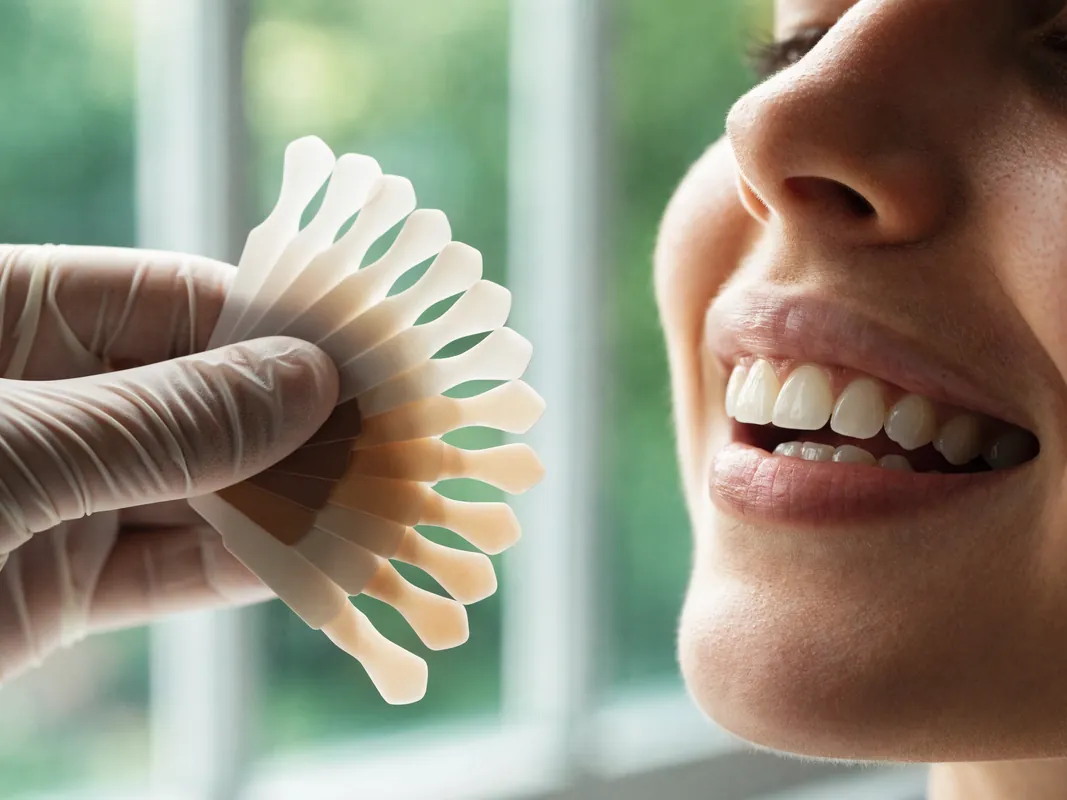
Treat shade guides as records, not promises
A shade guide can document baseline and follow-up appearance when lighting, hydration, camera settings and reference positioning are controlled. It does not turn biological response into a contract for a fixed number of tabs. Different guides arrange hue, chroma and value differently. Dehydrated teeth can appear lighter immediately after isolation or prolonged opening, making an immediate comparison misleading.
Record the guide brand, tab, lighting, date, tooth surfaces and photographs. If digital colour measurement is used, record the device and method. Do not mix manufacturer marketing scales with a clinical guide and call the numbers equivalent. Do not present a before-and-after image from another person as a forecast.
The written objective should be qualitative and bounded: for example, to seek a more even or lighter appearance while recognising stain type, anatomy, restorations and sensitivity. The final decision about later crowns, veneers or composite colour should be made after appropriate reassessment rather than from a promotional shade target.
Screen caries, cracks, exposed dentine and failing restorations
Peroxide contact through untreated disease or defects can worsen pain or expose tissues that need care. The Philips instructions identify untreated caries, exposed dentine, cracked teeth, failing restorations and periodontal involvement among conditions requiring exclusion or resolution in the relevant product context. A symptom-free person can still have defects that matter to whitening.
The assessment should record active caries, marginal leakage, fractured enamel, cervical lesions, erosion, abrasion, recession, exposed roots and recent restorative work. A history of sharp pain on cold, biting pain or spontaneous pain needs investigation. Whitening should pause when findings could change diagnosis, isolation or the product choice.
Do not hide this behind a checkbox saying “healthy teeth.” The responsible professional should document what was examined, what was found, what was treated first and which uncertainty remains. If treatment is deferred, state what symptoms require earlier review.
Assess gums and soft tissue before peroxide exposure
Gingival inflammation, ulceration, recession and periodontal disease affect both eligibility and the ability to protect tissue. Peroxide gel contacting gingiva can cause irritation. In-office protocols therefore require a documented isolation system, while take-home trays must be checked for fit, overextension, rough edges and leakage.
Record current bleeding, swelling, soreness, recession, pockets where relevant, mucosal lesions and recent surgery. Active disease should be stabilised or referred before elective whitening when it affects safety or consent. A patient with exposed roots may experience a different response and sensitivity pattern because root surfaces do not behave like intact enamel.
During in-office use, protective barriers, retractors and eyewear must correspond to the exact instructions. The patient should be able to report burning or pain. The ADA review notes concern that local anaesthesia can mask warning sensations during in-office bleaching; any anaesthetic proposal needs a clear clinical reason rather than convenience.
Take sensitivity history seriously
Sensitivity is a common adverse effect of peroxide whitening, not evidence that a person is weak or that the product has failed. The ADA review identifies temporary tooth sensitivity and gingival inflammation as common effects, with risk influenced by concentration, contact time and other factors. Existing hypersensitivity, exposed dentine, cracks, recent restorations and pulp status may change the decision.
Record which teeth are sensitive, triggers, duration, severity, spontaneous symptoms and previous whitening response. Diagnose pain that is focal, persistent, nocturnal or associated with biting before elective bleaching. A generic “sensitive setting” on a lamp does not diagnose the source.
The plan should explain how exposure can be modified or stopped, what professionally appropriate desensitising measures are considered, and when continued use is inappropriate. Do not promise zero sensitivity. If symptoms persist, intensify or localise, the answer is reassessment—not repeatedly reducing exposure while an untreated condition remains possible.
Review medical history, allergies, pregnancy and age limits
The governing product instructions control contraindications and precautions. The WhiteSpeed market document reviewed for this guide excludes people under 18 and identifies pregnancy or nursing and specified serious disorders among contraindications for that reference. The current DayWhite/NiteWhite document states that it is not to be used on a person under 18 in its relevant market context. Older instructions also list pregnancy, lactation, serious illness, severe allergy history and known hypersensitivity in their exclusions.
These statements should be checked against the exact current local IFU rather than copied across products. Ask about pregnancy or breastfeeding, current medical care, allergies, previous reactions to peroxide or tray materials, mouth dryness, medicines affecting oral tissues and the ability to follow instructions. Escalate uncertainty to the appropriate clinician.
Children and adolescents should not receive an adult cosmetic protocol by default. In the EU legal framework, products above 0.1% and up to 6% hydrogen peroxide have specific dental-practitioner and under-18 restrictions under [Directive 2011/84/EU](https://eur-lex.europa.eu/legal-content/EN/ALL/?uri=CELEX%3A32011L0084). Other jurisdictions can differ; current local law still governs.
Distinguish professional roles and legal ownership
Who examines, prescribes, applies, supplies, supervises and follows up may be regulated differently by jurisdiction. In the United Kingdom, the [General Dental Council tooth-whitening position statement](https://www.gdc-uk.org/docs/default-source/what-is-the-legal-position/tooth-whitening-position-statement.pdf?sfvrsn=16f71e9_4) explains the GDC view on whitening as the practice of dentistry and on peroxide concentration. EU cosmetic-product rules govern specified peroxide products and first use. Turkish professional and product rules require separate local verification.
The record should name the legal treating entity and each responsible individual, with verifiable registration where applicable. It should state who made the diagnosis, who selected the product, who performed any in-office application, who supplied take-home gel, who fitted the trays and who owns adverse-event follow-up. A receptionist, travel coordinator or reseller should not be presented as the clinical decision maker.
A Zoom training claim or logo is not a substitute for current professional registration, facility status or product traceability. Product authorisation and professional authorisation are separate questions. Neither alone proves appropriate case selection.
Protect eyes, skin, lips and oral tissue
Peroxide products are irritants and can injure eyes or soft tissue. Current Philips documents instruct users to avoid eye and skin contact and provide first-aid steps. The WhiteSpeed procedure requires compatible isolation, retractors, protective material and eyewear for the people specified in its instructions. Take-home syringes may be under pressure and should be opened away from the face.
Before an in-office procedure, the professional record should identify the isolation materials, confirm that lips and mucosa were inspected, and state how the barrier was checked during use. If burning, blanching or leakage occurs, exposure should be stopped and managed under the IFU and clinical judgement. Anesthetic numbness should not be used to conceal discomfort.
For take-home treatment, show the patient the amount and location of gel, how to remove excess, how to inspect a tray, and what to do after skin or eye contact. The current IFU directs prolonged water rinsing after eye exposure and urgent professional or poison-centre advice for specified ingestion or allergic events. The supplied instructions and label should travel with the patient.
Verify tray design, fit and gel placement
DayWhite and NiteWhite are not simply syringes. Their intended delivery depends on an appropriate tray and the exact instructions. The current Philips directions warn against damaged trays and overfilling because leaked gel can irritate gums. An older professional document describes custom-fitted trays made by the dentist. Current market configurations may differ, so the exact kit and tray pathway must be named.
The fitting record should note coverage, extension, edge smoothness, retention, tissue contact and any reservoir design if used. Demonstration should include how little gel is placed, how excess is removed, how the tray is inserted and removed, and how it is cleaned and stored. Hot water can deform tray material; follow the exact product directions.
If a tray no longer fits after restorative work, orthodontic movement or damage, stop and reassess. Do not force it or increase gel to compensate for poor adaptation. A tray from another system should not be described as Zoom-compatible without current manufacturer support.
Do not invent one universal wear schedule
Wear time belongs to the exact product and current regional IFU. The 2025 Philips instruction gives DayWhite 6% HP options of 30–60 minutes once daily or 30–45 minutes twice daily, and NiteWhite 10% or 16% CP for 4–6 hours once daily or overnight. The older broader instruction lists additional formulations and different wear directions. Those differences are precisely why a generic online schedule is unsafe.
The responsible professional should write the product, concentration, amount, frequency, maximum contact time, planned review and stop rules. Patients should not extend use because colour seems slow or double the gel because a tray looks empty. The current IFU says exceeding specified time can increase sensitivity or gum irritation without producing a better result.
This guide does not prescribe a schedule. The label, current local instructions, clinical assessment and professional plan control. If the syringe label and written schedule do not match, pause before use.
Handle storage, expiry and transport as clinical controls
Peroxide stability depends on the formulation and storage conditions. The current DayWhite/NiteWhite document directs storage at 15–25°C in a dark, dry place and warns that temperatures above 25°C reduce shelf life. The WhiteSpeed 25% document for its stated market directs refrigeration at 2–10°C and describes controlled warming before use. These requirements are not interchangeable.
Record receipt date, storage range, expiry, lot, whether the seal was intact, and any known temperature excursion. Cross-border transport, a hotel room, a vehicle or checked luggage may not maintain required conditions. A gel can remain visually normal despite compromised storage; appearance is not validation.
Do not transfer gel into an unlabelled syringe. Retain the ingredient label and instructions until the cycle and any adverse-event window have passed. If storage history is unknown or the product is expired, the responsible professional should decide under the IFU; a discount is not evidence of suitability.
Create a lot-level chain of custody
Case-specific traceability links the ordered product to the applied or supplied product. Capture the outer package, syringe label, product name, active ingredient, concentration, catalogue or reference number, lot or batch, expiry, manufacturer, market label and quantity. Link these details to the patient record without exposing them publicly.
For WhiteSpeed, record the procedure-kit reference, gel lot, mixing nozzle, single-patient allocation and lamp identifier. For take-home use, record every syringe supplied, tray identifier where used, instructions version and handover date. If a replacement syringe is issued, add it rather than overwriting the original record.
Authenticity is a chain, not one branded object. A lamp with a Zoom logo cannot authenticate the gel. A genuine syringe cannot prove correct storage, assessment or application. A supplier invoice can support provenance but does not prove that the same lot reached this patient. Reconcile conflicting identifiers before use.
Document device maintenance without turning it into accreditation
For a light-assisted WhiteSpeed proposal, request evidence that the lamp is the named compatible device, maintained under the manufacturer instructions and subject to the facility's relevant electrical, infection-control and quality procedures. Record serial or asset identifier, service state, light guide condition, settings used and any fault or interruption. A device training certificate is not a regulator credential and should not be marketed as one.
The lamp manual should govern cleaning, disinfection, protective barriers, inspection and fault handling. A generic LED curing light should not be substituted simply because the wavelength appears similar. Compatibility involves more than colour or intensity.
If the lamp fails during treatment, the procedure record should describe what happened, the actual exposure delivered, material removal, patient findings and the revised decision. Do not silently restart a full protocol or claim that incomplete exposure was equivalent. The patient needs an honest record for follow-up.
Record the actual in-office procedure, not the advertised protocol
Manufacturer materials may describe a typical sequence, but the clinical record should show what actually occurred. Record baseline findings and shade method, isolation, product and lot, mixing time where relevant, application areas, lamp and setting, each exposure interval, gel replacement, pauses, symptoms, barrier checks, post-procedure assessment and instructions. If a stage is omitted or stopped, say so.
Do not copy a fixed advertising duration into every record. Procedure-kit instructions and professional judgement may allow decisions based on findings, but neither should be converted into a guaranteed timetable. Preparation, isolation, reassessment and symptom management take individual time.
The record must also distinguish whitening from cleaning, restorative polishing, sensitivity products or take-home maintenance. If more than one product is used, name each. A final note saying “Zoom completed” is inadequate for adverse-event review or local handover.
Keep infection prevention separate from product branding
A branded single-patient kit does not replace standard infection prevention. The facility must apply current hand hygiene, personal protective equipment, surface decontamination, reusable-device reprocessing and waste rules appropriate to the jurisdiction and device. Single-use items should not be reused. Reusable light guides or accessories, if any, should follow the exact manual.
The chain of custody should show that the gel syringe and patient-contact components were assigned correctly. Barriers should not obscure device vents, controls or optical surfaces contrary to the manual. Cleaning chemicals should be compatible with the device materials.
Patients do not need a theatre log, but they can reasonably ask who is responsible and whether single-use or reusable components were handled according to the current instructions. Product authenticity and infection prevention are independent evidence streams.
Compare in-office, take-home and no-bleaching alternatives
Reasonable alternatives can include professional cleaning for external deposits, dentist-supervised custom-tray peroxide, a defined in-office peroxide system with or without light, a combined pathway, a lower-exposure approach, targeted management of a non-vital tooth, microabrasion or resin infiltration for selected lesions, restorative treatment for structural indications, or no colour treatment. The list depends on diagnosis.
Compare burden, reversibility, tissue exposure, sensitivity risk, control, effect on restorations, evidence, total follow-up and the ability to stop. “Fast” is not synonymous with appropriate. Take-home treatment shifts more handling responsibility to the patient; in-office treatment concentrates exposure and requires strict isolation.
Do not compare WhiteSpeed with a vague “normal whitening.” Name the alternative active ingredient, concentration, delivery, supervision and evidence. Do not use whitening as a reason to prepare intact teeth for veneers when less invasive choices could meet the person's objective.
Plan around crowns, veneers, bonding and implant restorations
Existing restorations require both colour mapping and timing. Natural teeth may lighten while ceramic, composite and denture teeth remain stable, creating a mismatch. Recently placed or failing restorations may also affect eligibility. The exact Philips instructions include warnings around restorative timing; those instructions and the treating clinician's current evidence should govern the sequence.
If new aesthetic restorations are planned, the team should decide whether whitening comes first, how long to wait before final shade selection or adhesive work under the governing materials, and what interim mismatch is acceptable. Avoid one fixed interval copied from an old leaflet; bonding materials and clinical circumstances differ.
The quote should separate whitening from any potential restoration replacement. Consent should say that some restorations may later need separate treatment for colour or condition, but should not imply that replacement is certain. Implant crowns do not become lighter merely because the adjacent natural teeth do.
Discuss white spots, fluorosis and banded discoloration
White-spot lesions, fluorosis, developmental marks and tetracycline banding can respond unevenly. Whitening the surrounding tooth may initially increase or later reduce contrast, but the direction and degree cannot be promised. Diagnose active caries versus inactive developmental or post-orthodontic change before aesthetic management.
Document the pattern with photographs and a surface assessment. Discuss whether monitoring, remineralisation support, microabrasion, resin infiltration, targeted restorative care or no treatment is reasonable. Manufacturer marketing about “deep stains” should not replace diagnosis or individual evidence.
If a combined plan is proposed, state the sequence, decision points and costs separately. A patient should be able to stop after whitening and reassess rather than consent in advance to every later aesthetic procedure.
Separate vital-tooth whitening from internal bleaching
External WhiteSpeed, DayWhite and NiteWhite protocols are primarily discussed for whitening discoloured natural tooth surfaces under their stated indications. A single root-treated dark tooth may require a different diagnostic and procedural pathway. Internal bleaching involves access to the pulp chamber, cervical sealing, material placement and risks that are not explained by an external-whitening brand page.
The WhiteSpeed market IFU reviewed here mentions possible use on non-vital teeth under dentist guidance in that specific document. That sentence is not a complete internal-bleaching protocol and should not be generalised across markets. The responsible clinician must diagnose the discoloration, review endodontic quality and resorption risk, explain alternatives and use a product and technique with current support.
Do not apply tray gel inside a tooth or improvise from external instructions. If internal treatment is planned, it needs its own consent, traceable materials, records and follow-up.
Interpret manufacturer evidence without importing marketing outcomes
Philips publishes product pages, technical descriptions and linked studies. These sources are valuable for identifying product composition, model, intended use and studied configurations. They are not neutral comparative guidelines and cannot promise a personal outcome. Claims about shade units, speed, comfort or satisfaction depend on study population, comparator, shade method, protocol and commercial context.
Use independent reviews alongside the exact IFU. The ADA whitening topic summarises evidence and common adverse effects. Systematic reviews may combine products that differ in concentration, light source and design, so their average does not become an individual forecast. A study of WhiteSpeed 25% plus its lamp should not validate another gel placed under the lamp.
Record whether a source is manufacturer instructions, manufacturer-funded research, independent systematic evidence, regulator guidance or clinical opinion. Evidence hierarchy and relevance matter more than the logo on the PDF.
Obtain product-specific informed consent
Consent should follow diagnosis and alternatives, not a sales deposit. It should name the exact product and pathway; active ingredient and concentration; light use or absence; expected uncertainty; restoration limits; sensitivity and soft-tissue irritation; possibility of uneven colour; stop rules; storage and self-use responsibilities; alternatives; follow-up; and any later restorative decision that remains optional.
The [GDC Standards Principle 3](https://standards.gdc-uk.org/pages/principle3/principle3) provides a useful official consent framework for UK registrants: communicate effectively, give information that patients need and obtain valid consent. Other jurisdictions have their own rules, but the core record should show a voluntary, informed decision by a person with capacity.
Consent is ongoing. If examination changes the product, concentration, device, number of applications or restorative sequence, update the explanation before continuing. A generic “whitening consent” signed before the exact gel is known is weak evidence.
Make the quotation itemised and conditional
An itemised quote should distinguish consultation and examination, any indicated diagnostics, cleaning if separately needed, in-office product and lamp use, take-home gel by exact name and quantity, custom tray fabrication, sensitivity materials, reviews, replacement syringes, repair of a tray, and any future restorative work. State exclusions and who invoices each element.
The quote should name the product family and concentration but remain conditional on assessment and lawful availability. It should explain what happens financially if whitening is unsuitable, stopped because of symptoms, or changed after examination. A deposit should not force acceptance of an unsafe or unidentified substitute.
Travel, accommodation and transport are separate consumer services and should not be used as evidence of dental quality. This page makes no package or fixed-price claim. Compare like-for-like clinical items, not a brand name against an all-inclusive headline.
Give aftercare that matches the exact product
Aftercare should reproduce the current product instructions and actual clinical findings. For take-home products, that includes gel amount, wear time, tray cleaning, storage, missed-use guidance, stop rules and whom to contact. For in-office care, record immediate findings, sensitivity advice and follow-up ownership. Avoid unsupported universal “white diet” rules or promises that one behaviour will preserve a shade.
Normal eating, drinking, smoking and oral-hygiene advice should be evidence-led and individual. Tobacco cessation supports health beyond colour. Highly pigmented habits can contribute to external staining, but a rigid list should not replace routine oral care or diagnosis.
Do not issue extra gel without reviewing consumption, tray fit and symptoms. Retain the label and lot information. If another clinician must assess a problem, the product record is more useful than a marketing brochure.
Define stop rules and urgent signs
Expected sensitivity and gum irritation can occur, but not every symptom should be normalised. Stop and contact the responsible dental professional for persistent or increasing pain, focal toothache, pain on biting, swelling, ulceration, defective restoration, continuing gum injury, nausea or a tray that leaks or no longer fits. The current Philips take-home IFU explicitly tells users to discontinue and consult an oral-health professional when sensitivity, irritation, toothache, defective restorations, nausea or other problems develop.
Eye contact requires immediate prolonged rinsing under the IFU and urgent advice. A large ingestion or suspected allergic reaction requires the first-aid pathway in the product instructions and appropriate poison-centre or medical care. Breathing difficulty, facial or throat swelling, rapidly spreading swelling, uncontrolled bleeding or severe systemic symptoms require emergency care rather than waiting for the whitening provider.
Keep the product label available for clinicians. Do not resume simply because redness fades if the cause has not been understood.
Protect privacy while preserving useful evidence
Whitening photographs, medical history, shade maps and product records are health data. Ask who controls them, where they are stored, why they are used, how long they are retained and how a copy can be obtained. Marketing permission should be separate from treatment consent. Refusing public before-and-after use should not affect care.
When sharing records across borders, use secure channels and disclose recipients. A patient copy can include clinical notes, photographs, shade record, product and lot, consent, instructions and adverse-event documentation without publishing personal identifiers. Staff should not send full records through informal messaging by default.
The UK Information Commissioner's Office and EU data-protection framework may apply depending on the organisations and patients involved. Local Turkish rules can also apply. The practical standard is purpose limitation, minimum necessary data, accurate records, controlled access and a portable patient copy.
Plan cross-border timing without a fixed treatment timetable
Travel does not justify compressing diagnosis, treatment or review. Allow enough flexibility to treat active disease first, reconsider suitability, manage sensitivity and reassess colour before irreversible restorative decisions. Do not promise that examination, whitening and definitive restorations will always fit a holiday schedule.
Transport and temperature matter for gels. A WhiteSpeed syringe with refrigerated storage requirements should remain under the responsible facility's validated controls. A take-home product should travel only when lawful and under its labelled storage conditions. Customs or airline rules may affect transport; a branded pouch does not exempt a product.
Before departure, obtain the complete record and identify who will respond if symptoms arise at home. Do not assume a local dentist will continue an undocumented product schedule or accept responsibility for a complication without assessment.
Arrange a local handover before whitening abroad
A useful handover names the exact product, concentration, lot, expiry, actual use, tray design, lamp and settings where applicable, baseline findings, sensitivity history, procedure notes, photographs, consent, stop rules and unresolved issues. It should identify the overseas responsible professional and a contact pathway that works after travel.
Discuss local follow-up before treatment, especially when there are restorations, existing sensitivity, white-spot lesions, planned adhesive work or a take-home course that continues after return. The local clinician decides what assessment is required and is not bound by the overseas plan.
If a restoration changes colour relationship later, reassess rather than assuming whitening failed. If pain develops, diagnosis takes priority over completing gel. A portable record improves continuity but cannot guarantee that every local service or exact product will be available.
Know how to report a product problem
An adverse event, damaged syringe, unexpected gel behaviour, packaging defect or suspected counterfeit needs exact identifiers. Preserve the product, outer box, label, lot, expiry, supplier record, photographs and storage history when safe to do so. Record the timing of use, amount, device, symptoms, first aid and professional assessment.
The treating provider and legal manufacturer can advise the relevant complaint and vigilance pathway. National authorities may require reporting depending on product classification and event. Do not return or discard all evidence before identifiers are captured, unless immediate safety requires disposal.
A complaint process investigates a product or handling event; it does not replace clinical care. Urgent symptoms should be treated first. The patient should receive a copy of the factual event record.
Red flags that justify pausing the proposal
Pause when the proposal says only “Zoom” without WhiteSpeed, DayWhite or NiteWhite; names no concentration or confuses CP with HP; uses a generic lamp as proof of the system; lacks a current local IFU; shows opened or expired gel; cannot provide lot or storage history; skips examination; promises a predetermined shade; claims restorations will whiten; dismisses sensitivity; uses a salon or intermediary as the clinical owner; bundles optional restorations without reassessment; or pressures same-day consent around travel.
Other red flags include an IFU in the wrong market presented without explanation, a syringe label that does not match the quote, a lamp model that cannot be identified, a tray that contacts gums, no first-aid instructions, no written aftercare, no route for local review and a refusal to provide records.
One gap may be correctable. Multiple unresolved gaps weaken the chain from diagnosis to product to procedure. Pausing is not rejection of a brand; it is ordinary evidence control.
Philips Zoom verification worksheet
Before consent, write down: clinical colour concern; diagnosis and causes considered; disease treated first; tooth and restoration map; sensitivity history; exact product; active ingredient; concentration; local label; legal manufacturer; reference; lot; expiry; storage; IFU code and date; WhiteSpeed lamp model and identifier if used; planned settings and exposure source; tray type and fit if take-home; responsible examiner, prescriber, operator and follow-up clinician; alternatives; uncertainty; quote; stop rules; record-copy format; local handover; and product-complaint contact.
After treatment, add what was actually used, any deviation, application record, symptoms, first aid, shade documentation method, instructions supplied and outstanding decisions. A worksheet should not become a prefilled marketing checklist. Unknown facts remain marked unknown until verified.
Store the completed worksheet with the dated plan and consent. It should be intelligible to a dentist who did not attend the procedure and should not rely on a messaging history that can disappear.
Primary official and independent sources used
Product identity and instructions in this guide come from Philips-controlled sources: the [professional whitening overview](https://www.usa.philips.com/professionals/dental/whitening), [in-office WhiteSpeed overview](https://www.usa.philips.com/professionals/dental/whitening/in-office-whitening), [current take-home configurations](https://www.usa.philips.com/professionals/dental/whitening/take-home-configurations), current 2025 [DayWhite/NiteWhite multilingual instructions](https://www.documents.philips.com/assets/20251022/ce0008c165e04542928ab37e0159ca96.pdf), the broader historic [DayWhite/NiteWhite professional instructions](https://www.documents.philips.com/assets/20201027/f9088679bce34ce3b6a8ac61001ccedf.pdf), the market-specific [WhiteSpeed 25% gel instructions](https://www.documents.philips.com/assets/20240412/02535aef788342cda656b150016f7f6a.pdf) and [WhiteSpeed procedure-kit instructions](https://www.documents.philips.com/assets/20201026/a00ebaf5659242a6ba90ac6000727202.pdf).
Clinical and legal boundaries use the [ADA whitening review](https://www.ada.org/resources/ada-library/oral-health-topics/whitening), [NHS teeth-whitening guidance](https://www.nhs.uk/tests-and-treatments/teeth-whitening/), [GDC tooth-whitening position statement](https://www.gdc-uk.org/docs/default-source/what-is-the-legal-position/tooth-whitening-position-statement.pdf?sfvrsn=16f71e9_4), [GDC consent standard](https://standards.gdc-uk.org/pages/principle3/principle3) and [EU Directive 2011/84/EU](https://eur-lex.europa.eu/legal-content/EN/ALL/?uri=CELEX%3A32011L0084). Manufacturer pages describe products and commercial evidence; professional and regulator sources set broader boundaries. Always record access date and confirm the current local document because pages, references and legal status can change.
Final rule: verify diagnosis, product and ownership separately
A defensible Philips Zoom decision has three linked but independent records. First is diagnosis: why the teeth look different, whether disease or pain changes the plan, which teeth are natural or restored, and which alternatives were considered. Second is product: exact WhiteSpeed, DayWhite or NiteWhite identity; active ingredient; concentration; market; current IFU; reference; lot; expiry; storage; compatible lamp or tray; and actual exposure. Third is ownership: named professionals for assessment, supply, application, consent, aftercare, adverse events and local handover.
None can be replaced by the others. A genuine product does not prove suitability. A registered professional does not authenticate an unlabelled syringe. A healthy examination does not justify an unknown exposure. If the plan changes, update all three records before continuing. If evidence remains unavailable, describe that limitation instead of replacing it with a brand promise.
What the product name does — and does not — tell you
Philips Zoom!® is a professional in-office and dentist-supplied tooth-whitening product family. The name can help a patient identify a product family, but it does not establish the diagnosis, the exact model selected, the competence of a treating professional or the quality of the finished treatment. Product ranges, indications and local availability can change. A current manufacturer instruction for use and the legal market status in the country of treatment take priority over a marketing page.
This page is a research guide. It is not a statement that WeCare, a particular clinic or an event clinician stocks or uses Philips Zoom!®. Availability must come from the named treating provider. If a quotation uses only a broad phrase such as “premium material”, ask for the manufacturer, product family and reference before accepting the plan.
Manufacturer information worth checking
- Current Philips-controlled pages separate WhiteSpeed in-office treatment from DayWhite and NiteWhite take-home products; the broad Zoom name is not an exact product identity.
- A market-specific Philips WhiteSpeed document describes a dual-cylinder syringe mixed to 25% hydrogen peroxide for use with the WhiteSpeed procedure kit and LED accelerator, under the restrictions of that document.
- The current 2025 multilingual DayWhite/NiteWhite document identifies DayWhite 6% hydrogen peroxide, NiteWhite 10% carbamide peroxide releasing 3.5% hydrogen peroxide, and NiteWhite 16% carbamide peroxide releasing 5.9% hydrogen peroxide.
- Older and United States Philips material lists additional DayWhite and NiteWhite concentrations while stating that formulation availability varies by country; those lists are not proof of current Turkish supply.
- Natural tooth tissue can respond to peroxide while crowns, veneers, implant restorations, dentures and fillings do not whiten in the same way, so a pre-treatment tooth-and-restoration map is essential.
These points describe the product family at a general level. They are not a recommendation for a particular mouth and they should not be extended to a different line carrying a similar brand name. The responsible dental professional should diagnose the colour concern, map natural teeth and restorations, investigate disease or pain, review sensitivity and medical factors, compare no-treatment and non-brand alternatives, and only then select an exact current product and exposure. A brand request, travel date or desired shade must not reverse that sequence.
Questions for the named provider
Ask the professional responsible for treatment to answer these points in writing:
- What is the exact manufacturer, product family, model or material grade proposed?
- What clinical finding makes that selection appropriate for this case, and what alternatives were considered?
- Who is the legal treating provider and who will perform each clinical or laboratory stage?
- Which current instruction for use, contraindications and local regulatory status apply?
- What reference, lot, batch or other traceability record will be retained and shared where the device permits it?
- Which components, cements, abutments, membranes, gels or accessories are included, and are they compatible?
- What follow-up is required, who is responsible after travel, and which costs are excluded from the quotation?
Product verification, evidence and traceability boundaries
Philips webpages and instructions can identify products, stated compositions, intended uses and warnings in their documented markets. They do not prove local lawful availability, provider inventory, product authenticity, storage, correct application, individual suitability or an outcome. Case evidence should connect the exact local label, reference, lot, expiry and current IFU to the supplier trail, procedure record, named responsible professional and patient handover.
Useful evidence may include a photograph of unopened labelled packaging before use, the product label, an implant or device record, a laboratory prescription, an invoice identifying the exact material, and the treating provider's signed notes. The appropriate record depends on the product. A logo on a website, a stock photograph, an unlabelled box or a verbal statement is not equivalent to case-specific traceability.
How to compare alternatives fairly
Compare exact active ingredient, concentration, in-office or take-home delivery, compatible lamp or tray, current market instructions, contact and stop rules, tissue isolation, sensitivity plan, restoration interaction, record quality, total itemised care and local follow-up. Do not rank options by brand fame, largest percentage, brightest lamp, shortest headline time or promised shade count.
Compare like with like: indication, exact product, compatible components, laboratory design, operator responsibility, maintenance, staged visits and written exclusions. Do not compare a named product in one quotation with an unspecified category in another. Brand recognition cannot remove biological uncertainty, and no material choice can promise a clinical outcome.
Assessment comes before the brand
A responsible plan starts with medical and dental history, examination and appropriate imaging. Implant decisions can depend on bone, soft tissue, bite, hygiene, smoking, medication and restorative space. Ceramic decisions can depend on remaining tooth tissue, preparation design, opposing teeth and laboratory workflow. Whitening decisions require screening for decay, gum disease, sensitivity and existing restorations. Endodontic and imaging tools are parts of a broader diagnostic or treatment process, not substitutes for professional judgement.
Before paying, request a dated, itemised written plan naming the treating provider, the proposed product, alternatives, material records, visit stages, aftercare responsibilities and financial terms. If the final assessment changes the product or procedure, ask for the reason and revised quotation before treatment proceeds.