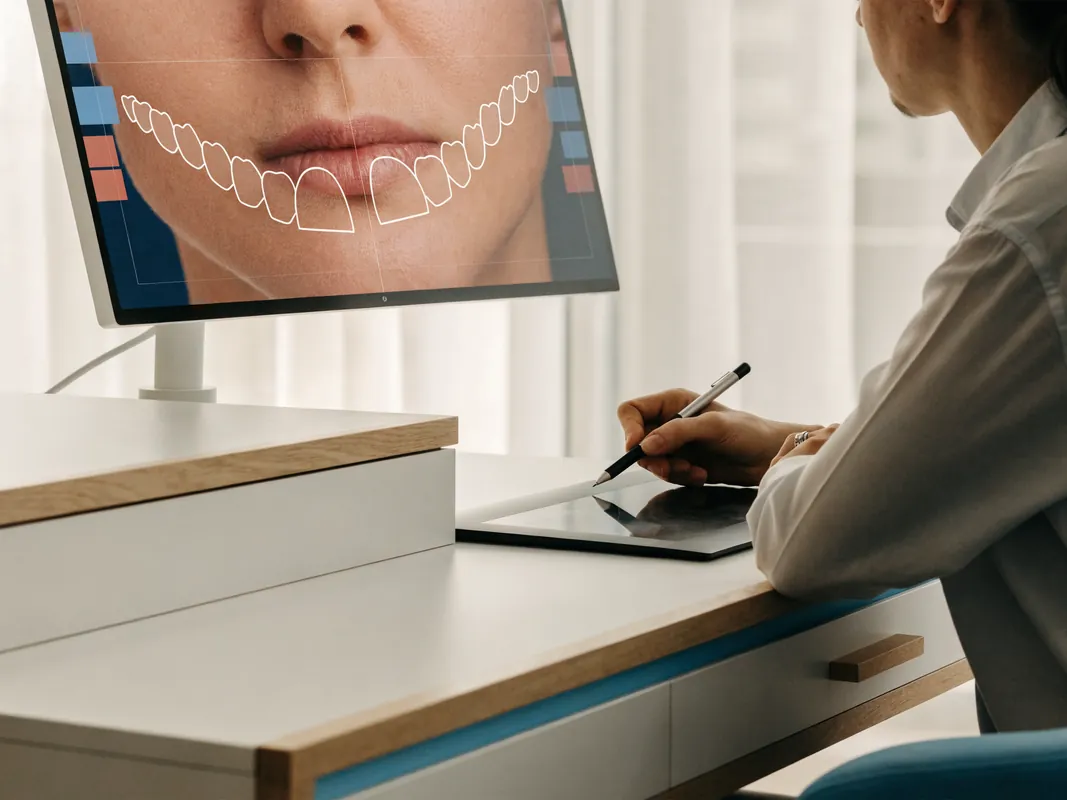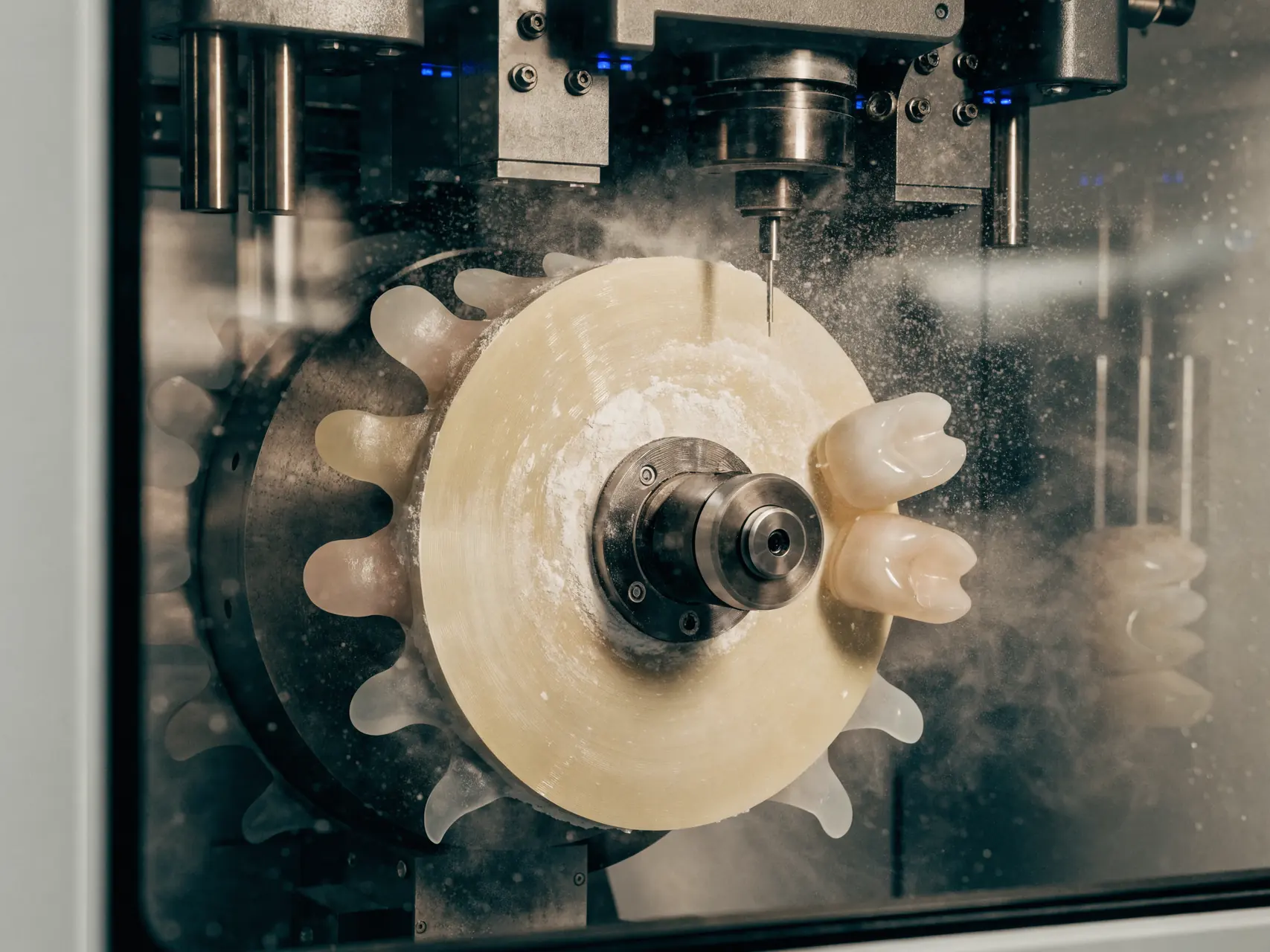
Imagine comparing a front crown with the neighbouring tooth in a bathroom mirror. Under one light they seem close; beside a window the crown looks flatter, and in a photograph it appears warmer. Whitening gel will not correct the ceramic. Ordering a new crown from a phone photograph may reproduce a second mismatch. The useful task is not simply “make both white”. It is to decide what should be treated, which natural teeth may be whitened, which restorations should remain, how shade will be recorded and who owns each irreversible step.
This guide is for adults researching zirconia crowns and whitening together, including people comparing care in Turkey with care near home. It does not diagnose a tooth, prescribe a whitening product or select a crown material. A remote photograph cannot show decay, gum disease, cracks, pulpal or root-canal problems, preparation quality, marginal fit, bite, sensitivity cause or every optical feature. Those questions require an individual clinical assessment by the named treating clinician.
The legal and clinical identities must be clear before records or money change hands. Ask for the named legal treatment provider, named treating clinician and, where laboratory work is involved, the laboratory or responsible fabricating party. A booking coordinator may pass information but does not examine teeth, prescribe whitening, prepare a tooth, approve a crown or obtain clinical consent. A marketing brand is not a substitute for those accountable names.
No fixed price, number of visits, shade change, service life or outcome is published here. The sequence depends on diagnosis, the location and condition of existing restorations, natural-tooth colour, whitening response, sensitivity, the planned crown and the opportunity for review. The purpose of the page is to help a patient demand a better written plan.
Natural teeth can lighten; zirconia and other ceramic restorations do not
Natural teeth can lighten; zirconia and other ceramic restorations do not. Whitening agents act on pigments within natural dental tissues. A crown, veneer, bridge unit, implant crown, ceramic inlay, composite filling or denture tooth is manufactured material. Its visible appearance may be affected by surface stain, plaque, glaze, polish, lighting and surrounding teeth, but whitening gel does not turn the restoration into a lighter manufactured shade.
The NHS teeth-whitening page explicitly distinguishes natural teeth from crowns, dentures and implants. This is the central sequencing fact. If natural teeth are lightened while an existing crown remains unchanged, the contrast may become more noticeable. If a new crown is fabricated before a planned whitening course is understood, its target may no longer fit the surrounding natural teeth afterwards.
That does not mean every patient should whiten before every crown. A crown may be needed urgently for structural or disease reasons. Whitening may be unsuitable, unwanted or irrelevant to the teeth visible beside it. A person may prefer the existing natural shade. Some natural teeth may not respond similarly because of their history, tissue, internal discolouration or restorations. The clinician should establish the objective rather than assume that “brighter” is always better.
It also does not mean a ceramic surface can never look cleaner. Professional cleaning, assessment of surface deposits, adjustment of a rough area or clinically appropriate repolishing may change how a restoration reflects light. Those are surface-management decisions, not bleaching. They should not be sold as whitening the ceramic itself.
A useful tooth map identifies, for every visible unit:
- natural tooth tissue that might respond to whitening;
- composite or other direct restorative material that will not change in the same way;
- ceramic or metal-ceramic crowns and veneers;
- implant-supported restorations;
- temporary restorations;
- teeth with internal discolouration or previous root-canal treatment;
- teeth whose colour is altered by decay, cracks, wear, translucency or underlying structure;
- units outside the intended aesthetic zone that still affect the overall appearance.
The map converts an ambiguous request into a patient-specific question. It also helps prevent surprise expenditure. If a visible filling or old crown may look different after whitening, the patient should know before starting, not after comparing photographs.
Separate existing crowns from planned crowns
Existing crowns and planned crowns create different decisions. An existing crown should first be assessed for health, fit, surface condition, function and appearance. A planned crown requires a diagnosis, tooth-preservation analysis, material choice, preparation design, laboratory prescription and try-in process. Mixing these categories can turn a modest colour concern into unnecessary replacement work.
For each existing crown, ask:
- Is the supporting tooth or implant healthy?
- Is the crown margin clinically acceptable?
- Is there recurrent decay, inflammation, fracture, loosening or another functional problem?
- Is the concern deposited stain, loss of polish, contour, opacity, value, hue, translucency or fluorescence?
- Does the crown mismatch in all lighting or only in a particular photograph?
- Could cleaning, adjustment, repair or repolishing address the actual problem?
- What biological and structural cost would removal create?
- If replacement is considered, what evidence supports it?
For each planned crown, ask a separate set of questions:
- Why does the tooth need full coverage?
- What tooth-preserving alternatives were considered?
- Is whitening part of the patient's chosen objective or merely assumed?
- Which neighbouring teeth define the intended appearance?
- What optical limitations arise from the prepared tooth, core, post or discolouration beneath the crown?
- Which zirconia family and laboratory design are being proposed, and why?
- How will shade, texture, form and translucency be communicated?
- What happens if the try-in does not meet the agreed clinical and aesthetic criteria?
A plan may leave sound existing crowns alone while creating a new crown elsewhere. It may repair a direct restoration after whitening without touching a ceramic crown. It may decide that replacement is justified for one crown but not another. A tooth-by-tooth rationale is more credible than a blanket statement about the whole smile.
Diagnosis and tooth preservation before shade planning
Shade planning must not hide the reason a crown is being proposed. NHS dental-treatment information explains that crowns cover a real tooth and that the tooth is shaped to receive the restoration. Preparation is irreversible. Before discussing colour, the clinician should diagnose why full coverage is needed and whether a less invasive option can meet the clinical objective.
Possible findings include substantial loss of tooth structure, a crack, an existing large restoration, wear, fracture, altered shape, previous root-canal treatment, recurrent decay or a failing existing crown. None automatically proves that zirconia is the correct material or that a crown is the only option. Depending on the examination, alternatives might include monitoring, preventive care, a direct restoration, repair, an onlay or another partial-coverage restoration, orthodontic movement, whitening alone, replacement of a smaller restoration, or no cosmetic intervention.
The clinician should record remaining sound tooth tissue, the condition of the pulp and roots, periodontal support, bite, parafunction, available space and the reason for any proposed preparation. If a tooth may be maintained with less tissue removal, the patient deserves that comparison. If full coverage is clinically justified, the explanation should distinguish structural need from aesthetic preference.
Tooth preservation also matters when an existing crown is removed. Removal can expose an already prepared tooth, reveal decay or fracture, damage remaining tissue, or require a different restoration than expected. A remote quote cannot establish what will be found. The written plan should state which parts are provisional and how renewed consent works if the diagnosis changes.
A second opinion is reasonable before broad preparation of previously unrestored teeth, removal of clinically serviceable crowns, extensive bite changes or a proposal driven mainly by a package label. The aim is not to reject aesthetic care. It is to make sure appearance is pursued with the least irreversible treatment compatible with the diagnosis and informed preference.
Stabilise caries, periodontal and endodontic disease
Stabilise caries, periodontal and endodontic disease before treating shade as the main problem. Whitening chemicals and definitive ceramics do not treat decay, active gum inflammation, an abscess, a cracked root or an unresolved pulpal problem. A new crown placed into an unstable oral environment may make diagnosis, cleaning or future access more difficult.
The examination should include caries assessment, existing filling and crown margins, gingival condition, periodontal screening, mobility, symptoms, vitality or endodontic assessment where indicated, and the condition of the bite. Radiographs or other tests should answer documented questions. Imaging should not be ordered merely because it appears in a sales pathway.
Bleeding or inflamed gums can distort the appearance of tooth length and margin position. Recession may expose darker root surfaces. Periodontal treatment can change the gingival frame around a crown. Selecting a final contour or shade before the tissues are adequately assessed can make the laboratory prescription unstable. The clinician should explain what requires treatment and how readiness for the next stage will be judged; this page sets no fixed healing calendar.
Endodontic status matters because a non-vital or root-filled tooth may have an internal colour issue and different restorative needs. External whitening of surrounding natural teeth may not resolve that tooth's appearance. Internal whitening, restorative masking, repair or another option requires a diagnosis and its own consent. A website must not prescribe one route.
Urgent pain, swelling, fever, trauma, uncontrolled bleeding or a rapidly worsening problem belongs to urgent or emergency care, not a cosmetic itinerary. In England, use a local dentist, NHS urgent pathway or emergency service according to the symptoms. Elsewhere, use the local urgent and emergency system. Do not wait for a distant shade consultation when clinical disease may be active.
Whitening suitability and sensitivity
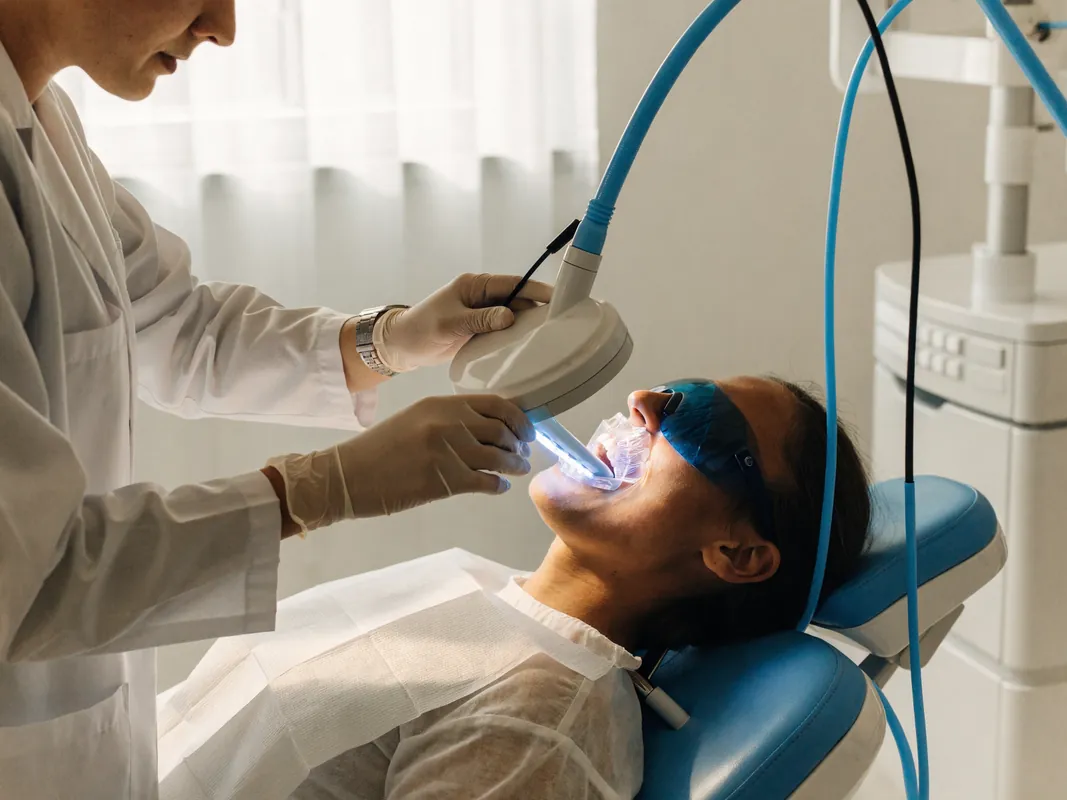
Whitening suitability and sensitivity require an examination. The GDC patient information says a dentist should assess a person before tooth whitening in the UK. NHS information also advises checking that teeth and gums are healthy and describes sensitivity and soft-tissue irritation as possible effects. The relevant professional should ask about symptoms, exposed dentine, recession, cracks, decay, restorations, previous whitening, allergies, oral conditions, medicines and the patient's expectations.
Sensitivity is not a simple yes-or-no history. Ask which teeth are sensitive, what triggers it, whether it lingers, whether there is pain on biting, and whether the pattern has changed. A new symptom may require diagnosis before any cosmetic treatment. The clinician should explain the chosen product route, supervision, instructions, foreseeable effects, what to do if symptoms arise and when to stop and seek review. This guide gives no product dose or personal regimen.
The likely visual response also varies. Natural teeth may begin at different shades or have different causes of discolouration. Enamel thickness, dentine colour, age, previous trauma, fluorosis, internal staining, restorations and dehydration can affect appearance. A responsible plan describes uncertainty rather than promising a predetermined shade.
The patient's goal should be expressed in ordinary language before it is translated into shade records. Is the aim to reduce a yellow cast, soften contrast with an existing restoration, refresh the overall smile, or create a lighter reference for planned crowns? Is a natural variation acceptable? Does the patient want to keep a characteristic or avoid an opaque look? Those preferences help the clinician and laboratory interpret measurements.
Whitening should not be used as an automatic precondition for crown treatment. A patient may decline it after understanding the options. The alternative could be matching a new restoration to the current natural teeth, limiting treatment, or revisiting the plan later. Consent includes the right to choose a less extensive objective.
UK legal-provider and examination boundary
In the United Kingdom, the GDC states that tooth whitening is the practice of dentistry and should follow assessment by a registered dentist and a dentist's prescription. Its position statement and illegal-practice information explain the roles of registered dental professionals and refer to the applicable UK legal framework. The Cosmetic Products (Safety) (Amendment) Regulations 2012, UK statutory instrument 2012/2263, set product restrictions and conditions in the UK context.
This GDC position applies to UK dental professionals and is not a claim about Turkish law. A provider in Turkey must identify the law, registration and professional rules that apply there; the patient should verify those matters through current official Turkish sources or independent advice. UK registration does not regulate a Turkish procedure merely because the patient lives in Britain, and a Turkish business name does not prove a particular person is legally authorised to provide whitening.
For treatment in the UK, check the professional on the GDC's register and confirm who assessed, prescribed and will carry out or supervise the whitening. For treatment abroad, ask the destination provider for the responsible dentist's full name, registration authority and number, legal treatment-provider identity, address and complaint route. Verify rather than relying on a logo or screenshot.
Product legality and professional authority are related but distinct. A product being sold online does not establish that it is appropriate, compliant or suitable for self-directed use. The Office for Product Safety and Standards published a report in 2025 about a home-whitening toothpaste presenting a serious chemical risk and being rejected at the border. That report concerns a specific product; it does not prove that every retail product is unsafe. It does demonstrate why packaging and marketing should not replace professional assessment and current regulatory checks.
Patients considering cross-border care should ask which jurisdiction governs the clinical contract, where a complaint is made, what indemnity applies and how records can be obtained. These are verification questions, not legal conclusions. Obtain independent legal advice if the answer matters to a significant decision.
Sequence options after diagnosis
There is no single sequence for every mouth. A useful plan selects among several pathways after diagnosis, tooth preservation and whitening suitability are established.
Pathway A: planned crown and chosen whitening of adjacent natural teeth
The clinician documents baseline shade and restoration map, completes necessary disease control, supervises the chosen whitening pathway, reassesses the natural teeth when clinically appropriate, then records the laboratory prescription for the planned crown. Preparation, provisional care, laboratory communication and try-in remain separate consent gates. The order is logical because the ceramic is made to a post-whitening reference rather than expecting it to change later.
Pathway B: existing crown is healthy and the patient accepts possible contrast
The patient may choose whitening while retaining a sound crown. The clinician should explain that natural teeth may change and the crown will not bleach. The patient can decide whether the possible mismatch is acceptable. No promise should be made that a later replacement will be necessary.
Pathway C: existing crown has a surface or maintenance problem
The clinician diagnoses whether deposits, roughness, loss of polish, contour or another issue is responsible. Cleaning, repair, adjustment or repolishing may be considered if clinically appropriate. Whitening natural teeth remains a separate choice. Replacement is considered only if supported by the condition, appearance objective and informed balance of risks.
Pathway D: urgent structural care cannot wait for cosmetic planning
A damaged or diseased tooth may need timely protection or treatment. The clinician can explain provisional and definitive options without forcing a cosmetic programme. Shade choices may be revisited when the clinical situation permits. Patient safety takes priority over an idealised sequence.
Pathway E: whitening is unsuitable or declined
The new restoration can be planned against the current natural teeth, subject to the material and optical limits explained by the clinician and laboratory. The absence of whitening is not a treatment failure. It is a valid preference or clinical decision.
Pathway F: broader diagnosis changes the proposed treatment
The examination may show that a crown is not needed, another material is more appropriate, an existing crown can remain, or disease treatment should come first. A high-quality pathway allows the plan to become smaller or stop. A deposit should not make the original proposal inevitable.
The written plan should say which pathway is intended, what remains provisional and who may change it. It should also state what the patient can choose if whitening response or crown appearance differs from the initial discussion.
No universal shade-stabilisation interval
No universal shade-stabilisation interval can be promised for every whitening system, tooth, patient and measurement method. Immediately after treatment, dehydration and short-term optical change may affect appearance. Later colour can also be influenced by rehydration, the underlying tissues, exposures and the way measurements are taken. The clinician should choose the reassessment point based on the actual whitening pathway, symptoms, records and laboratory needs.
A claim such as “the final shade is always ready after a fixed number of days” should trigger questions. What product and protocol was used? Were the teeth dehydrated? Is the proposed record provisional or the definitive laboratory prescription? Will the same lighting, camera settings and reference tabs be used? What happens if the patient or clinician considers the colour unsettled?
Avoid booking irreversible preparation or final manufacture around a generic calendar before the treating clinician has assessed the teeth. The plan may reserve flexibility for review without promising a particular interval. If travel makes a second in-person shade assessment difficult, compare the risk of compressing the sequence with local whitening, local shade recording, staged travel or the no-travel option.
The absence of a universal interval does not mean sequencing is arbitrary. It means the clinician documents the whitening completion, symptoms, shade records, hydration conditions and reason for proceeding. Consistency in measurement is more useful than an unsupported countdown.
Zirconia is a material family, not one optical formula
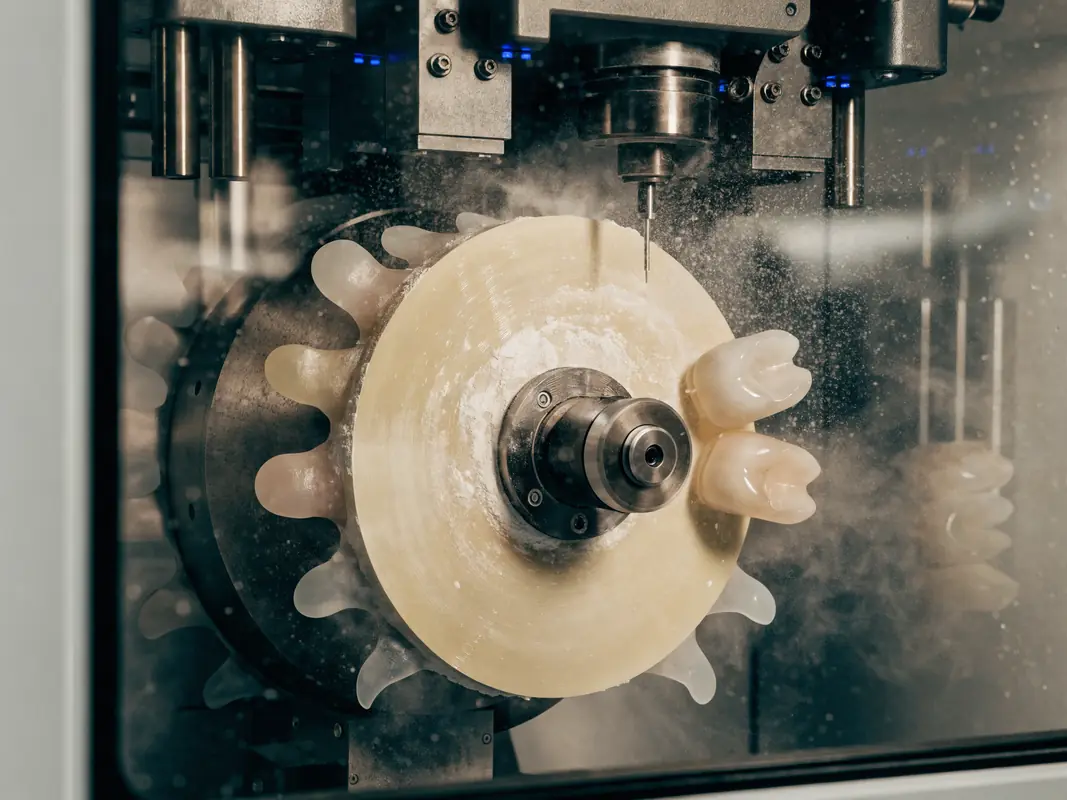
Zirconia is a material family, not one optical formula. Dental zirconia products differ in composition, phase distribution, translucency, opacity, strength, pigmentation, multilayer construction, thickness requirements, surface treatment and laboratory processing. A generic statement that “zirconia looks natural” does not specify what is being prescribed.
The 2025 systematic review and meta-analysis indexed as PubMed 39972972 and available as PMC7617540 examines how colouring pigments can affect zirconia's optical and other properties. It highlights variation rather than a single universal appearance. In-vitro material findings cannot predict one person's clinical result, but they support asking for the material family, laboratory process and optical strategy in the written prescription.
The prepared tooth or implant abutment beneath a crown can affect the visual challenge. A dark substrate may require masking; a highly opaque restoration may look flatter beside translucent natural teeth. Greater translucency may reveal underlying colour. Thickness, surface texture, polish, glaze, stain, cement and lighting can also influence perception. The clinician and dental technician must balance optical and structural requirements for the specific site.
Do not treat the word zirconia as a quality grade. Ask:
- What material category and manufacturer specification are proposed?
- Is the restoration monolithic, layered or otherwise characterised?
- What evidence supports the choice for this tooth and bite?
- What thickness and preparation are required?
- How will the underlying tooth or abutment colour be managed?
- How will surface texture and translucency relate to neighbouring teeth?
- What repair and maintenance options exist?
- What material and batch records will be supplied?
The answer may lead to a different ceramic or restorative design. This guide does not rank materials. Material selection is a clinical and laboratory decision made after the tooth, bite, aesthetic zone, substrate and patient priorities are known.
Photography, scans and lighting
Photography, scans and lighting each capture different information. A casual phone image is affected by automatic white balance, exposure, screen settings, compression and ambient light. It may support an initial conversation but should not be the sole laboratory instruction for a visible crown.
A structured photographic record can include a neutral facial view, smile, retracted teeth, close-up of the target and neighbouring teeth, and reference images with physical shade tabs. Cross-polarised photography may reduce surface reflections when the team is trained to use it. Camera settings, lighting and reference objects should be consistent enough for comparison. The laboratory needs to know when photographs were taken in relation to whitening and hydration.
Digital scans record shape and spatial relationships, not a complete objective truth about colour. Scanner colour rendering varies and can be influenced by calibration, ambient conditions, scanning path and software. A scan may help design contacts, contours and occlusion while photographs and physical references carry additional shade information.
Lighting changes perceived shade. Daylight, surgery lights, warm indoor lamps and phone screens can make the same crown appear different. Metamerism describes objects matching under one light but not another. The try-in should consider more than one relevant viewing condition where practical. The patient should understand that no material copies every optical behaviour of natural enamel and dentine.
Dehydration can make teeth appear lighter and more opaque. Long appointments with teeth isolated or the mouth open can therefore distort shade selection. The team should record the conditions and avoid treating a dehydrated appearance as a stable target. This page gives no fixed waiting period; it asks for documented clinical judgement.
Spectrophotometer, physical shade tabs and human judgement
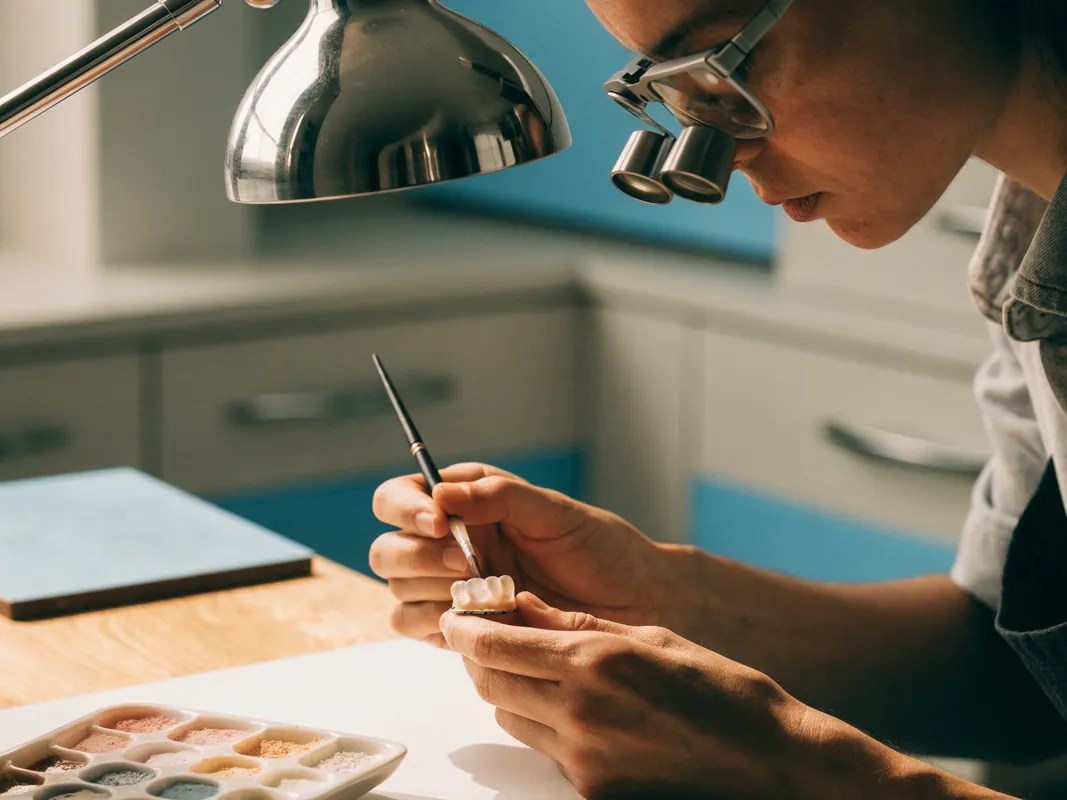
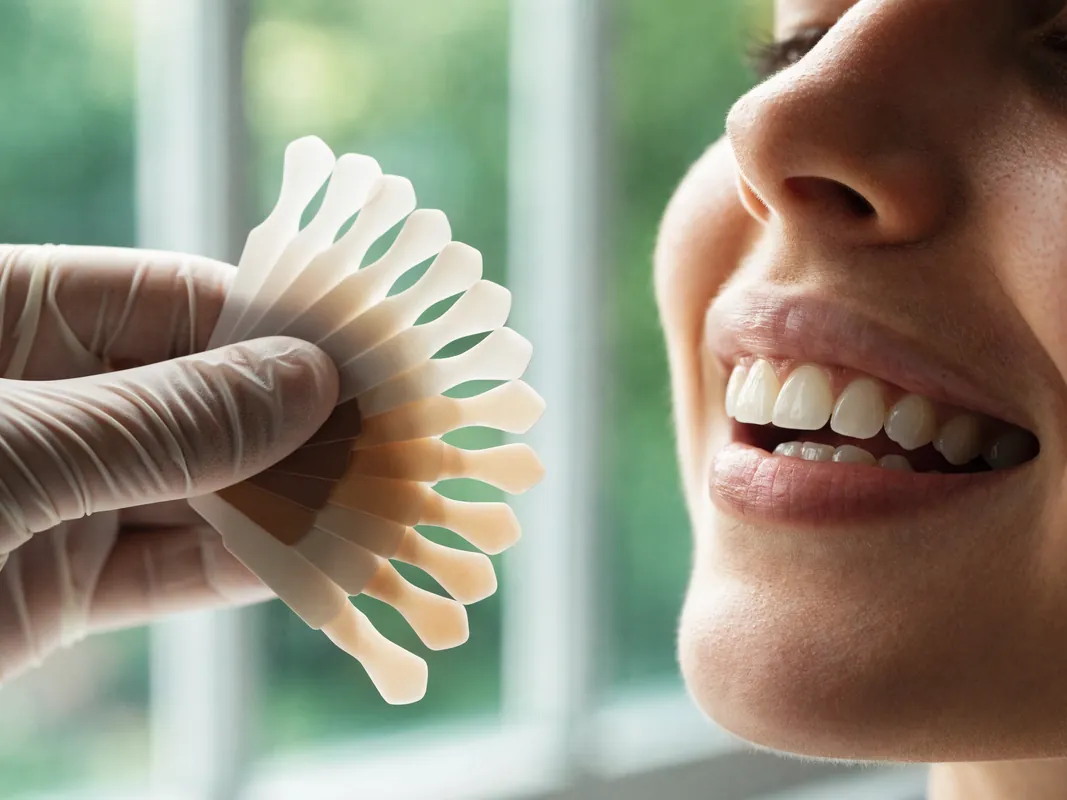
A spectrophotometer, physical shade tabs and human judgement can complement one another. None is infallible. An instrument can provide repeatable colour coordinates within its method, but positioning, calibration, surface curvature, translucency and ambient conditions affect readings. A physical tab provides a common laboratory reference but may not reproduce all characteristics of a natural tooth. Human observers see form, texture and context but are influenced by lighting, fatigue and adaptation.
Use multiple records when the aesthetic demand is high. A sensible shade record may include:
- baseline and post-whitening instrument readings taken under recorded conditions;
- photographs with identified physical tabs beside the target area;
- notes on value, hue, chroma, translucency, opacity, surface texture and characterisation;
- the underlying tooth or abutment shade;
- the provisional restoration and patient feedback;
- the planned zirconia family, thickness and layering or staining approach;
- agreed limits and aspects still to be evaluated at try-in.
The aim is not to produce a magical number. It is to make the prescription reproducible and intelligible to the laboratory. If two measurement methods disagree, the clinician and technician should investigate rather than choosing whichever supports the sale.
The patient should see the relevant reference and explain preferences in ordinary language. Some want a softer, age-compatible appearance; others prioritise brightness. The clinician must explain feasibility and biological cost. Consent is not valid if the only promised outcome is an edited image.
Laboratory prescription and traceability
The laboratory prescription and traceability record connect the clinical plan to manufacture. Ask which laboratory will fabricate the restoration, who writes the prescription, who approves the design and how questions are resolved. If subcontracting is possible, ask how the responsible provider tracks it.
A written shade prescription should identify the patient and tooth, restoration type, material specification, substrate, photographs and reference tabs, contour and contact requirements, surface texture, translucency or masking objective, and any characterisation. It should state whether the record was made before or after whitening and whether it is provisional.
Traceability should include the material and component information reasonably needed for future care. Keep the laboratory docket, material declarations supplied to the clinic, scan files where available, clinical photographs, preparation record and final invoice. A local dentist may need these if a crown chips, loosens, becomes uncomfortable or requires replacement.
The clinician remains responsible for the clinical prescription and fit even when a technician fabricates the crown. “The laboratory chose it” is not an adequate explanation for an unapproved change. Conversely, the technician needs adequate records; they cannot be expected to infer a complex shade from a compressed message.
Ask how remakes or adjustments are authorised and who pays under the written commercial terms. Keep that separate from clinical urgency. A patient with pain, swelling or bite trauma should receive assessment rather than waiting for a laboratory dispute.
Try-in is a clinical consent gate
Try-in is a clinical consent gate, not a ceremonial preview. Before definitive fitting, the clinician should assess seating, marginal adaptation, contacts, occlusion, contour, tissue relationship and the appearance under relevant conditions. The patient should have an opportunity to view and discuss the restoration before an irreversible bonding or cementation step, within the practical limits of the material and procedure.
Shade is only one part of the decision. A crown can look acceptable yet have a poor contact or heavy bite. It can fit mechanically while appearing too opaque. The clinician must combine biological, functional and aesthetic findings. If an adjustment changes the surface, the finishing and polishing process matters.
The consent discussion should clarify which changes remain possible at try-in and which would require laboratory work or a new restoration. A patient should not be pressured to accept because travel is ending. The written itinerary should contain contingency for clinical review rather than assuming every crown will be fitted at the first presentation.
Temporary try-in materials and lighting may alter appearance. The clinician should explain these limitations. Photographs can document the discussion, but a flattering angle is not proof of fit. The final record should state what was accepted, what adjustments were made and which clinician fitted the crown.
If the patient declines the appearance or the clinician finds a clinical problem, pause. Renew the plan and quote if needed. Consent remains valid only while the patient understands and agrees to the actual proposal.
Repair, repolish or replacement of an existing crown
Repair, repolish or replacement of an existing crown should follow diagnosis. Surface stain or roughness may respond to professional cleaning or a material-appropriate finishing process. A localised defect may sometimes be repairable. A crown with recurrent decay, fracture, poor fit, persistent symptoms or unacceptable function may require a different intervention. Colour mismatch alone is an aesthetic concern whose benefit must be weighed against removal risks.
Repolishing is not a universal cosmetic reset. The clinician must identify the material and surface condition, select a compatible technique and avoid damaging anatomy or increasing roughness. Glaze, stains and layered ceramic may behave differently. An untrained attempt can worsen the appearance or surface.
Repair may add another material with its own colour, ageing and bond limitations. The patient should know whether the repair is expected to be visible, how it will be maintained and what alternatives exist. The term repair should not conceal an uncertain short-term compromise.
Replacement requires removal of the existing restoration and assessment of what lies beneath. That can expose decay, insufficient tooth structure, a core, post, crack or other finding not visible beforehand. The quote and consent should address that uncertainty. The patient should not be told in advance that every visible crown requires replacement merely because natural teeth may be whitened.
If the crown is on an implant, component identification and implant-system records are important. The clinician should not damage a serviceable component by guessing. Local availability of compatible parts may influence the handover plan.
Irreversible preparation and biological risks
Irreversible preparation and biological risks must be explained before aesthetic enthusiasm narrows the choices. NHS information states that a tooth is shaped to receive a crown. Removing sound tissue cannot be undone. Depending on the tooth and procedure, foreseeable concerns may include sensitivity, pulpal injury, need for further treatment, fracture, loss of retention, decay at margins, periodontal inflammation, bite problems, ceramic fracture or eventual replacement. The named clinician should discuss the material risks relevant to the individual case.
Whitening has a different risk profile. NHS information lists sensitivity and irritation among possible effects. A person may be unhappy with the amount or pattern of colour change. Existing restorations may become more visible. Combining whitening and crowns accumulates decisions; it does not merge the risks into a simple cosmetic package.
Ask for a tooth-by-tooth preparation rationale. A diagnostic design or provisional restoration may help evaluate form and function, but it cannot remove biological uncertainty. Digital simulation can support communication without proving how tissues or ceramic will behave.
The clinician should also consider the bite and habits such as grinding. A crown selected only for colour may fail to address functional loading. Protective appliances, if considered, require an individual indication and should not be promised as a universal solution.
Consent without a promised shade
Consent without a promised shade is honest consent. GDC Principle 3 requires UK registrants to explain options, risks, potential benefits and costs, check understanding and keep consent valid at each stage. These standards regulate UK professionals; they can also serve as useful questions for a patient assessing any provider without implying that they govern treatment abroad.
The patient should receive:
- the diagnosis for each tooth;
- tooth-preserving and no-treatment alternatives;
- the whitening options and why a particular route is considered suitable;
- foreseeable sensitivity and irritation information;
- an explanation that restorations do not bleach like natural teeth;
- material choices and optical limits for the crown;
- the proposed sequence and what may change it;
- preparation, provisional and try-in stages;
- material risks and maintenance needs;
- provider and laboratory identities;
- the itemised quotation and cancellation terms;
- aftercare, complaint and remedial pathways;
- privacy and record-sharing information.
An edited smile image is not consent. A physical shade tab is not an outcome promise. The patient may approve an objective and still decline an irreversible procedure after learning its cost to tooth tissue. Consent should be renewed when findings, material, scope, quote or sequence changes.
Interpretation matters. If the patient and clinician do not share a language comfortably, arrange competent support. The person must be able to ask about colour, risks and alternatives, not merely sign a translated summary.
Maintenance, staining and review
Maintenance, staining and review continue after whitening and crown fitting. Natural teeth can darken or accumulate stain over time. Ceramic may collect surface deposits or change in surface quality. Gums may recede, revealing margins or root surfaces. Fillings beside a crown can require maintenance. None of this can be predicted from the initial shade photograph.
Ask how to clean around the crown margin and between teeth, how periodontal health will be monitored and who reviews the bite. The clinician should give instructions specific to the restoration and oral health. Abrasive products or unverified whitening products can damage tissues or surfaces; do not assume a product is appropriate because it is advertised for crowns.
Future whitening of natural teeth should be discussed with a dentist who can assess the mouth and consider the existing restorations. The crown will not follow the natural tooth colour change. This does not automatically require replacement; it requires informed choice.
Professional maintenance records should note periodontal findings, crown condition, symptoms, cleaning access and changes in appearance. Compare photographs only when the capture conditions are meaningful. A phone filter can manufacture a problem or hide one.
Records and local handover
Records and local handover are essential when treatment is split between countries or providers. GDC Principle 4 sets record expectations for UK registrants, including accurate clinical and medical information. A patient should ask any destination provider for enough information to support continuing care.
Keep copies of:
- medical and dental histories supplied;
- examination findings and diagnosis;
- radiographs, scans and reports;
- baseline and post-whitening shade records;
- photographs with reference information;
- whitening prescription and patient instructions;
- the tooth-by-tooth treatment plan;
- preparation and provisional records;
- the written shade prescription;
- laboratory and material traceability;
- try-in, adjustment and fitting notes;
- aftercare and maintenance instructions;
- invoices, complaint route and commercial terms.
Identify a local dentist before travelling. Ask whether they are willing to assess and maintain work planned elsewhere; do not assume. Send records securely and with consent. A local clinician may need an examination rather than photographs if there is sensitivity, pain, a bite problem, gum inflammation, loosening or fracture.
Remote review can assist communication but cannot test a tooth, examine a margin fully, measure periodontal tissues or adjust the bite. The destination clinic should provide a direct clinical contact, not only a booking chat. The patient should know which problems require local care immediately.
Travel and the no-travel option
Travel and the no-travel option should be compared before committing to a compressed sequence. Local treatment may make repeat shade assessment, sensitivity review, provisional adjustment and laboratory communication easier. Overseas treatment may offer different costs or availability but adds handover, travel-change and urgent-access dependencies. Neither location is automatically better.
Ask what is genuinely confirmed before travel. A photo-based estimate may be provisional. The clinician may decide that whitening is unsuitable, a crown is unnecessary, disease treatment must come first or another material is preferable. Flights and accommodation should not turn those findings into pressure to proceed.
Consider pathways such as local whitening followed by destination crown assessment, complete local care, destination assessment before deciding, or staged treatment with records exchanged. The clinical teams should agree who owns each step. Do not rely on a coordinator to interpret shade or symptoms.
Build contingency for a delayed laboratory step, a crown that is not accepted at try-in, sensitivity requiring review or a plan that becomes smaller. Travel insurance should be checked directly with the insurer. This guide makes no statement about coverage, fitness to fly or immigration rules.
Before returning home, obtain the clinical review and complete record set. Know how to access local urgent dentistry. The no-travel option remains valid at every decision gate, including after a remote quotation.
Itemised quotation and commercial terms
An itemised quotation and commercial terms make the sequence auditable. Separate examination, imaging, disease control, whitening assessment, whitening treatment, provisional restorations, crown preparation, laboratory work, try-in, fitting, review and maintenance. Mark provisional items and the findings that activate them.
For an existing crown, separate cleaning, repair, repolishing and replacement options. For a planned crown, identify material specification, laboratory work and any additional foundation treatment. State whether a remake, adjustment or changed plan creates a new charge and who authorises it.
The quotation should name the payment recipient and legal provider, currency, cancellation terms, refund conditions, complaint process and the boundary between clinical and non-clinical services. It must not convert an uncertain biological or aesthetic response into a commercial certainty.
Compare the total care pathway: local examinations, record production, maintenance, possible repeat travel and contingency. Do not treat a headline figure as the full cost when essential steps are excluded. Obtain the final dated plan before irreversible treatment.
Red flags in a whitening-and-crown proposal
Pause and seek clarification or another opinion if a proposal:
- claims ceramic crowns will bleach with natural teeth;
- orders crowns from a casual phone image without examination or shade references;
- recommends crown preparation before diagnosing the tooth;
- treats every visible tooth as an automatic crown unit;
- says all existing crowns require removal solely because whitening is discussed;
- promises a predetermined shade or appearance;
- uses a fixed shade-settling calendar without considering the actual pathway;
- markets light activation as proven superior without discussing evidence;
- does not name the legal provider, treating clinician or laboratory;
- hides material family and traceability behind the word zirconia;
- provides no periodontal, caries or endodontic assessment;
- has no try-in or refusal pathway;
- pressures acceptance because travel is ending;
- offers no local handover, records or urgent route;
- merges clinical fees into an opaque headline price;
- cannot explain complaint and remedial terms.
A red flag is a reason to investigate, not proof of misconduct. Ask for the missing evidence in writing. If the provider cannot supply it, choose a safer pathway.
Questions to ask the named clinician
- What is your name, registration, clinical role and direct contact?
- What is the legal identity and address of the treatment provider?
- What diagnosis supports each proposed crown?
- Which teeth can be preserved with less invasive care?
- Which existing restorations will not change with whitening?
- Is whitening suitable after examining my teeth and gums?
- What sensitivity or soft-tissue effects should I understand?
- Which disease-control work must happen first?
- Which sequence option are you proposing and why?
- How will you decide when shade is ready to record without relying on a universal interval?
- Which zirconia family and design are proposed for each tooth?
- How will the underlying tooth or abutment affect appearance?
- What photographs, scans, instrument readings and physical tabs will be used?
- Who writes the written shade prescription?
- Which laboratory will fabricate the crown?
- What material and batch traceability will I receive?
- What can be changed at try-in, and what requires a remake?
- What happens if I decline the appearance before fitting?
- Could an existing crown be cleaned, repaired or repolished instead of removed?
- What are the preparation and long-term maintenance risks?
- Who provides local review and urgent assessment after I return?
- What is provisional in the itemised quotation?
- What are the cancellation, complaint and remedial terms?
- What local-care and no-travel alternatives should I compare?
Shade-planning checklist
Before whitening
- Verify the named legal treatment provider and named treating clinician.
- Complete the necessary clinical examination.
- Map natural teeth, direct restorations, ceramic crowns, veneers and implant crowns.
- Diagnose caries, periodontal, endodontic, structural and sensitivity concerns.
- Compare tooth-preserving alternatives.
- Record baseline shade under documented conditions.
- Agree the patient's objective without promising a shade.
- Confirm provider authority and product pathway under the applicable jurisdiction.
After the chosen whitening pathway
- Record completion and any symptoms.
- Reassess when clinically appropriate rather than by a universal countdown.
- Capture consistent photographs and physical references.
- Use instrument readings as one input, not an automatic verdict.
- Review whether existing restorations now create a concern.
- Renew the treatment plan and consent if the scope changes.
Before crown manufacture
- Confirm the crown diagnosis and preparation rationale.
- Confirm the intended zirconia family or other material.
- Record substrate, optical objective and structural requirements.
- Name the laboratory and prescribing clinician.
- Send the written shade prescription, photographs, scans and references.
- Mark unresolved questions and provisional decisions.
At try-in and fitting
- Assess fit, margins, contacts, bite, contour, tissues and appearance.
- View the restoration under relevant lighting where practical.
- Give the patient an opportunity to ask questions and decline.
- Record adjustments and consent before definitive fitting.
- Supply material and laboratory traceability.
After treatment
- Provide individual hygiene and maintenance instructions.
- Supply the full clinical and shade record.
- Confirm direct clinical and local-dentist contacts.
- Explain urgent symptoms and examination boundaries.
- Keep the complaint and remedial pathway in writing.
Sources and review dates
This guide was reviewed against the following official and primary sources on 29 August 2026. Guidance, law and product alerts can change; clinicians and patients should check current versions in the relevant jurisdiction.
- General Dental Council, Tooth Whitening Position Statement, dated 11 July 2016 and accessed 29 August 2026: UK professional and product-law position, registration, assessment and indemnity boundaries. https://www.gdc-uk.org/docs/default-source/what-is-the-legal-position/tooth-whitening-position-statement.pdf
- NHS, Teeth whitening, accessed 29 August 2026: natural teeth versus crowns, dentures and implants; examination; supervision; sensitivity and soft-tissue effects. https://www.nhs.uk/tests-and-treatments/teeth-whitening/
- General Dental Council, Tooth whitening and illegal practice, accessed 29 August 2026: UK registered-professional and dentist-assessment boundary. https://www.gdc-uk.org/standards-guidance/information-for-patients-public/tooth-whitening-and-illegal-practice
- Cosmetic Products (Safety) (Amendment) Regulations 2012, UK statutory instrument 2012/2263, accessed 29 August 2026: UK product restrictions and dental-practitioner conditions. https://www.legislation.gov.uk/uksi/2012/2263/pdfs/uksi_20122263_en.pdf
- Maran and colleagues, Different light-activation systems associated with dental bleaching, systematic review and network meta-analysis, published 2019 and accessed 29 August 2026. Light activation was not shown to be superior to light-free in-office bleaching for colour-change efficacy in the included evidence. https://pubmed.ncbi.nlm.nih.gov/30767069/
- Gali and colleagues, Effect of Coloring Pigments on the Properties of Dental Zirconia, systematic review and meta-analysis, published 2025 and accessed 29 August 2026: variation in optical and other properties across pigmentation approaches and zirconia compositions. https://pubmed.ncbi.nlm.nih.gov/39972972/ Full text: https://pmc.ncbi.nlm.nih.gov/articles/PMC7617540/
- NHS, Dental treatments, page reviewed 8 July 2026 and accessed 29 August 2026: crown definition, tooth shaping and general treatment context. https://www.nhs.uk/live-well/healthy-teeth-and-gums/dental-treatments/
- Office for Product Safety and Standards, Product Safety Report 2502-0123, published 27 February 2025 and accessed 29 August 2026: a specific home-whitening product was assessed as presenting a serious chemical risk and rejected at the border. https://www.gov.uk/product-safety-alerts-reports-recalls/product-safety-report-home-teeth-whitening-diamond-white-toothpaste-2502-0123
- GDC Principle 2, Communicate effectively with patients, accessed 29 August 2026: written plans, cost information, complaints and emergency arrangements. https://standards.gdc-uk.org/pages/principle2/principle2
- GDC Principle 3, Obtain valid consent, accessed 29 August 2026: options, risks, potential benefits, costs, understanding and continuing consent. https://standards.gdc-uk.org/pages/principle3/principle3
- GDC Principle 4, Maintain and protect patients' information, accessed 29 August 2026: accurate records, confidentiality and information transfer. https://standards.gdc-uk.org/pages/principle4/principle4
- GDC, Going abroad for dental treatment, accessed 29 August 2026: provider checks, records, aftercare and complaint planning. https://www.gdc-uk.org/standards-guidance/information-for-patients-public/going-abroad-for-dental-treatment
The evidence supports examination, careful sequencing, transparent optical records and informed consent. It does not support a universal shade calendar, material slogan or promised appearance.