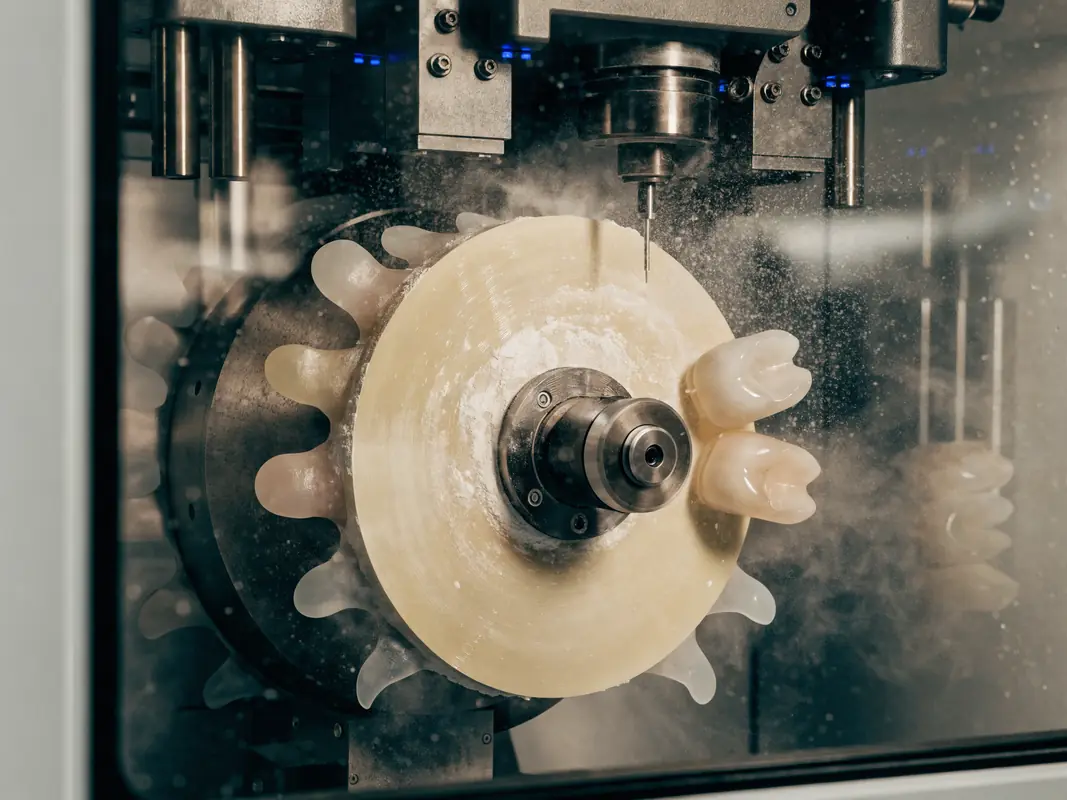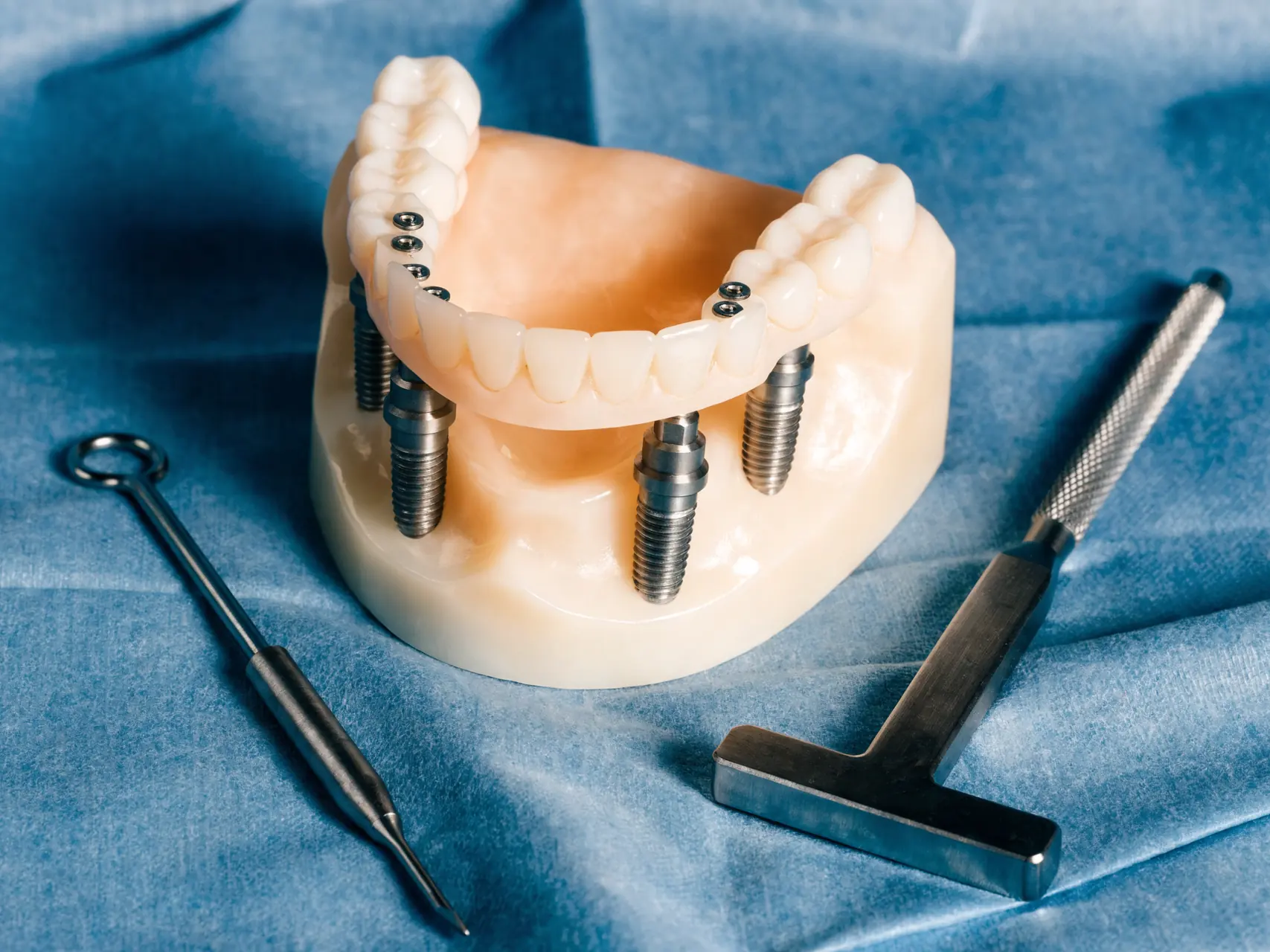
“All-on-4 versus individual implants” sounds like a comparison between two products. It is actually a decision between different rehabilitation strategies. A full-arch fixed concept replaces the teeth, and sometimes part of the missing gum contour, as one prosthetic system supported by distributed implants. A site-by-site strategy preserves the arch as a collection of individual teeth and spaces, using treatment, single crowns, short bridges, removable options or no replacement according to the prognosis of each site.
This page owns that strategic decision. It does not decide that four implants are appropriate, recommend extraction from a remote image, promise fixed teeth on the day of placement, rank a brand, or predict cost, duration or outcome. The decision needs an examination, diagnosis for each tooth and each arch, prosthesis-led planning, discussion of alternatives, and a written contingency if the preferred plan cannot be completed.
“Individual implants” also does not mean one implant for every missing tooth. One implant can support one crown, two or more implants can support a bridge, and some spaces may be restored with a tooth-supported bridge, removable prosthesis or not at all. “All-on-4” is used here as the familiar search term for a fixed complete-arch concept. It is not a rule that every arch needs exactly four implants, that tilted implants are required, or that every remaining tooth should be removed.
The useful comparison is therefore:
- full-arch fixed reconstruction: one complete-arch prosthetic plan supported by appropriately distributed implants; versus
- tooth- and site-specific rehabilitation: preserve teeth with a reasonable prognosis and replace selected missing or non-restorable sites using the least extensive suitable combination.
Both pathways can involve surgery, provisional restorations, laboratory work, maintenance, biological and mechanical complications, and later revision. Neither is “like having natural teeth again”. Natural periodontal tissues, an implant interface and a prosthesis do not behave identically.
Begin with diagnosis, not the number of missing teeth
A count such as “six missing teeth” cannot choose a plan. The same count can describe six adjacent posterior spaces, scattered spaces in both arches, a terminal dentition with widespread disease, congenital absence, trauma, or a stable arch with several long-standing gaps. Each creates different choices.
Build a diagnostic map with four layers:
- Person: health, medicines, smoking or nicotine exposure, previous treatment experience, capacity, dexterity, communication needs and ability to attend maintenance.
- Disease: caries, periodontal disease, peri-implant disease, infection, parafunction, erosion, mucosal conditions and any active process that could affect the plan.
- Tooth and site: restorability, periodontal support, endodontic status, cracks, root form, bone and soft-tissue anatomy, adjacent structures and aesthetic risk.
- Arch and system: missing-tooth pattern, ridge form, smile line, lip support, interarch space, opposing teeth or prosthesis, occlusion, speech, hygiene access and prosthetic material space.
The [Cambridge University Hospitals implant information](https://www.cuh.nhs.uk/patient-information/dental-implants-in-restorative-dentistry/) describes implants as one possible way to replace one or more teeth or support a denture and notes that crowns, bridges and dentures create different restorative processes. The [NHS denture page](https://www.nhs.uk/tests-and-treatments/dentures/) also lists bridges and implants as alternatives for missing teeth. These sources support an option set; they do not select a plan for a reader.
Define the treatment unit: tooth, segment or complete arch
Before comparing techniques, decide what clinical unit actually needs rehabilitation.
| Unit | Questions that own the decision |
|---|---|
| One tooth | Can it be restored? If not, should the space be replaced, and by implant crown, bridge, removable option or no treatment? |
| One segment | Can teeth at the boundaries support a bridge? Could implants support a short bridge? What span, anatomy, hygiene and load apply? |
| Several scattered sites | Are independent restorations sensible, maintainable and compatible with the bite? |
| Terminal dentition | Which teeth are truly non-restorable, which are strategic, and does preservation offer useful time or function? |
| Edentulous arch | Is a conventional denture, implant overdenture, fixed complete-arch prosthesis or another design appropriate? |
Moving from a tooth unit to a complete-arch unit is a major biological and prosthetic decision. It may involve extracting teeth that could otherwise remain, reshaping bone for restorative space, accepting a different cleaning method and transferring future function to a linked system. That decision needs more than a missing-tooth threshold.
Preserve restorable teeth before comparing implant layouts
A full-arch proposal must not make tooth preservation disappear. Ask for a tooth-by-tooth prognosis with the evidence behind each category. “Bad”, “failing” and “needs extraction” are conclusions, not diagnoses. The record should state the structural, periodontal, endodontic, restorative or strategic reason and the uncertainty.
For each remaining tooth, ask:
- What is the diagnosis?
- What findings support that diagnosis?
- Is the tooth currently painful, infected, mobile, fractured or functionally compromised?
- Can caries, periodontal disease or endodontic disease be treated?
- Is there enough sound structure for a maintainable restoration?
- What is the prognosis with treatment and maintenance?
- What is the consequence of keeping it for now?
- What is the consequence of extracting it now?
- Would preservation change the prosthetic plan, cost, travel burden or future options?
The systematic review on [tooth preservation versus extraction and implant placement](https://pubmed.ncbi.nlm.nih.gov/35794083/) found that both approaches can be viable in selected periodontally compromised cases and emphasised the limitations of the comparative evidence. It does not establish that every compromised tooth should be kept. It does show why automatic extraction is not an evidence-based shortcut.
Preservation may include periodontal treatment, endodontic treatment, restoration, splinting, monitoring or a staged plan. It can also be reasonable to conclude that a tooth is non-restorable. The important point is that the conclusion belongs to a documented clinical assessment and informed consent, not to the name of a package.
A second opinion is most valuable before irreversible extraction
When a proposal changes the whole arch, obtain an independent second opinion while the teeth and records are still available. Give the second clinician diagnostic-quality radiographs or scans, photographs, periodontal charting, medical history and the first written plan. Ask that clinician to identify disagreements about diagnosis, restorability, implant distribution, grafting, provisionalisation and maintenance.
Independence matters. A salesperson, coordinator or clinician working under the same commercial proposal is not an independent second opinion. The second opinion may agree with full-arch treatment; its value is in testing the reasoning and alternatives before an irreversible step.
The [GDC consent standard](https://standards.gdc-uk.org/pages/principle3/principle3) describes consent as an ongoing process for professionals it regulates, including discussion of options and material changes. Check the regulator and consent law that apply to each named clinician. A UK standard does not govern or endorse an overseas provider, but it supplies useful questions about explanation, voluntariness and records.
List every reasonable alternative on the same page
The comparison should include more than two columns. Depending on diagnosis, reasonable alternatives may include:
- monitoring or no immediate replacement;
- preserving and restoring strategic teeth;
- a resin-bonded or conventional tooth-supported bridge;
- one implant and crown;
- two or more implants supporting a segmental bridge;
- a removable partial denture;
- a conventional complete denture;
- an implant-retained or implant-supported removable overdenture;
- a fixed complete-arch implant prosthesis;
- a staged combination across different segments or arches.
The [NHS dental-treatment overview](https://www.nhs.uk/live-well/healthy-teeth-and-gums/dental-treatments/) distinguishes bridges, implants and dentures at a general level. A removable option is not automatically an inferior temporary measure. It may offer easier hygiene, lip support, lower surgical burden, easier repair or a useful contingency. A fixed option may meet a person's priorities but can demand more restorative space, surgical planning and professional maintenance.
The implant-supported overdenture guide owns the removable implant-assisted alternative. The multiple implants and bridge guide explains segmental implant-supported planning. Use those pages to build questions, not as a diagnosis.
What site-by-site rehabilitation really means
Site-by-site rehabilitation tries to preserve the identity and prognosis of individual teeth and segments. It can be modular. A problem with one crown or short bridge may sometimes be assessed without removing a complete-arch prosthesis. Future changes can sometimes be confined to one area. However, “modular” does not mean simple or risk-free.
Scattered implants must still work with the full bite. Implant position, angulation, restorative space, emergence profile, contact with adjacent teeth, tissue support and cleaning access must be planned before placement. Multiple separate restorations can create many interfaces, contacts and maintenance tasks. A poor implant position cannot be corrected by choosing an expensive crown material.
One implant per missing tooth may be unnecessary or anatomically impossible. A bridge supported by fewer implants may restore a segment, while another space may not need replacement. Conversely, connecting implants and natural teeth can introduce different biomechanical questions and must be planned case by case.
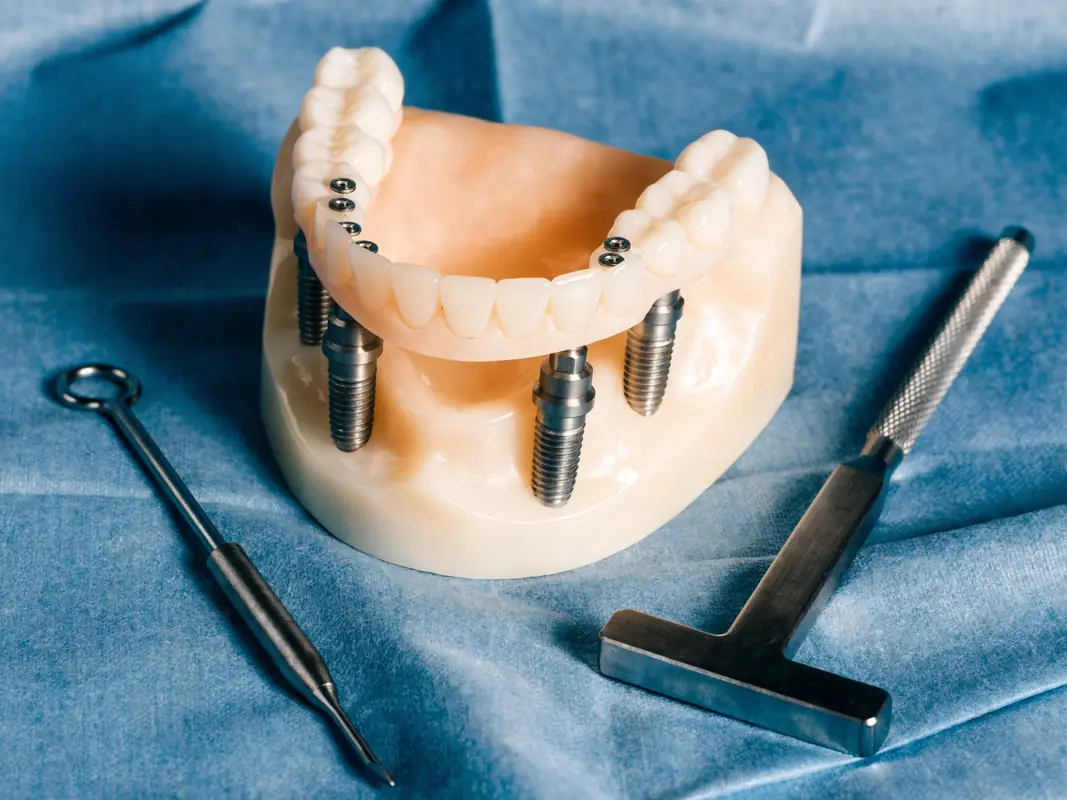
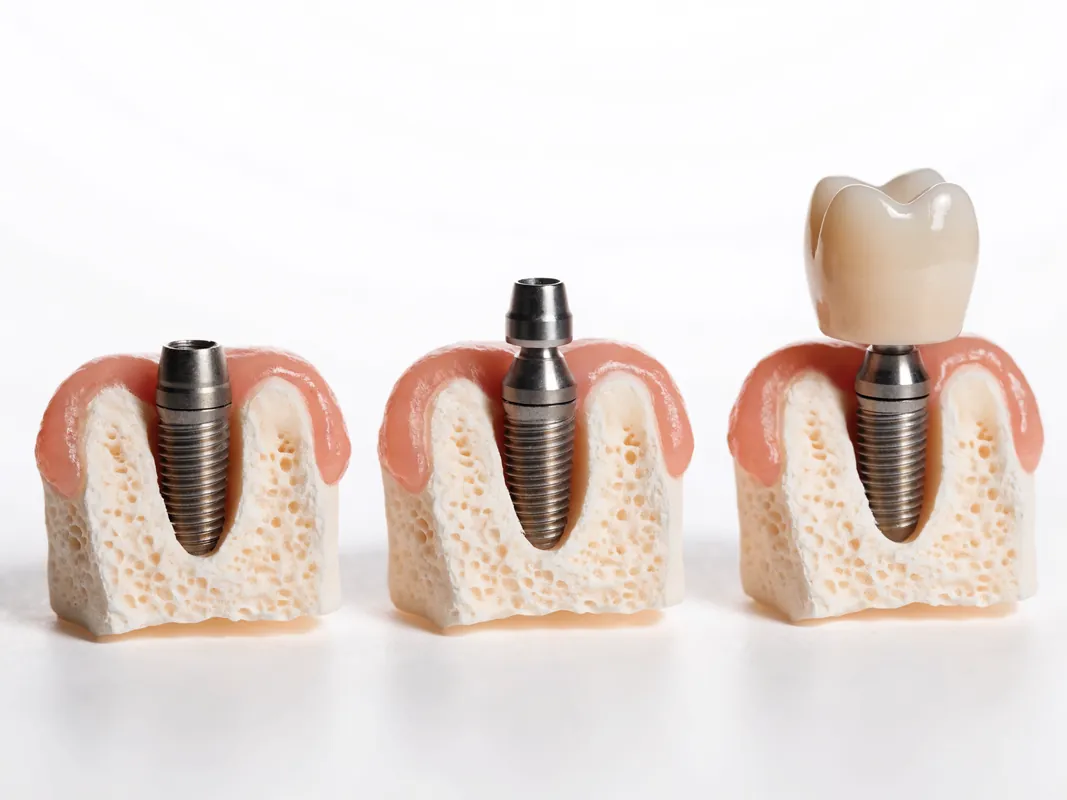
The [FDA dental implant overview](https://www.fda.gov/medical-devices/dental-devices/dental-implants-what-you-should-know) explains that an implant system includes an implant body, abutment and often a fixation screw, supporting a crown, bridge or denture. Those components and the prosthesis are a system. Counting fixtures alone misses most of the restorative decision.
What a fixed complete-arch concept really means
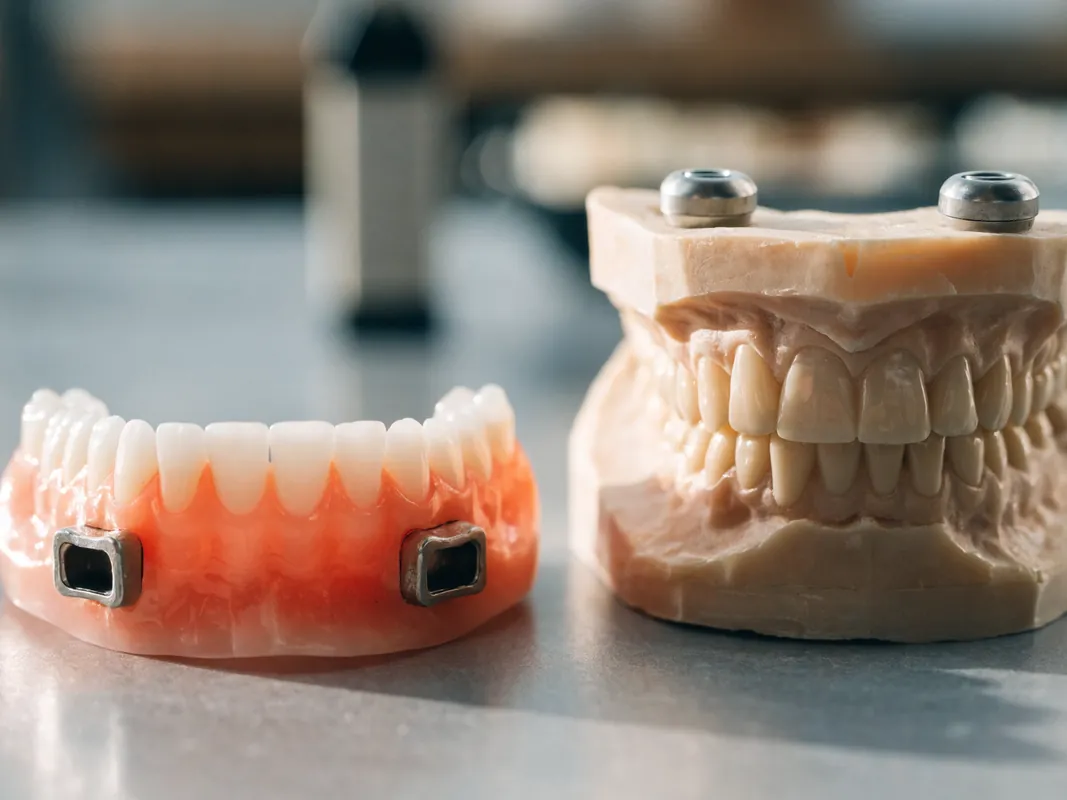
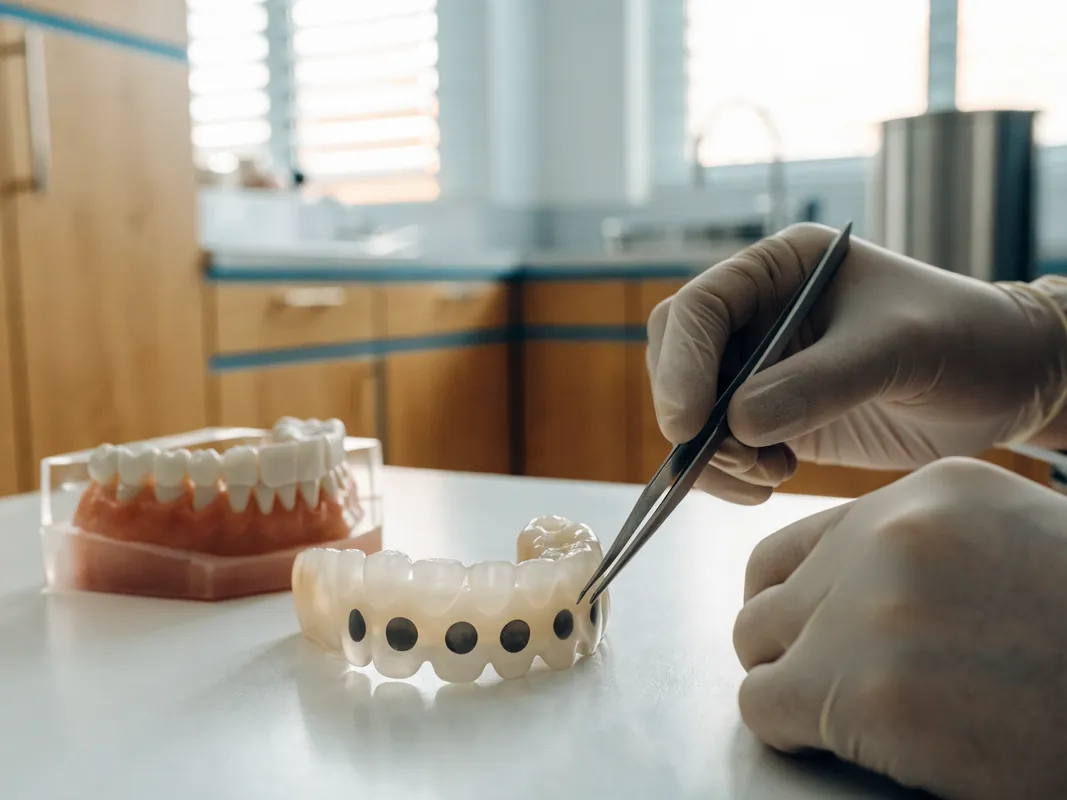
A fixed complete-arch prosthesis links the restoration across an edentulous or terminal-dentition arch. The prosthesis may replace tooth crowns alone or tooth crowns plus part of the lost tissue volume. It may be one piece or segmented. It may be screw-retained or use another connection design. Materials, framework, veneering, access channels and repair strategy vary.
The plan begins with the final prosthesis, not with a promise to insert four fixtures. The prosthetic plan identifies:
- where teeth should appear in relation to face, lips and speech;
- how much tooth and tissue replacement is needed;
- required restorative space;
- the relationship to the opposing arch;
- how load will be distributed;
- where cleansable contours and access can exist;
- whether one-piece or segmented construction is appropriate;
- how the prosthesis can be retrieved, repaired or remade;
- what implant positions and distribution support that design.
The ITI consensus on the [number of implants for complete-arch fixed prostheses](https://network.iti.org/academy/consensus-database/consensus-statement/-/consensus/number-of-implants-placed-for-complete-arch-fixed-prostheses/1701?recFrom=10801&recFromId=1817) explicitly recommends considering the final prosthetic plan when developing the surgical plan. It includes anatomy, prosthesis material, opposing dentition, implant distribution, cantilever, hygiene access and patient preference among the factors. It also says that preservation of teeth should be considered when teeth remain.
“Four” is a design option, not a universal prescription
The number of supporting implants must be selected with distribution, anatomy, prosthesis design and contingency. The ITI consensus recommends a minimum of four appropriately distributed implants for a one-piece full-arch fixed prosthesis, while also asking planners to consider how later implant loss or complications would affect support. It does not say that four is optimal for every person or arch.
More fixtures do not automatically create a better result. An additional implant in an unusable restorative position can compromise design or hygiene. Fewer fixtures do not automatically make treatment less invasive if anatomy, augmentation, angulation or prosthetic space demands additional procedures. The useful question is whether the planned number and positions support the planned prosthesis and a credible contingency.
Ask the proposal to show:
- planned implant sites and why each is chosen;
- anterior-posterior distribution and intended cantilever;
- bone volume and anatomical limitations at each site;
- whether implants are axial or intentionally tilted and why;
- how implant angulation is managed prosthetically;
- what happens if one planned site cannot accept an implant;
- what happens if one implant does not reach the stability needed for the intended loading plan;
- whether a different number would allow segmentation or a safer repair pathway.
The systematic review underlying the consensus, [Polido and colleagues](https://pubmed.ncbi.nlm.nih.gov/30328199/), compared published complete-arch fixed prostheses supported by fewer than five implants with those supported by five or more. Study-level survival findings do not choose an individual number, position or contingency. Avoid converting a population comparison into “four is enough” for an unexamined arch.
Implant distribution matters as much as implant count
Imagine four fixtures clustered near the centre of a long arch and four appropriately distributed fixtures supporting a carefully designed prosthesis. The count is identical; the mechanical and restorative plan is not. Distribution affects the span beyond the last support, load paths, access, emergence, framework design and the response if a component has a problem.
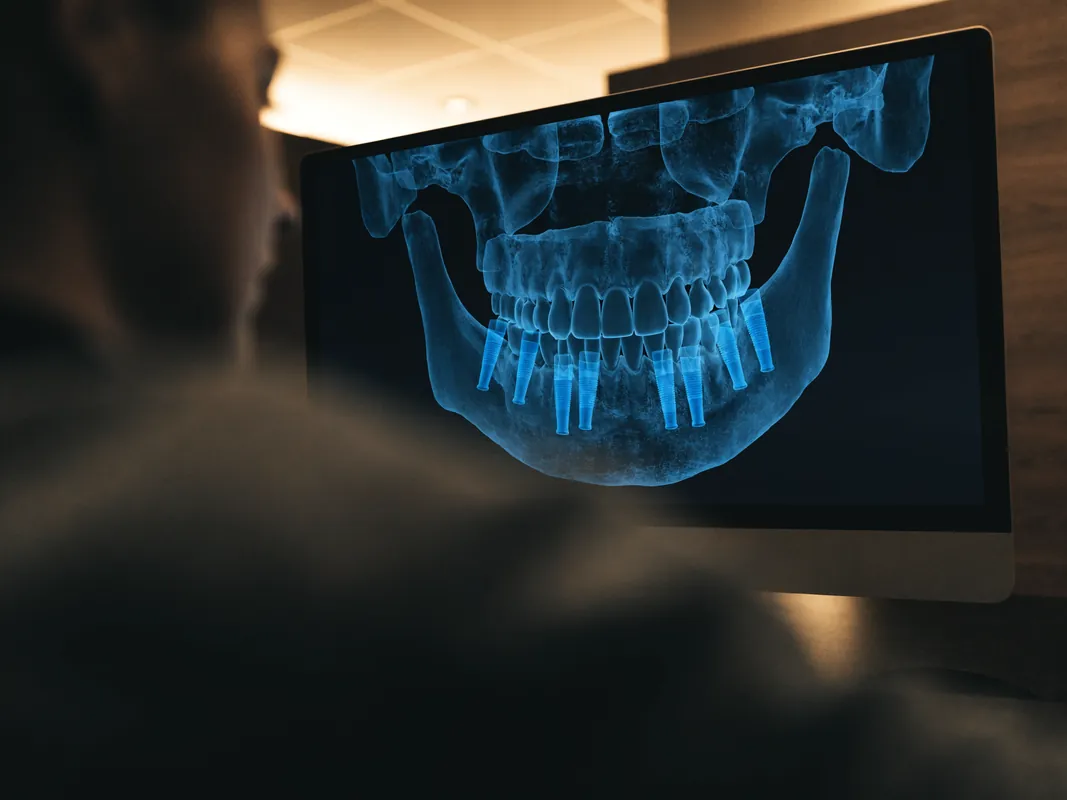
Ask for a prosthesis-led diagram showing proposed teeth, tissue replacement, implant platforms, abutments, screw access, cantilever and cleaning space. A three-dimensional radiographic dataset can help assess anatomy, but it does not itself design the teeth, lip support or hygiene access. Digital planning must be reconciled with examination, records, jaw relationship and the intended prosthesis.
Do not accept a single panoramic image as proof of implant number, bone quality, nerve location, sinus relationship or restorative space. The imaging decision should follow history, examination and justification. The named clinician remains responsible for interpreting the information and explaining limitations.
Upper and lower arches are different decisions
Do not copy an upper-arch plan onto the lower arch or treat both arches as a discounted pair. Bone anatomy, available space, sensory structures, sinus anatomy, tongue space, lip support, smile display, ridge resorption and opposing dentition differ.
For each arch, document:
- teeth present and prognosis;
- pattern and volume of missing tissue;
- relevant anatomical structures;
- restorative space in function and at rest;
- smile line, lip support and phonetics;
- opposing teeth or prosthesis;
- parafunction or uneven load concerns;
- cleaning access and manual ability;
- preferred fixed or removable experience;
- independent contingency.
A person can reasonably have different solutions in different arches: site-specific treatment in one, an overdenture in another, or a fixed complete-arch design in only one. Symmetry is not a clinical goal by itself.
Anatomy can change both strategies
Individual implant sites and complete-arch plans are constrained by bone and soft tissue, but in different ways. A site-specific plan may need augmentation at one strategically important position. A full-arch plan may use alternative distribution, tilted or shorter implants, augmentation, or a different prosthesis design. None of those choices is automatically graft-free.
Ask which anatomy was evaluated, which procedure is proposed, why it is needed and what alternative avoids it. The [CUH bone-grafting information](https://www.cuh.nhs.uk/patient-information/bone-grafting-for-dental-implants/) describes grafting as more complex than conventional placement and also recognises bridges and removable dentures as alternatives when implants are not feasible. That general information does not determine whether a particular graft or avoidance strategy is suitable.
The surgical plan should address bone volume, ridge shape, soft-tissue thickness, keratinised tissue, sinus or nasal floor, nerve position, adjacent roots, extraction defects and the space needed for instruments and restoration. A full-arch concept can sometimes use available bone efficiently, but “avoids grafting” must remain a case-specific conclusion after assessment.
Disease control comes before prosthesis selection
Implants do not remove the causes of periodontal or peri-implant disease. Extracting periodontally affected teeth may remove those teeth, but it does not erase smoking exposure, plaque-control difficulty, diabetes control, previous disease susceptibility, occlusal risk or the need for maintenance.
Before either pathway, establish:
- periodontal diagnosis and stability;
- caries activity and preventive needs;
- oral-hygiene capability and support;
- smoking, vaping or nicotine history;
- medical conditions and medicines relevant to surgery or healing;
- signs of existing peri-implant disease if implants are already present;
- parafunction, fracture history and occlusal risk;
- capacity to attend local follow-up.
The EFP's [peri-implant disease guideline](https://www.efp.org/fileadmin/uploads/efp/Documents/Other_publications/Clinical_guidelines/peri-implantitis-guideline-03-peri-implant-diseases.pdf) includes prosthesis cleansability, oral hygiene and supportive peri-implant care in decision-making. It does not support the idea that a linked full arch is inherently easier to maintain.
Function cannot be reduced to a bite-force percentage
The old marketing comparison that assigns each option a percentage of “natural bite force” is not a clinical decision tool. Function includes comfort, chewing strategy, speech, sensory feedback, jaw relationship, muscle function, opposing dentition, load distribution, food choice, adaptation and the integrity of the prosthesis.
Implants lack the periodontal ligament of natural teeth, so sensory feedback is different. A full-arch bridge also links support across the arch. These facts do not predict how one person will experience eating or speech. Ask how the proposed tooth position, occlusion, material, cantilever, tissue surface and provisional evaluation will be used to test function.
A site-specific restoration may feel different from a natural tooth and can alter contacts or load. A full-arch prosthesis may change tongue space, palatal contour, tooth display or lip support. A removable design can provide tissue support differently. The decision should capture the person's priorities without promising an identical natural-tooth experience.
The opposing arch is part of the treatment
A prosthesis does not function alone. Natural teeth, a removable denture, individual implant crowns, a fixed bridge or another complete-arch prosthesis on the opposite side of the bite each create different restorative conditions.
Ask the written plan to explain:
- the condition and prognosis of the opposing teeth;
- material relationships across the bite;
- how contacts and excursions will be evaluated;
- whether vertical dimension or jaw relation is changing;
- how parafunction is assessed;
- whether a protective device is considered and who determines it;
- how changes to one arch affect the other.
Do not consent to additional treatment of the opposing arch merely to make a preselected full-arch package symmetrical. Each intervention needs its own diagnosis, alternatives and consent.
Cleanability is a design requirement, not an aftercare leaflet
The person must be able to clean the final contour with the tools and dexterity available. “Use a water flosser” is not a substitute for demonstrating access. A prosthesis can be technically fixed yet poorly cleansable because the tissue surface, emergence, implant position or restorative space makes daily access unrealistic.
Before definitive manufacture, ask to see and practise the proposed cleaning path. Consider:
- brush access at prosthesis margins;
- access under pontic and tissue surfaces;
- interdental or threader paths where appropriate;
- implant and abutment emergence contours;
- vision, grip, tremor, arthritis or cognitive limitations;
- caregiver involvement and consent;
- professional instrument access;
- whether a removable design would be more maintainable.
The American College of Prosthodontists' [position on full-arch implant restoration maintenance](https://www.prosthodontics.org/about-acp/position-statement-maintenance-of-full-arch-implant-restorations/) emphasises hygienic contours, patient skills and professional maintenance. It discourages routine removal solely by schedule when cleaning is adequate and no mechanical issue requires it. That position is more nuanced than a fixed annual “bridge removal” promise.
Compare the daily maintenance burden honestly
Site-by-site crowns and bridges may allow familiar-looking cleaning paths, but multiple contacts, pontics and implant interfaces still need technique and professional review. A fixed complete-arch prosthesis may reduce the number of separate crowns but creates a large tissue surface and linked maintenance system. A removable overdenture may be easier to clean outside the mouth but introduces attachments, bases and tissue surfaces that also need maintenance.
Maintenance planning should specify:
- the home-care method demonstrated for this design;
- tools compatible with the materials and tissues;
- professional review based on individual risk, not a generic calendar alone;
- baseline clinical and radiographic records;
- how peri-implant tissues can be assessed;
- who can remove or service the prosthesis if needed;
- replacement parts and component compatibility;
- a local provider willing and equipped to help.
The systematic review on [removing full-arch prostheses for supportive care](https://pubmed.ncbi.nlm.nih.gov/38501398/) found limitations in the evidence for a specific removal frequency. Use that uncertainty to demand a risk-based plan rather than a fixed universal rule.
Separate placement, restoration and loading
“Same-day implants”, “same-day teeth” and “immediate result” can hide several different events. Use precise terms:
- extraction timing: whether a tooth is removed and when;
- implant placement timing: when the implant body is placed relative to extraction;
- restoration timing: when a provisional or definitive prosthesis is connected;
- loading: whether that prosthesis contacts the opposing arch in function;
- definitive stage: when the final planned prosthesis is approved and delivered.
The ITI [implant placement and loading consensus](https://network.iti.org/tr/academy/consensus-database/consensus-statement/-/consensus/implant-placement-and-loading-protocols/1802) distinguishes immediate placement from immediate restoration and immediate loading. It identifies patient, site, stability, augmentation and prosthetic factors that can prevent the intended combination. A tooth visible after surgery is not proof that every implant is loaded, integrated or ready for a definitive restoration.
Ask each proposal to state the intended placement and loading protocol for every site, the criteria used on the day, and the fallback if those criteria are not met. Do not accept a guarantee that an immediate fixed provisional will be possible before the necessary findings exist.
A provisional prosthesis is not the final prosthesis
A provisional can provide appearance, limited function, tissue guidance, occlusal evaluation or a way to test tooth position. Its material, reinforcement, fit, contacts and intended service differ from the definitive design. It may need adjustment, repair or replacement. It should be clearly labelled as provisional in the consent, quotation and records.
For a complete arch, ask:
- whether the provisional will be fixed or removable;
- which implants, teeth or tissues support it;
- whether it is in occlusion and what loading boundaries apply;
- how it will be cleaned;
- what fracture, loosening or tissue change requires review;
- which observations inform the definitive tooth position and contours;
- what happens if the provisional cannot be fitted as planned.
For site-specific treatment, ask whether a temporary crown, bridge, removable tooth or space is planned and whether it contacts the opposing dentition. A single visible temporary crown and a linked full-arch provisional are not equivalent interventions.
The definitive stage requires new approval
Time passing does not prove osseointegration, tissue health, prosthesis fit or readiness for definitive loading. The responsible clinician should assess the case using appropriate history, examination, imaging and restorative checks. Ask which findings support proceeding and which findings would delay, revise or abandon the planned definitive design.
Before approving manufacture or delivery, review:
- tooth position, midline and display;
- lip and tissue support;
- speech and tongue space;
- occlusion and opposing arch;
- material and framework specification;
- cleansability and professional access;
- retention and retrievability;
- component identity and compatibility;
- maintenance and repair route;
- whether the result is provisional or definitive in the record.
The [FDA implant guidance](https://www.fda.gov/medical-devices/dental-devices/dental-implants-what-you-should-know) advises patients to keep implant brand and model information. A definitive bridge record should go further by identifying relevant abutments, screws, framework, restorative material and laboratory documentation where available.
Every immediate plan needs a written contingency
The strongest comparison is not “who promises fixed teeth fastest?” It is “which plan remains safe and usable when the preferred path is unavailable?” Create a branch for each material uncertainty.
Possible branches include:
- a tooth expected to be extracted proves restorable after review;
- a planned implant cannot be placed;
- primary stability is inadequate for intended loading;
- anatomy differs from the remote estimate;
- augmentation is required or declined;
- a provisional cannot be fixed;
- one implant is intentionally left unloaded;
- a provisional fractures or loosens;
- soft tissue, hygiene access or speech needs redesign;
- the patient chooses to pause before irreversible treatment.
For each branch, record the alternative prosthesis, responsible clinician, additional procedure if any, revised consent, revised cost, extra visit or stay, and effect on return travel. A removable interim option can be a legitimate contingency. It should not be presented as failure or sprung on the patient after extraction.
The dental treatment timeline guide explains why clinical gates, not flight bookings, control stage progression.
Linked and independent restorations fail differently
Site-by-site work can isolate some repairs, but a bridge still links its supporting implants or teeth. A complete-arch prosthesis links more components and may need wider intervention for one mechanical problem. At the same time, a linked design can distribute function across support. The trade-off depends on design, not slogans.
Ask what happens if there is:
- loss of one implant;
- fracture or loosening of a screw;
- chipping, wear or fracture of restorative material;
- loss of a crown or bridge segment;
- a poor contact or food trap;
- peri-implant inflammation at one site;
- change in the opposing teeth;
- need for a biopsy, tissue treatment or access beneath the prosthesis.
Can the prosthesis continue temporarily? Must it be removed? Can it be repaired locally? Does the remaining support allow a redesign? Which proprietary tools and components are needed? The original number of implants is only one part of resilience.
Material names do not choose the concept
“Zirconia”, “titanium”, “acrylic”, “ceramic” and “hybrid” describe materials or families, not a complete specification. Clinical performance depends on framework design, thickness, connector dimensions, veneering, bonding, support, occlusion, manufacturing, finishing and repair strategy.
Request:
- exact provisional and definitive material specification;
- framework material and manufacturing route;
- whether aesthetic veneering is present and where;
- manufacturer and lot or statement-of-conformity information where applicable;
- laboratory legal name and location;
- approving clinician and approval record;
- shade, tooth mould and tissue-shade record when relevant;
- repair and replacement process;
- substitution control if the named material becomes unavailable.
The systematic review of [full-arch zirconia prostheses](https://pubmed.ncbi.nlm.nih.gov/28944367/) reported short-term prosthetic findings and evidence limitations. It does not establish zirconia as universally superior, nor can its study averages predict one design's performance.
Component traceability enables local care
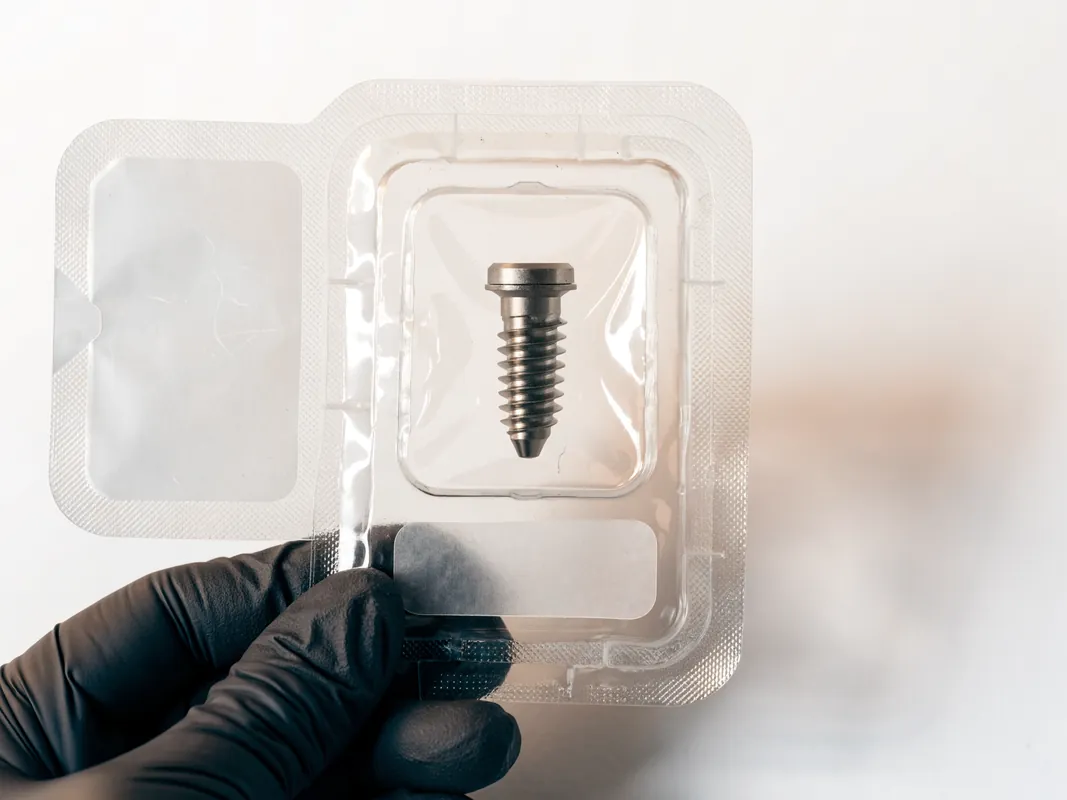
Implant systems contain connected parts that may require system-specific drivers, screws and restorative components. A verbal brand name is not enough. Request a site-specific implant record with:
- manufacturer, system and model;
- platform or connection;
- implant dimensions and location;
- lot or batch information where supplied;
- abutment or multi-unit component details;
- prosthetic screws and tightening protocol documented by the clinician;
- provisional and definitive prosthesis retention;
- compatible tools or components needed for service;
- relevant radiographs and operation notes.
Do not accept a generic “implant passport” that omits the components between fixture and prosthesis. Confirm before travel whether a local dentist can obtain compatible parts and is willing to assess the design. A transferable record does not force a clinician to accept maintenance responsibility, but the absence of one makes continuity harder.
Maintenance is a lifelong system cost, not a free afterthought
Compare anticipated maintenance categories rather than a promised lifespan:
- home hygiene tools and training;
- periodontal and peri-implant assessment;
- professional cleaning compatible with materials;
- radiographs when clinically justified;
- screw, attachment or restorative maintenance;
- provisional and definitive repair;
- replacement of worn teeth, veneering or framework where required;
- occlusal review as opposing teeth change;
- local professional access and component availability;
- travel if work cannot be serviced locally.
No restoration is permanent in the sense of needing no maintenance. Do not compare a full-arch “lifetime” with an individual crown “warranty”. Compare written terms, exclusions and the practical clinical response to each likely maintenance event.
The ACP's full-arch maintenance statement and the EFP peri-implant guideline both place design, hygiene and supportive care inside the treatment concept. Maintenance should influence selection before implant placement, not be introduced after delivery.
Compare equivalent quotations, not headline totals
Rewrite each proposal into the same rows. Mark every row included, excluded, conditional, pending examination or supplied elsewhere.
| Scope row | Site-by-site plan | Full-arch fixed plan |
|---|---|---|
| Teeth preserved and treatment required | Identify each tooth and intervention | Identify every tooth retained or extracted and why |
| Implant surgery | Sites, number, placement protocol, augmentation | Sites, distribution, placement protocol, augmentation |
| Provisional | Type, support, loading and repair | Fixed or removable, support, loading and contingency |
| Definitive prosthesis | Crown or bridge units, materials, retention | Arch design, material, framework, retention, tissue replacement |
| Records | Implant, abutment, crown/bridge and lab record | Full component, framework, prosthesis and lab record |
| Maintenance | Per-site hygiene, review and repair | Under-prosthesis hygiene, review, removal/repair criteria |
| Travel stages | Assessment, surgery, restoration and review | Assessment, surgery, provisional, definitive and review |
| Local aftercare | Named feasible route and component access | Named feasible route, tools, retrievability and contingency |
Do not compare totals until the clinical scope is equivalent. One quote may omit extractions, disease treatment, augmentation, sedation, provisional work, definitive material, laboratory stages or follow-up. Another may include a line that is not clinically required. A lower total does not resolve a diagnostic disagreement.
Request the legal provider, payment recipient, currency, taxes, cancellation terms, refund conditions, staged payments and cost of foreseeable changes. Do not accept pressure to pay for irreversible treatment before the diagnosis and alternatives are understood.
Travel magnifies the difference between plans
Both strategies can need more than one clinical stage. Site-by-site care may be spread across segments or combined where clinically appropriate. A complete-arch plan may involve assessment, extraction, placement, provisionalisation, healing review, records, definitive design and later maintenance. Neither has a universal trip count or duration.
For each stage, record:
- clinical purpose and decision gate;
- named responsible clinician;
- what must be complete before travel;
- what findings can change the stage;
- required recovery and fitness-to-fly decision;
- accommodation and companion needs;
- what happens if the appointment changes;
- which care must be available after return.
The returning-home guide owns clinical handover and local continuity. Travel convenience must not determine which teeth are extracted or whether an implant is loaded.
Local aftercare must be tested before treatment
“Remote follow-up available” is not the same as local clinical care. Photographs and video can transfer information, but they cannot measure pockets, test mobility, inspect every tissue surface, assess occlusion, take justified imaging or remove a prosthesis.
Before travelling, contact a local dentist or suitable service and share the proposed concept. Ask:
- whether it can examine implants and the proposed prosthesis type;
- which records, systems, components and tools it would need;
- whether it can provide routine maintenance, urgent assessment or both;
- which services it does not offer;
- how records can be transferred securely;
- how referral to a specialist would work;
- what costs and waiting times are outside the overseas contract.
Do not describe a local practice as an aftercare partner without its explicit agreement. Do not assume the NHS or an ordinary private dentist will repair, remove or replace unfamiliar overseas components. Keep the treating provider's clinical contact, but use local assessment when symptoms or a mechanical problem need examination.
The implant aftercare guide separates routine monitoring, urgent dental assessment and emergency help. It applies after an individual implant or full-arch procedure only through the written case-specific instructions.
Know which changes need prompt assessment
This comparison cannot diagnose symptoms. Before discharge, obtain written case-specific thresholds and contact routes. Seek prompt professional assessment for concerns such as new or worsening swelling, persistent or recurrent bleeding, fever or systemic illness, altered sensation, increasing pain, difficulty swallowing, discharge, a bad taste with other signs, a loose or fractured restoration, a bite that changes, inability to clean, or trauma to the prosthesis.
Use emergency services for breathing difficulty, uncontrolled bleeding, collapse, severe allergic reaction or another emergency. Do not wait for a warranty discussion, international message reply or return flight. Stabilising health comes before determining payment responsibility.
A full-arch provisional that moves, fractures or feels high should not be repeatedly tested. A single crown that loosens also needs review. Stop applying load as directed, preserve detached parts, record what happened and obtain professional advice. Do not tighten a screw, glue a component or adjust the bite yourself.
Consent must name the concept and the irreversible steps
Valid consent is not a signature for “implants”. The discussion should identify:
- diagnosis for each tooth and arch;
- which teeth are retained, treated or extracted;
- fixed, removable, bridge and no-treatment alternatives;
- proposed implant number and distribution with uncertainty;
- placement, restoration and loading protocol;
- provisional and definitive prosthesis distinctions;
- augmentation or other additional procedures;
- biological, mechanical, aesthetic and functional risks;
- cleaning and maintenance burden;
- contingency if the preferred path cannot be completed;
- local aftercare, records and complaint route;
- itemised financial terms and consequences of changes.
Consent should be renewed when material findings, scope, cost, clinician or prosthesis change. A deposit, flight or time-limited promotion must not remove the option to pause. Ask for information in a language and format the patient understands and enough time for questions.
The GDC [record-keeping standard](https://standards.gdc-uk.org/pages/principle4/principle4) lists radiographs, photographs, consent, laboratory prescriptions and statements of conformity among relevant records for professionals it regulates. Use those categories as handover questions while checking the rules that apply to the actual provider.
A practical full-arch versus site-by-site worksheet
Complete this worksheet with each clinician. “Unknown” is a useful answer because it exposes a pre-travel decision gate.
Diagnosis and preservation
- [ ] Each tooth has a documented diagnosis and prognosis
- [ ] Restorative, periodontal and endodontic preservation options are recorded
- [ ] Extraction reasons are site-specific
- [ ] An independent second opinion was possible before irreversible treatment
Treatment concept
- [ ] The treatment unit is defined as tooth, segment or arch
- [ ] Fixed, removable, bridge and no-treatment alternatives are compared
- [ ] Full-arch treatment is not selected solely by missing-tooth count
- [ ] The opposing arch is included in functional planning
Implant and prosthesis plan
- [ ] Implant number, position and distribution follow the intended prosthesis
- [ ] Anatomy, restorative space, cantilever and cleanability are assessed
- [ ] Placement, restoration and loading are stated separately
- [ ] Provisional and definitive prostheses are clearly labelled
- [ ] Failure of a site or loading criterion has a written contingency
Maintenance and records
- [ ] The patient can demonstrate the cleaning path
- [ ] Professional maintenance is risk-based and locally feasible
- [ ] Components, laboratory and materials are traceable
- [ ] Repair, retrieval and redesign routes are understood
- [ ] Local aftercare has been checked with a real provider
Consent and commercial scope
- [ ] Named clinicians and legal treatment provider are verified
- [ ] Quotes use equivalent scope rows
- [ ] Changes require revised explanation, consent and price
- [ ] Travel arrangements do not control clinical gates
- [ ] No outcome, lifespan or same-day provisional is guaranteed
How to read outcome research without turning it into a promise
Research may report implant survival, prosthesis survival, complication, patient-reported quality of life, maintenance or tissue outcomes. These are different endpoints. An implant can remain in place while the prosthesis needs repair. A prosthesis can remain in service while hygiene is difficult. Satisfaction averages do not show whether a design fits one person's anatomy, priorities and ability to maintain it.
The 2026 systematic review of [patient- and clinician-reported outcomes for maxillary full-arch fixed prostheses](https://pubmed.ncbi.nlm.nih.gov/41732069/) found limited evidence linking outcomes to the number of implants and reported varying risk of bias. The review of [fixed and removable mandibular full-arch options](https://pubmed.ncbi.nlm.nih.gov/33571328/) found that both concepts require treatment-planning trade-offs. Neither source can promise a personal result.
Ask any provider quoting a percentage to supply the source, population, arch, prosthesis, loading protocol, follow-up, endpoint, losses to follow-up and complication definition. Ask whether the figure is independent research or audited provider data. Do not treat either as a guarantee.
Final decision rule
Choose neither “All-on-4” nor “individual implants” from a website matrix. First decide which teeth can reasonably be preserved. Then define whether the treatment unit is a tooth, segment or complete arch. Compare all reasonable fixed and removable alternatives. Design the prosthesis before selecting implant positions. Test cleanability, maintenance, contingencies, local aftercare and equivalent financial scope.
A full-arch fixed concept may be a reasonable option for a diagnosed edentulous or terminal-dentition arch when the patient understands the alternatives and the prosthesis-led plan is maintainable. Site-by-site rehabilitation may be reasonable when strategic teeth and segments have usable prognosis and the combined design remains functional and maintainable. A mixed plan may be more appropriate than either label.
The answer is not universal. It belongs to a named, accountable clinical team after examination, with records that another clinician can understand and a plan that still works when the preferred branch changes.