Travelling from Germany to Antalya for dental work is not a long weekend with a dentist appointment attached. It is a project with two trips, a healing gap of several months in between, and an administrative half that is far easier to complete before you book than after. The clinical part is usually the straightforward one. The part where German patients genuinely get stuck is reimbursement — and this page does not gloss over it.
This page covers two things: how the trip actually runs, and how the German insurance system treats treatment abroad. The full price breakdown lives on the cost page and the general safety argument lives on the safety page. Here it is your route and your paperwork.
Before paying, require the named provider to identify the responsible clinician and confirm the provisional findings, required examination, treatment stages, materials, records, exclusions and itemised quotation in a dated written plan. A website range and a remote assessment are not a final diagnosis or price.
The journey end to end, stage by stage
| Stage | Where you are | Typical duration | What actually happens |
|---|---|---|---|
| Remote assessment | Home | 1–3 days | You send an OPG (panoramic X-ray) or sharp photographs. The clinic replies with findings, options and a provisional plan. |
| Written Kostenvoranschlag | Home | Same week | Line-item quote, named materials and implant systems, number of trips, number of clinic days. |
| Heil- und Kostenplan and the query to your Kasse | Home | 2–6 weeks | The decisive step, and the one most often skipped. Detail below. |
| Booking and dates | Home | 2–8 weeks ahead | Deposit, fixed treatment dates, flights booked around the clinic diary rather than the other way round. |
| Arrival day | Antalya | Half a day | Transfer, hotel, rest. No treatment on arrival day for surgical cases. |
| Diagnostics on site | Antalya | Day 1 | CBCT scan, clinical examination, plan confirmed or revised in front of you. |
| Treatment days | Antalya | Days 2–5 | Surgery or preparation, with review appointments in between. Never one marathon session. |
| Return flight | Antalya to Germany | Day 5 or 6 | Collect your documentation before you leave for the airport. |
| Healing gap | Home | 3–4 months | Implants only. Crowns and veneers skip this stage entirely. |
| Second trip | Antalya | 3–5 nights | Uncovering, impressions, final restoration fitted. |
Pure crown or veneer cases drop the healing gap and the second trip, which collapses the whole thing into a single six-to-eight-day visit. Implant cases should be planned as two trips from the outset — and planned so that you can genuinely make the second one, both at work and financially.
Flights from Frankfurt, Munich, Düsseldorf and Berlin
Antalya (AYT) is one of the best-connected airports in the eastern Mediterranean during the summer season. In winter the schedule thins out noticeably.
| Departure airport | Direct flight in summer | Winter season | Note |
|---|---|---|---|
| Frankfurt (FRA) | around 3h 15m | Direct flights substantially reduced, otherwise via Istanbul | Densest schedule, including early departures |
| Munich (MUC) | around 3h | A few direct flights, otherwise a connection | Shortest flying time from Germany |
| Düsseldorf (DUS) | around 3h 25m | Reduced, frequently a connection | Heavy demand, often competitive fares |
| Berlin (BER) | around 3h 20m | Substantially reduced | Usually via Istanbul in winter, six to nine hours door to door |
Two practical points. First, do not book flights until the treatment dates are confirmed in writing. Second, do not put your return flight on the day after surgery. After a routine implant placement most patients fly comfortably 24 to 48 hours later. After a sinus lift many surgeons ask for one to two weeks because of cabin pressure changes — which is exactly why that procedure is scheduled at the start of the trip rather than at the end.
The reimbursement question: the general framework, and explicitly not a promise
This is why this page exists. Read this section slowly.
The most important sentence first: what follows is the general framework as it typically applies in Germany. Rules change, statutory health insurers interpret individual cases differently, and private insurers decide according to their own policy conditions. None of this is a guarantee of reimbursement, and nobody can tell you from a website what your own Kasse will do in your case. Before you book or pay a deposit, obtain written confirmation from your own Kasse or your own insurer. A phone call with a hotline is not written confirmation.
Why Turkey is treated differently from Spain or Poland
Inside the EU and the EEA there are European coordination rules for healthcare. Anyone treated in Spain, Poland or Hungary is moving inside a system explicitly designed for cross-border treatment, complete with a reimbursement route and prior authorisation for certain services.
Turkey sits outside the EU and the EEA. Those coordination rules do not apply there. There is a bilateral social security agreement between Germany and Turkey, but its logic is aimed at people who are already in Turkey and become acutely in need of care while there — not at planned treatment you travel for on purpose. That distinction, between acute need on the spot and a planned treatment journey, is precisely where applications routinely fail.
A second principle compounds it: statutory health insurance generally covers planned treatment outside the EU only where the required treatment is not available in Germany at all. For implants, crowns and prosthetics that is obviously not the case. Do not expect your trip to be recognised as medically necessary treatment abroad.
What Kostenerstattung actually means
Kostenerstattung — the reimbursement principle — means you pay the bill yourself first and submit it afterwards for partial reimbursement. There is no card that works in Antalya. You pay the full amount up front, and whatever comes back afterwards is measured against what your Kasse would have paid for the diagnosed condition anyway, not against what you actually spent.
That leads somewhere many people underestimate. Even in the best case, nobody simply reimburses a share of the Turkish invoice. The reference point is always the German diagnosis and the standard care allotted to it. A very cheap treatment abroad therefore does not automatically shrink your out-of-pocket share by the same proportion that it shrinks the bill.
The Heil- und Kostenplan belongs before the trip, not after it
The Heil- und Kostenplan, usually shortened to HKP, is the German form on which a dentist documents the diagnosed condition, the planned restoration and the expected cost. For prosthetic work it is submitted to the Kasse and reviewed by them before treatment starts. That is the mechanism by which the Kasse confirms the subsidy it will pay for that condition.
Three things matter about it.
First, a Turkish clinic cannot issue a German HKP. The plan is produced by a dentist licensed in Germany, based on your own diagnosis. That means one additional appointment at home before you fly. Schedule it rather than skipping it.
Second, the review takes time. Allow several weeks. Booking the flight first and starting the HKP afterwards inverts the order, and leaves you making a decision that needs time under time pressure.
Third, an approved HKP for treatment in Germany is not automatically approval for treatment in Turkey. You have to put that to your Kasse explicitly and in writing: that the treatment is to take place abroad. Concealing it and submitting a Turkish invoice afterwards risks a flat refusal, and leaves you with no argument left to make.
Festzuschuss and Bonusheft
For prosthetic work, German statutory insurance uses a Festzuschuss — a fixed subsidy tied to the diagnosed condition rather than to the treatment you choose. Whether you then opt for the standard restoration or something more elaborate does not change the subsidy. It only changes your own share.
The Bonusheft — the check-up booklet — raises that subsidy in steps if you can show unbroken annual check-ups over a number of years. There are two such steps, reached after several and after many years of unbroken records. The actual amount is stated in euros on your own Heil- und Kostenplan and depends on the diagnosis; any flat figure quoted on a website would be misleading here.
Two practical consequences. Get your Bonusheft stamped and up to date before the HKP is drawn up. And do not let the annual check-up lapse during the healing gap just because the main treatment is happening abroad — a gap in the Bonusheft cannot be filled in retrospectively.
Private insurance and Zahnzusatzversicherung
Privately insured patients, and anyone holding supplementary dental cover, face a different but not easier question. Here the policy wording decides, not social law. Check your conditions explicitly for:
- Whether treatment outside the EU is reimbursable at all.
- Whether prior authorisation is required, in what form, and by what deadline.
- Whether the invoice has to be structured according to the German fee schedule. Turkish invoices typically are not, and reimbursements fail on this more often than on anything clinical.
- How prosthetics manufactured in a foreign laboratory are handled.
- What evidence is required about materials and the implant system.
- Whether translations are needed and whether they must be certified.
Many supplementary dental policies also pay only on top of a statutory contribution. If that statutory contribution does not materialise, the supplementary payment can fall away with it — even when the policy looks generous on paper. Settle that before booking too.
The questions to put in writing
Send your Kasse or insurer a message through the customer portal, or a letter, so the answer exists in black and white. Ask specifically:
- I am planning dental treatment in Turkey. Will you contribute to the cost, and if so, on what basis?
- Do I need to submit a Heil- und Kostenplan for approval before treatment begins, and does it have to state that treatment will take place abroad?
- What documents will you require afterwards, in which language, and must a translation be certified?
- Is there a deadline for submission after treatment is complete?
- Does anything in your answer change if the treatment runs across two trips over several months?
Do not book until all five answers are in. If a clinic pushes you towards a deposit before you have them, that is a standalone reason to pause.
Treatment days in Antalya
The first day on site is a diagnostic day, not a treatment day. CBCT, clinical examination, and any correction to the plan. A clinic that prepares teeth or operates on arrival day is not being efficient; it is showing you a warning sign.
For an implant case, the placement itself is followed by a review the next day and, depending on the case, one more appointment before you leave. Expect swelling that peaks on days two and three. Do not plan excursions, long drives, alcohol, or midday sun in summer.
Crown and veneer cases run to a different rhythm: preparation and temporaries early in the week, a try-in mid-week, final cementation at the end. Insist on that try-in, with colour, bite and marginal fit checked, before anything is permanently cemented. Cutting the try-in to catch an earlier flight saves one day and risks a result that is expensive to correct in Germany.
The healing gap and the second trip
Three to four months normally separate implant placement from the final crown, longer where bone grafting was involved. You spend that time at home, usually with a temporary.
Your jobs during that period: follow the hygiene instructions, do not overload the temporary, send photographs to the clinic immediately if you notice pain, movement, pressure or a change in taste — and book the second trip early. Clinics fill up in high season, and asking four weeks in advance may not get you the slot you need.
The second trip is shorter and calmer: uncovering or impressions, laboratory work, try-in, fitting. Three to five nights is usually enough. The same rule applies: do not fly home on fitting day. Leave a buffer day so an adjustment is still possible on site.

Documents your German dentist will ask for first
Do not ask for these on departure day. Request the complete documentation two days before your flight, check it, and have anything missing added while you are still in the country.
| Document | What it must contain | Why Germany asks for it |
|---|---|---|
| Behandlungsdokumentation | Diagnosis, work performed per tooth in FDI notation, dates, name of the treating dentist | Without a tooth chart nobody can tell which tooth was restored how |
| Röntgenbilder | OPG before and after, CBCT dataset, ideally DICOM on media or as a download | A German dentist will not assess bone or implant position from a phone photo |
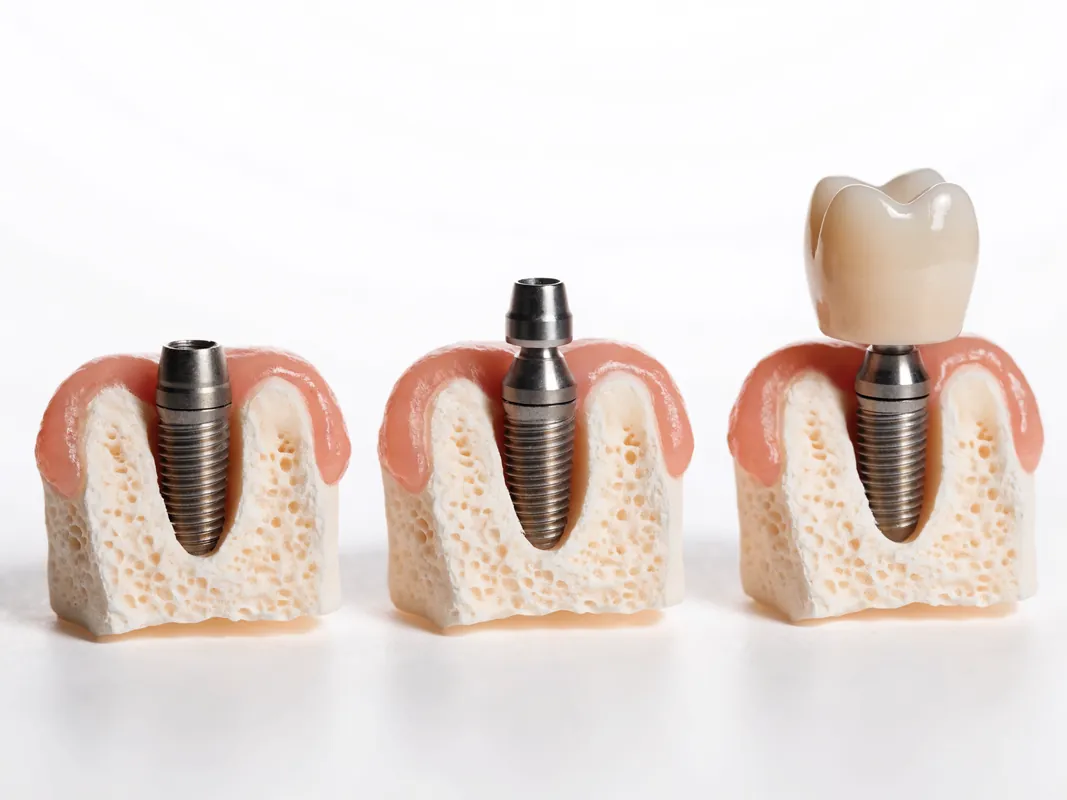
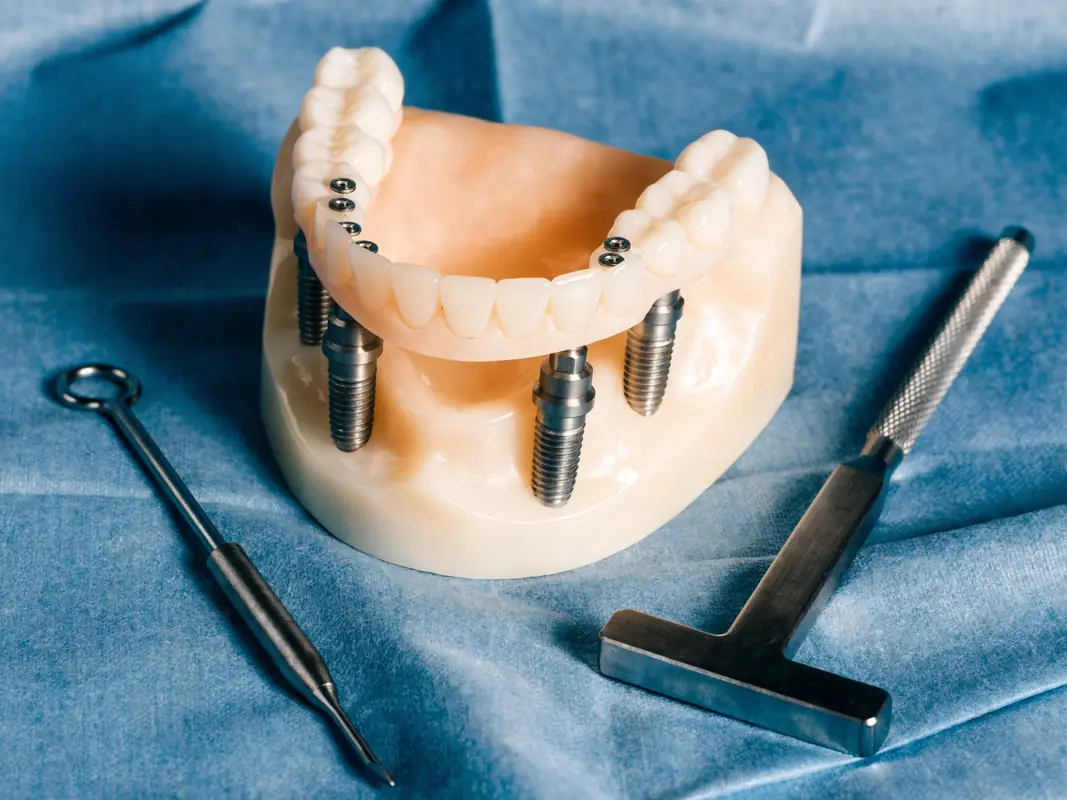
| Implantatpass | Manufacturer, system, product line, diameter, length and batch or LOT number per implant | Essential for aftercare, spare parts and screws. Without the system, no driver fits |
| Materialnachweise | Crown and bridge materials, alloys, cement type, conformity documentation | Relevant to allergies, to repairs, and to every reimbursement claim |
| Garantieunterlagen | Term per item, exclusions, evidence obligations, who pays travel in a warranty case | A warranty with no written terms is an advertising claim, not an entitlement |
| Rechnung | Itemised lines, date, clinic stamp, proof of payment | No insurer reviews anything without itemised lines |
The Implantatpass is the item patients underestimate most often. If an abutment screw loosens two years later, the system entry decides whether a German dentist solves it in twenty minutes or whether it becomes a search with an uncertain ending.
Aftercare in Germany
Two things to accept plainly.
First, no German dentist is obliged to take over continuing care for work carried out abroad. Many will; some will not — partly for liability reasons, partly from bad experiences with missing documentation. Find that practice before you fly, not when something hurts.
Second, reviewing work done abroad is almost always a private service. Budget a low to mid two-figure euro amount for a review with examination and consultation, more with an X-ray, and a mid two-figure to low three-figure amount for a professional cleaning. Implant patients are usually reviewed roughly every six months. These sums belong in your calculation even though no clinic quotation contains them.
One practical tip for that first appointment at home: bring the complete documentation in a folder with the Implantatpass on top. Practices that are sceptical about overseas work in principle change their position surprisingly often once the paperwork is complete and coherent.
If a crown debonds or an abutment screw loosens
First the boundary: facial swelling, fever, difficulty swallowing, or severe and increasing pain is an emergency. That means the out-of-hours dental service or the emergency department, regardless of where treatment was carried out.
Everything else is not an emergency but a case for an orderly process:
- Keep the piece that came loose. Do not stick anything back yourself, not with denture adhesive and not with a repair kit from the chemist.
- Photograph the site the same day and send the images to the clinic in Antalya. That starts the documentation for any warranty claim.
- Do not chew on that side.
- Book a re-cementation appointment in Germany promptly. A crown that has debonded but is otherwise intact can often simply be re-cemented.
- For a loose abutment screw you need the system details from the Implantatpass. With them it is a short appointment; without them it is a search.
Settle in advance what your warranty actually covers in a real case: materials only, or chair time as well — and who pays for the flight if rework is needed. That answer belongs in your file, in writing, before you pay.
What the trip really costs
The treatment invoice is not the total. This table covers the travel share for one person and one implant case across two trips.
| Item | First trip | Second trip | Note |
|---|---|---|---|
| Flights from Germany, return | €150–400 | €150–400 | Off-season at the bottom, school holidays at the top |
| Hotel | 4 nights, €180–440 | 4 nights, €180–440 | €45–110 per night, near the clinic |
| Airport transfers | €30–70 | €30–70 | Often included in the clinic package — get it confirmed in writing |
| Food and incidentals | €100–200 | €100–200 | €25–50 per day |
| Travel insurance | €55–170 | €55–170 | Only policies that do not exclude planned treatment |
| Aftercare in Germany | — | €120–350 in year one | Reviews and cleaning, paid privately |
| Travel share, total | roughly €515–1,280 | roughly €635–1,630 | Excluding treatment cost |
For orientation only — and explicitly only that — here is the order of magnitude of the treatment itself in Antalya. The full price breakdown, with the material differences that drive it, belongs on the cost page rather than here.
| Item | Order of magnitude in Antalya | What the number is good for |
|---|---|---|
| Implant including abutment and crown | roughly €650–1,100 | Rough planning of the total |
| Zirconia crown | roughly €180–280 | Comparing unit counts between quotations |
| All-on-4 per jaw | roughly €4,500–7,500 | Judging whether the trip is worth making |
Do the arithmetic honestly: treatment plus travel share plus aftercare at home. Only that total is comparable with a German quotation — and only after that do you subtract whatever subsidy your Kasse has confirmed to you in writing. Not the other way round.
Who should not travel
This section is deliberately uncomfortable. For some people a treatment trip is the wrong decision, and it is better to know that beforehand than afterwards.
- Anyone who needs their Kasse to cover it and has no written confirmation. Do not travel on hope. Without a written answer the reimbursement is open, and in practice open not infrequently means nothing.
- Anyone for whom the second trip is uncertain. If you cannot reliably set aside the time, money or leave for the second trip, do not start an implant project abroad. An implant without its final restoration is not a finished state; it is an open one.
- Anyone in the middle of periodontal therapy. Placing implants into untreated, inflamed periodontal tissue is clinically wrong regardless of the country. Complete the therapy, demonstrate stable conditions, then plan.
- Anyone whose situation needs close monitoring. Poorly controlled diabetes, ongoing antiresorptive therapy, head and neck radiotherapy or heavy smoking put this decision into a long conversation, not an online quotation.
- Anyone expecting a full rehabilitation in one week because it is cheap. Time pressure is the most reliable route to a result that becomes expensive later.
Best months to travel, and the July and August problem
| Period | Daytime temperature | Flight situation | Suitability for a treatment trip |
|---|---|---|---|
| March to May | 18–28 °C | Direct flights increasing | Very good. Comfortable, moderate prices |
| June | 28–34 °C | Full schedule | Good, but already warm |
| July and August | 34–40 °C | Full schedule, highest fares | Poor. Reasons below |
| September and October | 25–32 °C | Full schedule | Best. Quieter, warm, easy to reach |
| November to February | 12–18 °C | Thinned out, usually via Istanbul | Cheap, but a long journey |
On July and August: forty degrees is not a footnote after oral surgery. Swelling and heat do not mix, you are told to drink plenty while being forbidden a straw after some procedures, physical exertion and direct sun are to be avoided anyway, and swimming in the sea or a pool is off limits in the first days after implant placement. Add the highest flight and hotel prices of the year. If you have the choice, choose September or October.
In short
The clinical half of dental treatment in Antalya is plannable: two trips, a healing gap, clearly structured treatment days. The German half needs preparation. Have the Heil- und Kostenplan drawn up before you travel, get your Kasse's answer in writing, bring the Bonusheft up to date, find the aftercare practice at home before you fly — and carry the complete documentation, Implantatpass included, home with you. Do those five things and you have secured exactly the part where most German patients come unstuck.