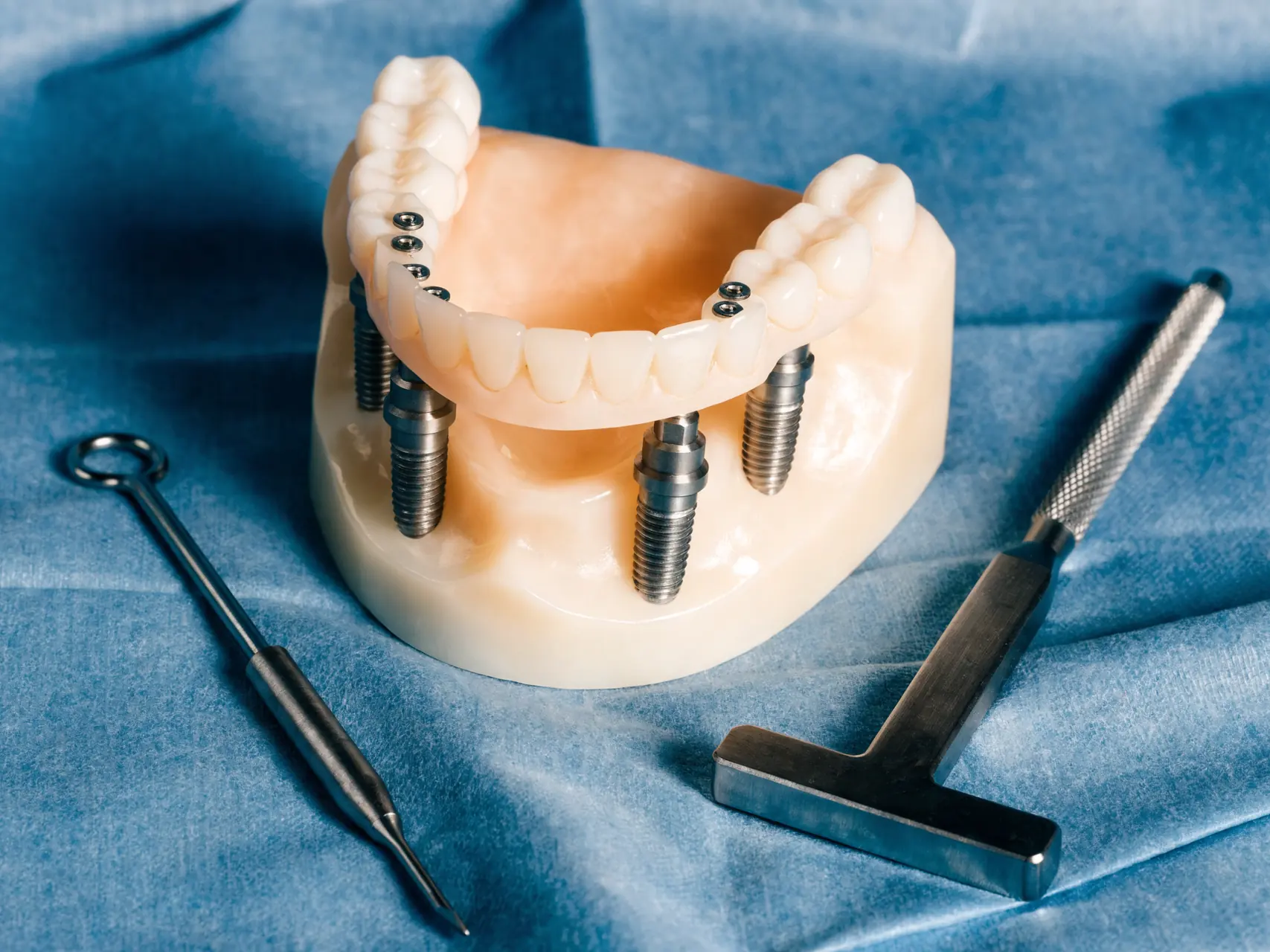
Extraction and immediate implant placement are often marketed as one convenient procedure. Clinically, they are not one decision. First, a responsible clinician must decide whether the tooth is genuinely beyond reasonable preservation. If extraction is justified, a separate decision concerns when an implant may be placed. If an implant is placed in the extraction socket, another separate decision concerns whether a provisional restoration can be connected and whether it may carry functional contact. The definitive restoration is a later decision again.
Keeping these gates separate protects patients from a slogan-driven plan. A phrase such as same-day implant may refer only to implant placement on the day of extraction. It does not prove that a crown will be attached, that the crown will be used in normal function, that grafting will be unnecessary, that the original plan will survive the extraction unchanged, or that no further visit will be needed. A remote photograph or panoramic image cannot settle all of those questions.
This guide is not a diagnosis, quotation or promise of eligibility. It does not publish a standard timetable, package, implant brand, success figure or restoration formula. It explains the records and decisions a patient can request from the named legal treatment provider and responsible clinicians. The [ITI consensus on implant placement and loading protocols](https://network.iti.org/tr/academy/consensus-database/consensus-statement/-/consensus/implant-placement-and-loading-protocols/1802) treats placement timing and loading timing as distinct classifications and recommends planning alternatives before extraction. The more recent [ITI selection criteria for immediate placement and loading in a single aesthetic-zone site](https://network.iti.org/it/academy/consensus-database/consensus-statement/-/consensus/selection-criteria-for-immediate-implant-placement-and-immediate-loading-for-single-tooth-replacement-in-the-maxillary-esthetic-zone/2305) also makes clear that even a selected case may change during extraction or site assessment.
The decision is a sequence, not a bundle
A defensible pathway answers these questions in order:
- What is the diagnosis for the tooth and surrounding tissues?
- Is the tooth restorable, and what evidence supports that conclusion?
- What reasonable tooth-preserving options, extraction options and no-treatment consequences were discussed?
- If extraction is agreed, what replacement options are reasonable, including a bridge, removable option, implant option or leaving the space?
- If an implant is considered, what site, medical, periodontal, prosthetic and travel factors affect timing?
- If immediate placement is planned, what findings must still be confirmed after extraction?
- What is the written fallback if those findings are unfavourable?
- If an implant is placed, will it be left unloaded, receive a non-functional provisional restoration, or support a restoration in function?
- What later evidence must be accepted before a definitive restoration?
- Who owns each stage, record, complication pathway and local handover?
A plan that starts with a package name and works backwards can conceal uncertainty. A plan that starts with diagnosis and records can show why the proposed sequence is reasonable and when it must change.
Name the legal provider and clinical owners
Before sharing health records or paying a deposit, identify the legal entity contracted to provide treatment. A marketing site, travel coordinator, lead generator, hotel or transfer company is not automatically the treatment provider. Ask for the provider's registered legal name, physical facility, responsible contact, complaint route and the jurisdiction governing the treatment agreement.
Then identify the clinicians who own the extraction decision, implant decision and restorative decision. These roles may be held by one appropriately trained clinician or by different clinicians. The written plan should say who will examine the tooth, who may remove it, who may place an implant, who will decide whether loading is permitted, who will prescribe the provisional and definitive restoration, and who will review healing. Verify each clinician through the relevant current professional register and confirm the scope in which that person will work.
Do not substitute a coordinator's assurance for a clinician's dated assessment. Do not assume that a person shown on a website will attend. Names, registration status, facility permissions and actual attendance should be confirmed for the intended episode of care. If a team changes, the patient should receive an updated plan and a meaningful opportunity to reconsider before an irreversible step.
Start with tooth preservation and restorability
The word extraction is not a diagnosis. A tooth may be painful, fractured, loose, infected, heavily restored or cosmetically unacceptable, but each finding raises different questions. The clinician should document the source of symptoms, periodontal support, remaining sound tooth structure, root condition, previous treatment, crack or fracture evidence, decay extent, strategic value, adjacent teeth, occlusion and the patient's priorities.
Restorability is a distinct clinical judgment. It asks whether a tooth can be repaired in a way that is biologically, structurally and functionally reasonable, not merely whether a procedure is technically possible. It also asks what maintenance, uncertainty and future intervention the preservation option may carry. A preservation plan might involve caries management, periodontal care, endodontic treatment or retreatment, a direct or indirect restoration, orthodontic movement, monitoring or referral. Those are examples for discussion, not a claim that any one option applies.
A responsible record explains why preservation is recommended or rejected. Phrases such as bad tooth, failed tooth or implant is better are not enough. If a specialist opinion could materially change the choice, ask whether referral is appropriate before extraction. The [European Society of Endodontology resources for clinicians](https://www.e-s-e.eu/for-professionals/resources-for-clinicians/) provide evidence-led material on diagnosis and tooth-preserving endodontic care. Their relevance is not that every tooth should be retained, but that removal should follow a documented diagnosis and comparison of reasonable alternatives.
Confirm the extraction indication
When extraction is recommended, request a tooth-specific statement of indication. It should distinguish, for example, between non-restorability, vertical root fracture, advanced loss of support, recurrent disease, treatment failure, trauma, pathology or a broader prosthetic reason. It should explain the evidence used and the uncertainty that remains.
The record should also address whether symptoms require urgent management or whether there is time for a second opinion. Urgency may change how pain, swelling, spreading infection, bleeding or trauma is managed, but it should not be used to pressure consent for an elective replacement plan. Emergency care and long-term reconstruction are separate decisions.
Ask what happens if extraction is postponed or declined. No treatment may carry a risk of persistent symptoms, further breakdown, infection or other consequences, but those consequences depend on the diagnosis. The clinician should explain the relevant risks without exaggeration. A patient's refusal of an implant is not refusal of all care; symptom control, disease management, monitoring and alternative replacement discussions may still be relevant.
Compare replacement options before choosing timing
Extraction does not automatically create an implant indication. Depending on the site and patient, possible pathways may include no replacement, a removable prosthesis, a tooth-supported bridge, an adhesive bridge, orthodontic space management, an implant-supported restoration or another staged solution. Each can affect adjacent teeth, maintenance, appearance, function, future access and cost differently.
The comparison should be patient-specific. Ask what the option requires from adjacent teeth, what hygiene access is needed, how it may affect speech or function, what records and maintenance are required, and what happens if it later needs repair. Ask whether a temporary replacement is needed while the site heals and who will provide it.
A quote that lists only an immediate implant creates a false choice. A consent conversation should include reasonable alternatives, their main risks and benefits, and the consequences of doing nothing. The goal is not to make every option appear equal. It is to show why the selected option follows from the patient's diagnosis and preferences rather than from a pre-sold itinerary.
Remote review is preliminary
Photographs, a panoramic image, a video call and existing records can help organise questions. They may reveal that more information is needed or that an advertised pathway is unlikely to be straightforward. They do not replace the examination and investigations chosen by the treating clinician.
Remote material may not show socket-wall integrity, exact defect shape, soft-tissue quality, mobility, probing findings, occlusal forces, crack extent, surgical access or the restoratively suitable implant position. Image quality, age, projection and incomplete history can also limit interpretation. The final extraction, placement and loading decisions should be made only after the responsible clinicians have adequate current evidence.
A remote proposal should therefore use conditional language. It should say what is assumed, what must be checked in person, what could change, and whether the quoted total changes if the immediate pathway is abandoned. If the proposal is presented as final before examination, request a revised provisional document.
Build the diagnostic evidence set
The evidence set should be proportionate to the clinical question. It commonly combines history, examination, periodontal findings, appropriate imaging, photographs where useful, occlusal assessment, prosthetic space analysis and review of previous records. The clinician should explain why each investigation is indicated and how it affects the choice.
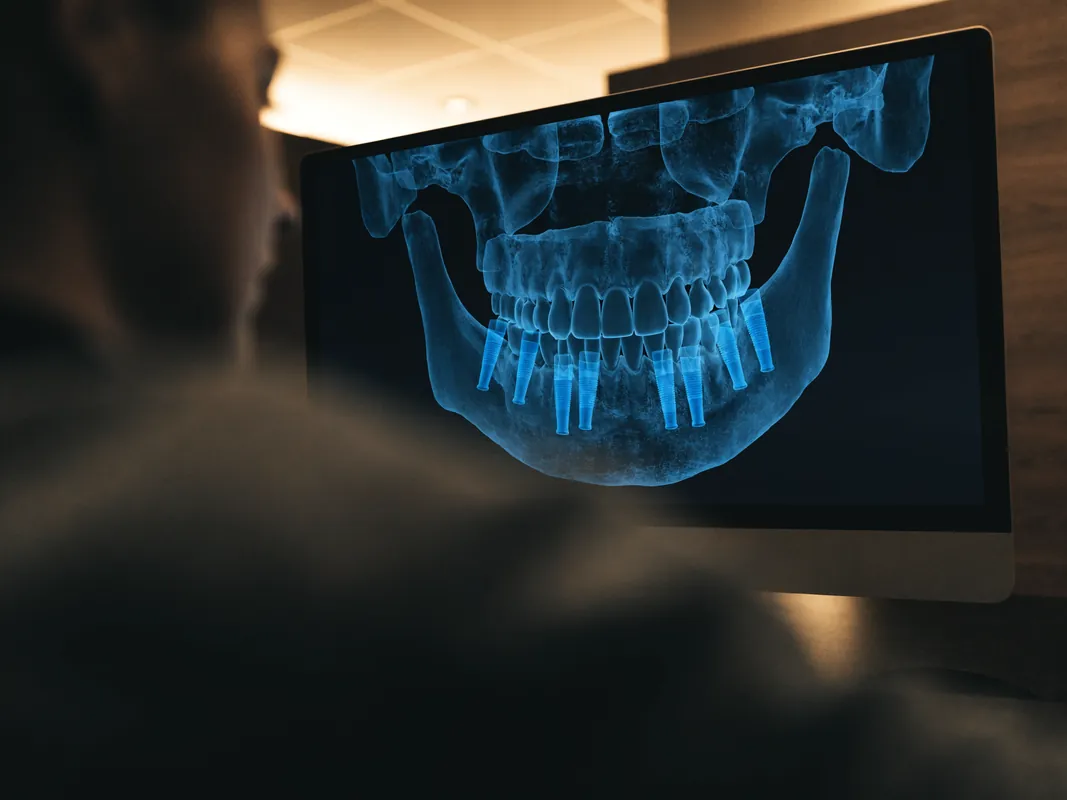
Imaging should answer documented questions, not operate as a marketing badge. A two-dimensional image may answer some questions; cross-sectional imaging may be justified for others. The treating team should determine the appropriate modality, field and timing under applicable standards. Ask for the report or interpretation, not only a screenshot used in a sales call.
The prosthetic plan matters before surgery. The intended emergence, crown space, neighbouring roots, opposing teeth and cleaning access influence whether an implant can be placed in a restoratively sensible position. Bone availability alone does not establish suitability. A site can appear capable of receiving an implant yet be unsuitable for the proposed restoration without augmentation, altered timing or a different option.
Stabilise active disease before elective expansion
An extraction socket is part of a mouth, not an isolated hole. Plaque control, gingival inflammation, periodontitis, caries, endodontic disease and problems elsewhere can affect risk and maintenance. The plan should document active disease and explain what must be managed before or alongside implant treatment.
For patients with periodontal disease, ask for a current periodontal diagnosis, risk assessment, treatment plan and maintenance strategy. The [EFP guideline for stages I to III periodontitis](https://www.efp.org/education/continuing-education/clinical-guidelines/guideline-on-treatment-of-stage-i-iii-periodontitis/) presents stepwise, evidence-based care rather than a one-appointment shortcut. The relevance to an implant proposal is that disease control and reassessment must be visible; an implant does not erase susceptibility or hygiene needs.
Infection should not be reduced to an automatic yes or no slogan. The source, extent, acute features, available bone, ability to debride, patient condition and clinician's experience all matter. The written plan should describe how infection and inflammation are assessed, what treatment is required, and what intra-operative finding would trigger a staged pathway. It should not promise that antibiotics alone make a site suitable.
Review medical and medication factors
A complete medical history belongs before consent, not after payment. It should cover relevant conditions, previous surgery, allergies, medicines, tobacco and nicotine exposure, alcohol or substance use where relevant, pregnancy status where relevant, healing history, immune or metabolic concerns, bleeding history and any previous radiotherapy or medicines associated with jaw risk. The clinician decides which factors are material and whether medical liaison is required.
Patients should not stop, start or change prescribed medicines because a website or coordinator suggests it. Anticoagulant and antiplatelet management is an example where bleeding and thrombotic risks must be balanced. The [SDCEP guidance on anticoagulants and antiplatelets](https://www.sdcep.org.uk/published-guidance/anticoagulants-and-antiplatelets/) supports structured risk assessment and treatment planning; it is not a patient instruction to alter medication. Any change belongs with the relevant prescriber and treating professionals.
Similarly, do not accept a blanket promise of sedation, antibiotic prophylaxis or pain control. Ask who assesses the indication, who prescribes, what allergies and interactions were checked, what monitoring is used, and what alternatives exist. Medication should follow a documented clinical need and local law.
Assess periodontal, infection and hygiene risk
Immediate placement does not bypass the need for a maintainable mouth. Ask whether there is active periodontal disease, the stability of remaining teeth, plaque-control ability, keratinised tissue and access for cleaning around the planned restoration. Ask how risk around neighbouring teeth and implants will be monitored.
The extraction indication and implant plan should not conflict. If a tooth is being removed because of severe loss of support, the plan should explain the condition of the surrounding site and why immediate placement is or is not reasonable. If several teeth are compromised, each site may need a separate decision. A single package label cannot substitute for a tooth-and-site map.
Home care instructions should be realistic for the patient's dexterity, vision, routine and access to maintenance. If the proposed restoration would be difficult to clean, that is a design issue to address before surgery. The patient should know who will provide professional maintenance after travel and what records that local clinician will receive.
Assess anatomy after extraction as well as before
Pre-operative planning estimates the site. Extraction reveals it. Socket walls can be thinner, more damaged or differently shaped than expected. The extraction itself can alter the site. Granulation tissue, root anatomy, defects and the available restorative position may only be fully understood after the tooth is removed and the site is inspected.
This is why the immediate pathway must include an intra-operative gate. The clinician should check whether the implant can be placed in the planned three-dimensional restorative position with acceptable stability and without unacceptable compromise. If not, the safe response is a documented alternative, not forcing the original itinerary.
The [ITI selection-criteria consensus](https://network.iti.org/it/academy/consensus-database/consensus-statement/-/consensus/selection-criteria-for-immediate-implant-placement-and-immediate-loading-for-single-tooth-replacement-in-the-maxillary-esthetic-zone/2305) specifically notes that a planned immediate protocol may not be completed because of extraction events or insufficient primary stability. Consent should anticipate that possibility before the tooth is removed.
Evaluate the facial wall and soft tissues
In visible areas, the facial socket wall, gingival margin, soft-tissue volume and tissue phenotype influence aesthetic risk. Immediate placement does not freeze the extraction socket or prevent normal remodelling. An implant placed on the day of extraction can still be followed by tissue change.
Ask the clinician to record the pre-operative risk, the condition observed after extraction, the intended implant position and whether hard- or soft-tissue augmentation is considered. If augmentation is proposed, it should have its own indication, material identity, consent, cost, traceability and contingency.
A patient should not be promised an indistinguishable tooth or stable gum line. The [ITI consensus on clinical performance in the aesthetic zone](https://network.iti.org/pt/academy/consensus-database/consensus-statement/-/consensus/clinical-performance-of-immediately-placed-and-immediately-loaded-single-implants-in-the-esthetic-zone/2304) describes the approach as viable in selected circumstances while acknowledging surgical, technical and biological complications. That is a reason for careful selection and records, not a universal endorsement.
Use a restoration-led implant position
An implant should not merely occupy the easiest part of an extraction socket. Its position and angulation must support a cleansable, repairable and aesthetically acceptable restoration within anatomical limits. The clinician should plan from the intended restoration backwards and then verify whether the site can support that plan.
Ask how the implant position relates to the planned crown, screw access or retention method, emergence profile, adjacent roots and teeth, opposing contact, tissue support and hygiene access. If a surgical guide or digital plan is used, ask who prescribed it, what records informed it, and what would cause the clinician to deviate from it. A guide does not remove clinical judgment.
If a compromise would produce an implant that is difficult to restore or maintain, staging, augmentation or another replacement option may be safer. Speed is not a justification for a poor restorative position.
Immediate, early and delayed placement are different pathways
Immediate placement means placing the implant in the extraction socket during the extraction episode. Early and delayed pathways allow different degrees of soft-tissue or bone healing before placement. The precise schedule should follow the site, disease control, healing, prosthetic plan and responsible clinician's assessment rather than a fixed calendar published online.
The [ITI placement and loading consensus](https://network.iti.org/tr/academy/consensus-database/consensus-statement/-/consensus/implant-placement-and-loading-protocols/1802) separates these placement categories because each presents different clinical opportunities and risks. A staged plan is not automatically inferior or a failure. It may create a better opportunity to manage infection, tissue defects, uncertainty, prosthetic design or patient circumstances.
Ask for the reason behind the proposed timing and the reason the alternatives were rejected. The answer should refer to the patient's site and treatment goal. Statements such as immediate is modern or delayed is safer for everyone are not sufficient.
Placement and loading are separate decisions
This is the most important terminology check. Immediate placement describes when the implant enters the bone. Loading describes when and how a restoration applies force to the implant. A provisional tooth connected soon after placement may be deliberately kept out of functional contact; that is not the same as a restoration intended to function in the bite.
The written plan should use precise terms. Ask whether the implant will be left under the tissue, fitted with a healing component, connected to a non-functional provisional restoration, or connected to a restoration intended to take load. Ask what occlusal restrictions apply, how they will be checked, and what finding would change the loading decision.
Do not let immediate implant become a promise of immediate tooth. A patient may leave with a separate removable or adhesive temporary option even when an implant is placed. Conversely, a provisional restoration may be possible only after the clinician confirms stability and site conditions. Both outcomes should be covered in consent and quotation.
Primary stability is an intra-operative gate
Primary stability is the mechanical stability achieved at placement. It is one factor in deciding whether an implant can be placed as intended and whether a provisional restoration can be connected. It is not a remote prediction, a brand property or a guarantee of integration.
The treating clinician should assess stability using the methods appropriate to the system and case. This guide deliberately does not publish a universal numeric threshold. Relevant evidence, measurement methods, implant design, site anatomy, restorative loading and clinician judgment must be considered together. A number without context can create false certainty.
The plan should say what happens if adequate stability is not achieved. Options may include placing the implant without loading, changing the provisional arrangement, changing the implant plan, grafting and staging, or not placing an implant at that episode. The fallback must be clinically owned and consented before extraction.
Grafting is a separate, case-specific decision
Immediate placement does not prove that grafting will or will not be needed. The gap around an implant, socket-wall condition, contour objective, defect, soft tissues and intended restoration may affect the decision. Hard- and soft-tissue procedures add their own risks, materials, healing considerations and costs.
Ask for the indication, target, material category, source, manufacturer and lot or traceability information where applicable. Ask whether the material is patient-derived, donor-derived, animal-derived or synthetic where relevant, and whether the patient has religious, ethical or medical preferences. Ask who performs the procedure and what alternative exists.
Do not accept preserved bone as a guaranteed benefit. Extraction-site remodelling can continue after immediate placement. Grafting may be intended to manage a specific defect or contour concern, but the written consent should describe uncertainty and possible further intervention.
Extraction technique and the post-extraction pause
The extraction should follow the diagnosis, anatomy and preservation objective. The plan may aim to minimise avoidable trauma to bone and soft tissue, but no technique can guarantee an intact socket. The responsible clinician needs authority to pause after extraction, inspect the site, update the risk assessment and choose the fallback.
That pause is a clinical gate, not wasted time. The record should describe socket-wall integrity, debridement, pathology or tissue findings, bleeding control, restorative position, stability assessment and any change from the provisional plan. If material findings change, updated consent should occur before proceeding where circumstances allow.
Patients should know what temporary appearance and function will be provided if the implant cannot be placed. The fallback might differ between a visible front tooth and a posterior site. It should be practical, costed and available rather than promised vaguely.
Infection requires diagnosis, not slogans
Marketing often presents infection as either an absolute barrier or something automatically cured by extraction and antibiotics. Both shortcuts are unsafe. The diagnosis, acute or chronic features, extent, surrounding tissues, systemic status, ability to debride and available bone all affect planning.
The newer ITI selection consensus for a selected single aesthetic-zone site explains that chronic periapical infection is not automatically disqualifying when other conditions permit stability. That does not mean every infected socket is suitable, nor does it authorise a general same-day pathway. It means the clinician must assess the actual site.
Ask how infection is diagnosed, whether pathology needs investigation, how the site will be debrided, what signs would postpone placement, and how postoperative infection would be managed after travel. Antibiotics should not be promised as a universal solution. Their use belongs to the prescribing clinician after considering indication, allergy, interaction and antimicrobial stewardship.
Aesthetic-zone risk deserves a separate consent discussion
A front-tooth site carries appearance concerns that go beyond implant survival. Gum-margin change, papilla loss, contour mismatch, colour differences, recession, provisional shape and the relationship to neighbouring teeth may affect the result. A technically integrated implant can still produce an appearance the patient dislikes.
Ask for pre-operative photographs where clinically useful, a description of soft- and hard-tissue risk, the provisional strategy, the intended emergence design and the limits of correction. If soft-tissue grafting is considered, ask whether it is planned or contingent and how that affects the quote.
The patient should understand that provisional restorations may be used to shape and test tissue support but are not proof of the definitive result. The final restoration should wait for the responsible team to accept the relevant biological and restorative gates.
Posterior and multi-rooted sites need their own analysis
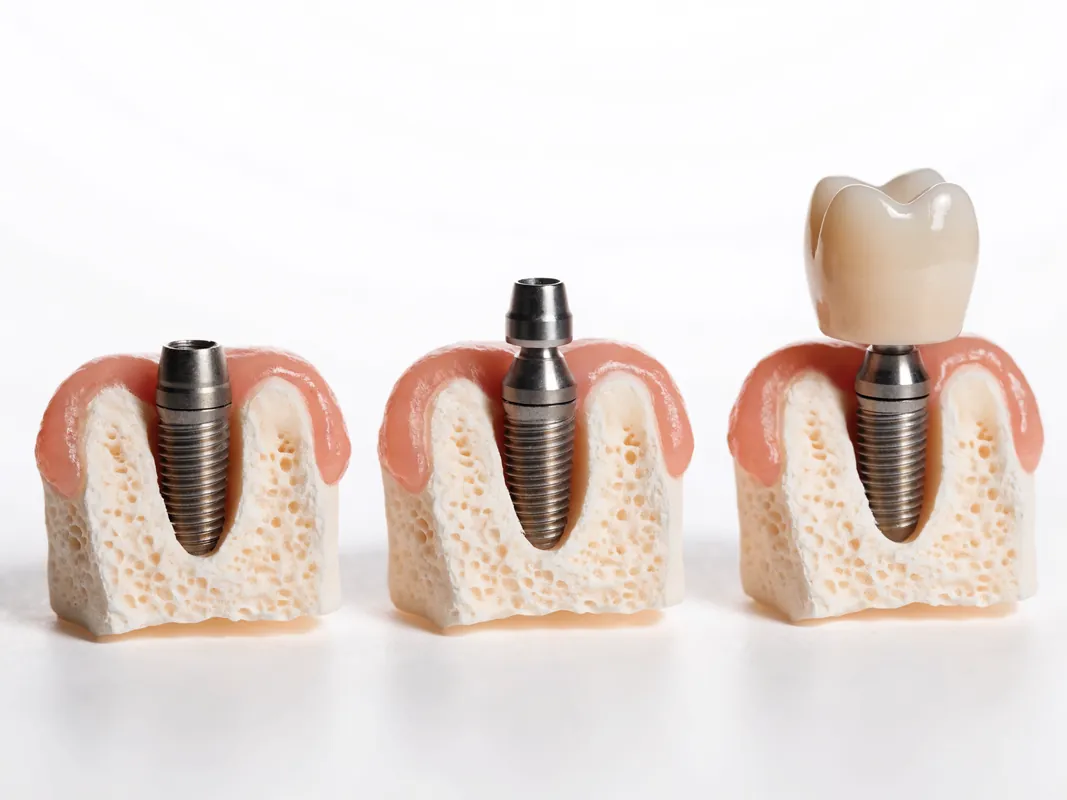
A molar extraction socket differs from a single-rooted anterior site. Root configuration, septal bone, proximity to anatomical structures, occlusal forces, restorative space and access may change whether immediate placement is reasonable. The mere presence of a large socket does not mean it is easy to place an implant correctly.
Ask how the planned implant position relates to the final crown rather than to one removed root. Ask whether the available anatomy supports stability in the intended position, what defect may remain, and how loading will be protected. If the site is close to a sinus, nerve or other structure, the clinician should explain the investigation and contingency appropriate to that patient.
A website should not declare all molars suitable or unsuitable. The site-specific record decides.
Multiple adjacent extractions multiply dependencies
When several neighbouring teeth are proposed for extraction, the decisions interact. Removing one tooth can change temporary restoration support, tissue contour, implant spacing and load distribution. A plan may require a bridge rather than one crown per implant, or it may preserve selected teeth for strategic reasons.
Request an arch map showing each tooth, extraction indication, proposed implant site, provisional support and definitive restorative unit. Ask which decisions are independent and which depend on the condition of another site. Ask what happens if only some sites permit immediate placement.
Do not allow the term immediate implants to hide a mixed pathway. Some sites may receive implants, some may be grafted, some may heal, and some teeth may be retained. The quote and record should show that complexity.
Full-arch marketing must not replace individual assessment
A proposal to remove many or all remaining teeth and place a full-arch restoration is qualitatively different from replacing one non-restorable tooth. Tooth preservation, periodontal prognosis, prosthetic space, jaw relationship, hygiene, speech, function, anatomy and patient adaptation all need explicit assessment.
Do not infer eligibility from an advertised implant count or a package name. Ask for the diagnosis and prognosis of every tooth proposed for removal, the alternatives to removing all teeth, the restorative design, the number and distribution of implants proposed, the loading fallback, maintenance access and the consequences if one implant does not progress.
For a dedicated package-scope checklist, see the All-on-4 package guide. That guide should not be read as a recommendation for full-arch extraction. This page remains focused on the decision relationship between extraction timing and implant placement.
Provisional restoration is an information stage
A provisional restoration may protect appearance, support tissue, help assess shape, and provide information about speech, cleaning or bite. It is not automatically a same-day fixed tooth, and it is not the definitive restoration.
The plan should identify the provisional type, material, retention, functional restrictions, expected review, repair responsibility and replacement cost if damaged. It should also state what alternative temporary solution is available if the implant cannot support the planned provisional. A removable, adhesive or tooth-supported temporary may be considered depending on the case.
Ask who designs and fits the provisional, who adjusts it, and what records are preserved. If it is connected to the implant, the loading status and occlusal plan should be explicit. If it is not connected, the patient should understand how it is worn and cleaned.
Definitive restoration requires a later gate
Placement is not the end of treatment. A definitive restoration should follow adequate clinical review, tissue assessment, restorative records and acceptance of the implant's condition by the responsible clinician. The exact sequence is case-specific and should not be replaced by a flight date.
Ask what evidence is required before the definitive stage, who reviews it, what happens if healing or tissue conditions are not ready, and whether a new scan, impression, photograph, radiograph or other record may be needed. Ask how appearance, contact, occlusion, cleaning access and material choice will be evaluated.
A laboratory appointment or pre-booked travel itinerary should not override clinical readiness. If the definitive stage is deferred, the quote should explain the consequences for provisional care, travel and additional costs.
Trace the implant, components and materials
A future dentist needs more than the word implant. The record should include the implant manufacturer, system, reference or catalogue identifiers where available, dimensions, site, batch or lot traceability where applicable, placement date, responsible clinician and relevant component details.
The same principle applies to graft or membrane materials, abutments, screws and restorative materials. Ask for an implant passport or equivalent component record and preserve it independently of a messaging app. Ask which parts are original system components and whether compatible alternatives are used.
Traceability supports maintenance, repair and investigation. It does not guarantee that components will remain available forever. The contract should explain who bears the cost and responsibility if a part, laboratory remake or future intervention is needed.
Consent must include the fallback pathway
Valid consent is more than a signature beneath the preferred plan. It should record diagnosis, material risks, reasonable alternatives, the option not to proceed, uncertainties, who provides care, and what happens if conditions change.
For immediate placement, the consent should explicitly cover at least these branches:
- extraction followed by immediate implant placement without a connected restoration;
- extraction followed by immediate placement with a provisional restoration only if the loading gate is met;
- extraction followed by site management and later implant assessment;
- extraction followed by an alternative temporary replacement;
- discovery of a defect or pathology requiring a revised plan;
- a decision not to place an implant;
- later deferral of the definitive restoration;
- the emergency and complaint routes.
Consent should be updated when the plan changes materially. The patient should be able to ask questions without losing a deposit merely because a clinical finding requires reconsideration. Financial terms and clinical consent should not be used to force continuation.
Version the plan, quote and consent together
A remote plan may be version one. The in-person assessment may create version two. The post-extraction findings may create another version. Every material change should appear in the clinical plan, quotation and consent rather than in an informal chat message alone.
Each version should show its date, author, assumptions, included items, excluded items, clinical gates and effect on the total. Superseded versions should remain available so the patient can see what changed and why. If a substitute clinician or material is proposed, that change should be recorded before use where practicable.
Version control is especially important for cross-border care because the patient may later need to explain the pathway to a local dentist. A clear record reduces ambiguity about what was planned, what occurred and what remains outstanding.
Build an itemised clinical quotation
The quotation should separate examination and diagnostics; treatment to preserve or remove the tooth; extraction; pathology or laboratory fees where relevant; implant placement; implant and component costs; grafting or soft-tissue procedures if planned; provisional replacement; laboratory stages; definitive restoration; medications; reviews; maintenance; and management of foreseeable changes.
For each item, ask whether it is included, optional, contingent or excluded. Ask how the price changes if:
- extraction is completed but no implant is placed;
- grafting is needed;
- a different temporary replacement is required;
- the implant is placed but not loaded;
- the definitive stage is deferred;
- extra imaging or pathology is indicated;
- a component or provisional restoration needs repair;
- local aftercare is required;
- another trip becomes necessary.
Do not compare quotes by headline total until scope is equivalent. A lower figure may omit the provisional, graft, abutment, definitive crown, records or follow-up. A higher figure may still fail to identify the responsible provider. Itemisation is not proof of quality, but it exposes assumptions.
Separate treatment cost from total-trip cost
Cross-border decisions involve more than the clinical invoice. Create a separate worksheet for travel, accommodation, meals, accessible transport, companion costs, unpaid leave, childcare, insurance, local dental review and a contingency for schedule change. Use current quotes rather than website averages.
Keep logistics providers separate from the healthcare contract unless the written terms establish otherwise. A transfer or hotel arrangement does not prove clinical suitability. If a bundled travel service is offered, ask who contracts it, whether it is refundable when treatment changes, and whether accepting it affects clinical cancellation rights.
The [NHS guidance on planned treatment abroad](https://www.nhs.uk/using-the-nhs/healthcare-abroad/going-abroad-for-treatment/going-abroad-for-medical-treatment/) notes that ordinary travel cover and health cards may not cover planned treatment. Check specialist cover and exclusions directly with the insurer. Do not assume emergency complications, altered travel or remedial care are covered.
Plan aftercare before travel
Aftercare is a clinical service, not a promise that someone will answer messages. The plan should identify the responsible reviewer, intended review method, local examination arrangements, expected maintenance records and the route for escalation. Remote photographs may support triage but cannot replace an examination when one is required.
Before travelling, ask a local dentist whether they are willing and able to provide routine care or urgent assessment, and what records they require. Do not assume a local clinician will accept responsibility for another provider's work or use unfamiliar components. Budget for local care even if the overseas provider offers remote contact.
The [GDC guidance for patients considering dental care abroad](https://www.gdc-uk.org/docs/default-source/information-standards-and-guidance/going-abroad-for-dental-treatment/going-abroad-for-your-dental-cared3d463b7cee0446882bf877483299dd4.pdf?sfvrsn=c67e2b57_7) encourages questions about clinician training, aftercare, complaints and records. Use those questions before payment, not only after a problem.
Define urgent signs and the emergency route
The treating team should provide personalised written instructions on expected postoperative effects, hygiene, diet or loading restrictions, medicines, review and warning signs. The instructions should state whom to contact, what information to provide and when local urgent or emergency care is required.
Examples that can require prompt professional assessment include bleeding that does not settle as instructed, increasing swelling, fever or systemic illness, breathing or swallowing difficulty, worsening pain, altered sensation, trauma, a loose provisional, or concern about infection. This list is not a diagnosis and not a substitute for local emergency services. Severe or rapidly worsening symptoms may require immediate local care rather than waiting for a reply from abroad.
The emergency route should distinguish a medical emergency, urgent dental assessment, non-urgent provider query and complaint. It should include usable contact details, operating boundaries and a method for transferring records securely.
Know when not to travel
Fitness to fly and readiness for a long journey depend on the procedure, symptoms, complications, medical history, medicines and access to care. A generic website cannot declare a universal safe departure point.
Ask the treating clinician for individual advice and check the airline and insurer's current requirements. Postpone or change travel when the responsible professionals advise it, or when acute symptoms make local assessment more appropriate. Keep flexibility in the itinerary because an intra-operative fallback or postoperative concern can change the plan.
Before booking, review current official foreign travel advice at [GOV.UK](https://www.gov.uk/foreign-travel-advice), entry rules, airline terms and insurance wording. Travel rules can change and should not be hard-coded into a clinical promise.
Arrange a local handover
A useful handover pack should be available promptly and in a form another clinician can understand. It can include the diagnosis, consented plan and versions, tooth and implant chart, relevant images and reports, operative notes, medicines administered or prescribed, pathology information where relevant, implant and component identifiers, graft traceability, provisional design, loading restrictions, complications, review findings and outstanding stages.
Ask who is responsible for producing the pack, in what language, how it will be sent securely, and whether any fee applies. Ask for copies before leaving when possible. Screenshots of a chat are not a substitute for an operative record.
The local clinician should know what is provisional, what is definitive and what requires review. The overseas provider should know who can be contacted locally, but the patient should not be placed between two teams with no agreed ownership.
Complaints and remedy need written terms
Before treatment, ask for the provider's complaint process, response route, governing law, records-access process and professional indemnity information where applicable. Ask what happens if there is disagreement about diagnosis, workmanship, biological complication, component failure, trauma or maintenance.
A warranty label does not answer those questions. Read exclusions, evidence requirements, maintenance conditions, travel obligations and who decides whether a remedy applies. Do not assume that repair, replacement, travel or local care will be free.
Clinical complications are not automatically negligence, and dissatisfaction is not automatically resolved by replacing a component. The pathway should permit independent assessment and preserve evidence. Seek independent clinical or legal advice when the situation warrants it.
When immediate placement may be considered
Immediate placement may enter the discussion when extraction is justified, the patient and site have been adequately assessed, disease and medical risks are managed, the implant can be placed in a restoratively appropriate position, the post-extraction anatomy is acceptable, the responsible clinician can achieve suitable stability, a maintainable provisional strategy exists, and a fallback is ready.
This is not a checklist a patient can use to self-qualify. Each point requires clinical interpretation, and a favourable remote impression can change after extraction. The clinician's experience must match the complexity, especially in the aesthetic zone or when augmentation and immediate restoration are contemplated.
The benefit must be patient-centred, not merely convenient for a sales calendar. If the same outcome can be pursued more safely or clearly through staging, the patient should be told.
When early or delayed placement may be considered
A staged pathway may be considered when disease control, soft-tissue healing, defect management, diagnostic uncertainty, anatomy, prosthetic redesign, medical coordination or patient circumstances make immediate placement less suitable. Staging can also provide time to reassess whether an implant remains the preferred replacement.
The plan should explain what occurs during the interval, how the space is managed, what must heal or be reassessed, and what could still prevent later implant placement. Staging is not a guarantee that grafting or additional procedures will be avoided.
Patients should compare the burden of additional stages with the value of additional information and risk control. The right balance is individual.
When neither implant pathway is ready
Sometimes the immediate question is not timing but readiness. Active disease, incomplete diagnosis, uncertain restorability, unresolved medical risk, inability to maintain the proposed restoration, absent local aftercare, coercive consent or an unclear provider contract may justify pausing the implant decision.
A pause can allow urgent care, disease stabilisation, further imaging, specialist review, medication liaison, smoking support, financial clarification or comparison of non-implant options. It can also reveal that the patient does not want the maintenance or travel burden.
Choosing not to proceed is a legitimate outcome. A deposit or booked flight should not become a clinical indication.
Red flags in an extraction-and-immediate-implant proposal
Treat these as reasons to slow down and request evidence:
- extraction is recommended from a photograph without a tooth-specific diagnosis;
- the provider refuses to discuss preservation or no-treatment consequences;
- the legal treatment entity or responsible clinicians are unnamed;
- immediate placement and immediate loading are described as the same event;
- a fixed crown is promised before examination or extraction;
- the plan has no fallback if the socket wall is damaged or stability is inadequate;
- infection is treated as an automatic yes or no without site assessment;
- automatic antibiotic supply is described for every patient without an individual prescribing decision;
- grafting is guaranteed unnecessary or added without consent and traceability;
- a brand name is offered as proof of suitability;
- the temporary and definitive restorations are not distinguished;
- the quote changes verbally but no revised document is issued;
- records, component identifiers or operative notes will not be shared;
- aftercare means only a messaging number;
- travel dates override clinical readiness;
- refund, complaint or remedy terms cannot be read before payment;
- the patient is pressured to remove more teeth to fit a package.
No single red flag proves poor care. A pattern of missing identity, missing evidence and inflexible promises is a strong reason to seek another assessment.
A verification workflow before committing
Gate A — provider identity
Record the legal treatment provider, facility, responsible contacts, governing terms and complaint route. Verify the clinicians expected to own extraction, implant and restorative decisions.
Gate B — diagnosis and preservation
Obtain a tooth-specific diagnosis, restorability assessment, periodontal status and reasonable alternatives. Ask whether another opinion is appropriate before irreversible treatment.
Gate C — provisional clinical plan
Review the required examination and imaging, placement options, loading options, provisional replacement, definitive stage and all assumptions. Mark the document provisional until in-person assessment.
Gate D — fallback branches
Write down what happens if extraction reveals a defect, stability is inadequate, grafting is indicated, loading is unsafe, the implant is not placed, or the definitive stage is deferred.
Gate E — consent and quotation
Make the consent and itemised quote match the same plan version. Separate clinical charges from travel costs and list exclusions.
Gate F — records and traceability
Confirm that imaging reports, operative notes, implant and component data, graft records, provisional design and review notes will be released.
Gate G — aftercare and emergency
Arrange local handover, maintenance, urgent assessment, remote-review boundaries and insurance before travel.
Final decision checklist
Before agreeing to extraction with a possible immediate implant, be able to answer:
- What is the tooth-specific diagnosis?
- Why is preservation not reasonably recommended?
- Who is the legal treatment provider?
- Who owns extraction, implant placement, loading and restoration?
- Have current registrations and intended attendance been verified?
- What replacement alternatives and no-treatment consequences were discussed?
- What examination and imaging support the provisional plan?
- What periodontal or other disease must be stabilised?
- What medical or medication liaison is required?
- What site and soft-tissue risks were recorded?
- Is the implant position planned from the restoration?
- Does immediate describe placement, restoration or functional loading?
- What stability and anatomy findings must be confirmed after extraction?
- What is the written fallback if those gates are not met?
- Is grafting planned, contingent or excluded?
- What temporary replacement will be available in every branch?
- What evidence must be accepted before the definitive restoration?
- Are implant, component and graft records provided?
- Does the quote itemise every stage and foreseeable change?
- Are travel costs and insurance separate?
- Who provides local aftercare?
- Which warning signs require local urgent care?
- What are the complaint and records-access routes?
- Can consent be reconsidered if the plan changes?
The safest answer may be immediate placement, a staged pathway, a different replacement or no implant. The purpose of good planning is not to defend the fastest label. It is to preserve reasonable teeth, reveal uncertainty, match clinician skill to complexity, keep alternatives available and leave the patient with usable records whatever branch the case takes.
For a wider explanation of implant assessment and restoration choices, see the dental implants service guide. For full-arch package-scope questions, use the All-on-4 package guide. Neither linked page can determine individual eligibility.