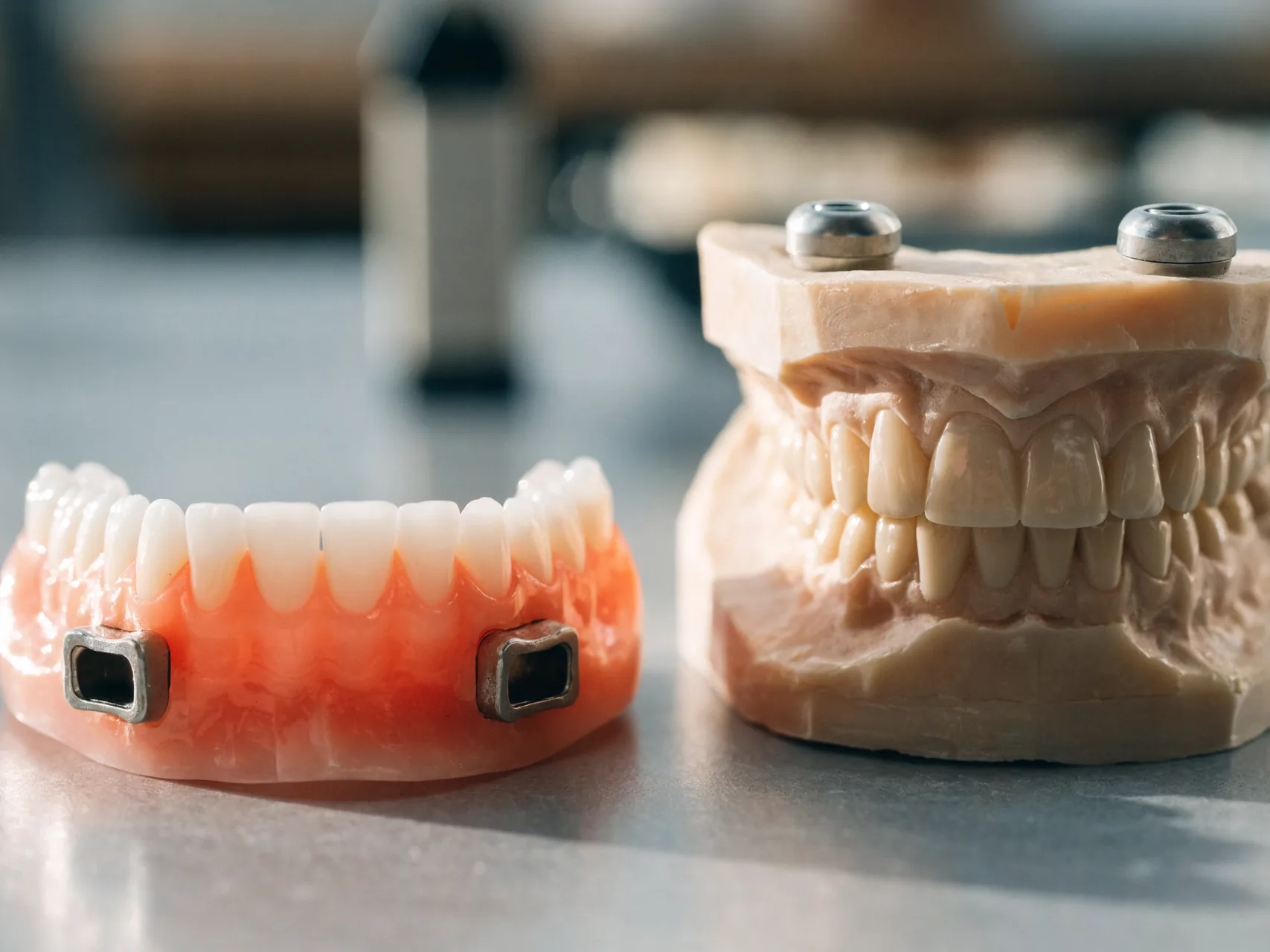
“All-on-4 versus dentures” sounds like a choice between one premium product and one basic product. Real full-arch planning is more complex. A person may have restorable teeth, a few strategically useful teeth, one edentulous arch, two edentulous arches, an existing denture that could be improved, anatomy suited to an implant overdenture, or a fixed-prosthesis proposal that requires substantial surgery and lifelong maintenance. The first decision is not which package to buy. It is what can be preserved, what needs treatment and which prosthetic concept fits the patient’s biology and priorities.
Three broad concepts deserve comparison. A conventional complete denture is removable and supported mainly by oral tissues. An implant overdenture is removable by the patient and uses implants or attachments for retention or support. A fixed full-arch implant prosthesis is attached to implants and removed only by a clinician when indicated. “All-on-4” is a widely used label for one fixed full-arch concept; it does not prove that exactly four implants, angled posterior implants, immediate loading or any particular material is appropriate for every arch.
This is an evidence-led decision guide for adults with extensive tooth loss or a full-arch proposal, including people considering treatment abroad. It is not a personal diagnosis, extraction recommendation, implant prescription, quotation, timetable, material choice or outcome promise. A named dentist must examine the patient, determine whether teeth are restorable, assess medical and dental risks, compare reasonable options, explain uncertainty, obtain continuing consent and remain responsible for care. Oral surgery, periodontics, prosthodontics, restorative dentistry, geriatric or medical input may be needed.
Do not extract restorable teeth to fit a package
The most consequential step in many full-arch plans is extraction, not implant placement. Natural teeth should be assessed individually and as part of the whole arch. Caries, fractures, periodontal support, pulp and apical status, restorability, strategic value, function, symptoms, patient ability to maintain them and reasonable restorative alternatives all matter. A poor photograph or a panoramic image alone cannot establish that every tooth is hopeless.
Possible alternatives to clearing an arch include periodontal treatment, endodontic care, repair or replacement of selected restorations, crowns where structurally justified, short-span bridges, removable partial dentures, tooth-supported overdentures, strategic extraction, transitional treatment or no immediate treatment after informed assessment. Preserving a tooth is not always feasible, but removing it is irreversible and may change bone, soft tissue, proprioception, prosthetic space and future options.
Ask for a tooth-by-tooth prognosis and the evidence behind each proposed extraction. “The package requires a clear arch” is not a diagnosis. If several teeth are labelled hopeless without periodontal measurements, appropriate tests or a restorative opinion, obtain an independent second opinion before surgery.
Urgent disease and uncontrolled symptoms come before comparison shopping
Pain, swelling, spreading infection, uncontrolled bleeding, trauma, a mobile tooth at aspiration risk, severe ulceration or systemic illness needs clinical assessment. Breathing or swallowing difficulty, rapidly increasing facial or neck swelling, collapse or another medical emergency requires urgent local care. A remote coordinator cannot diagnose or safely triage these conditions from a sales chat.
Active periodontal disease, untreated caries, endodontic infection, suspicious oral lesions, poorly fitting dentures causing persistent trauma and unstable medical conditions require diagnosis and management. A fixed bridge cannot cure peri-implant or periodontal disease, and a new denture cannot treat an undiagnosed lesion. Antibiotics do not replace definitive dental treatment.
If a current denture suddenly becomes painful or unstable, the reason may include tissue change, fracture, tooth change, occlusal wear, dry mouth, infection or another condition. Do not assume the only solution is implants.
Define the condition of each arch separately
The upper and lower jaws differ in anatomy, bone pattern, tissue support, tongue space and the way a removable prosthesis may obtain retention. A person may wear a satisfactory upper complete denture but struggle with a lower one, or may have natural teeth opposing an edentulous arch. Treating both arches identically for package symmetry may add unnecessary surgery and restorative burden.
Document for each arch:
- remaining teeth and their tooth-specific prognosis;
- periodontal support, mobility and maintainability;
- ridge form, tissue quality and undercuts;
- jaw relationship and available restorative space;
- smile display, lip support and facial profile;
- tongue position, gag reflex and dexterity;
- current denture fit, borders, base, teeth and occlusion;
- opposing teeth or prosthesis and their material and condition;
- parafunction, wear and fracture history;
- patient-reported problems with comfort, stability, speech, eating or appearance;
- what the patient can clean and maintain independently.
A plan may reasonably be fixed in one arch and removable in the other, implant-retained in one and conventional in the other, or staged. The choice must arise from diagnosis and shared decision-making rather than a mirrored implant count.
Conventional complete dentures: removable, non-implant treatment
A conventional complete denture replaces the teeth and lost supporting tissues with a removable prosthesis. It can restore appearance, provide lip and cheek support, aid speech and allow useful function without implant surgery. It may be the preferred choice where the patient wants to avoid surgery, anatomy or health makes implants unsuitable, dexterity favours removal for cleaning, financial priorities differ or a transitional option is needed.
The result depends on much more than the acrylic teeth. Impression or scanning strategy, extension and border form, jaw relation, tooth position, occlusion, base fit, saliva, ridge anatomy, neuromuscular control, expectations and adjustment all affect the experience. An upper denture may cover part of the palate; a lower denture interacts closely with the tongue and floor of mouth. Retention and stability vary between people and can change as tissues remodel.
Conventional dentures require cleaning, review and possible adjustment, reline, rebase, repair or replacement. They are not “just stop wearing them” reversible if teeth were extracted to create the edentulous arch. The prosthesis is removable; the biological changes that preceded it are not.
Implant overdentures: removable by the patient, retained or supported by implants
An implant overdenture is removed by the patient for cleaning. Implants connect through individual attachments, a bar or another designed mechanism. Depending on the arch and design, implants may add retention, support or both. The denture base can still contribute tissue support and facial contour.
Research comparing mandibular implant overdentures with conventional complete dentures often reports improvements in selected patient-reported and functional outcomes. These group findings do not guarantee that every patient will prefer an overdenture, and much of the evidence concerns specific mandibular configurations. Maxillary planning, opposing dentition, anatomy, implant number, splinting, attachment system and prosthetic design can be different.
Overdentures trade some fixed-prosthesis complexity for removability and easier direct access to the prosthesis and attachments. They also introduce surgery, peri-implant tissues, attachment wear, insert or matrix replacement, clip or bar maintenance, denture-base fracture risk and the need for ongoing professional review. “Snap-in” is a marketing nickname, not a complete clinical description.
For a focused explanation of removable implant retention, read the implant-supported overdenture guide. It should supplement, not replace, the individual comparison of a conventional denture, overdenture and fixed prosthesis.
Fixed full-arch implant prostheses: clinician-removable, not maintenance-free
A fixed full-arch prosthesis is attached to implants and is not removed by the patient. It may replace teeth and some lost tissue. Depending on design, it can be screw-retained or use another retrievable approach. A provisional may be used during a staged pathway, but “fixed” does not mean biologically permanent, unbreakable or identical to natural teeth.
Potential advantages include reduced movement during function and a patient experience that does not involve taking the prosthesis out daily. Potential burdens include implant surgery, difficult hygiene access, technical complications, repairs, professional removal when indicated, replacement of prosthetic components and peri-implant disease risk. A bulky tissue-replacement design can affect speech, lip support and cleanability even when it is fixed.
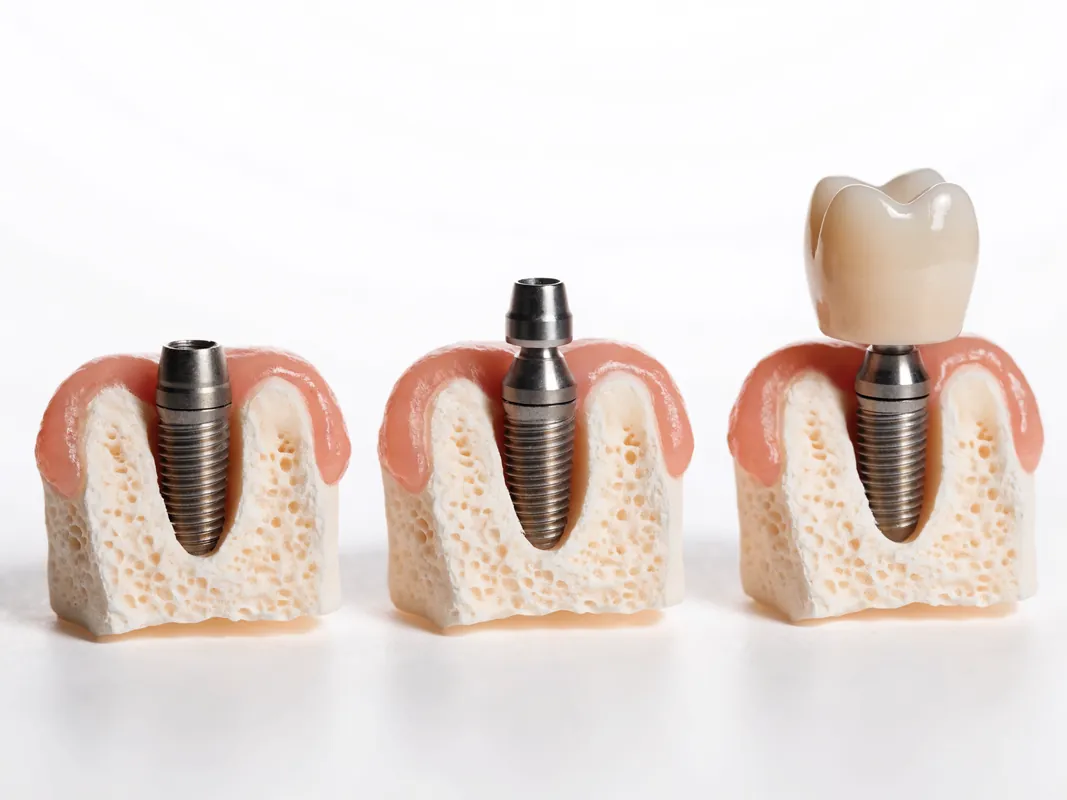
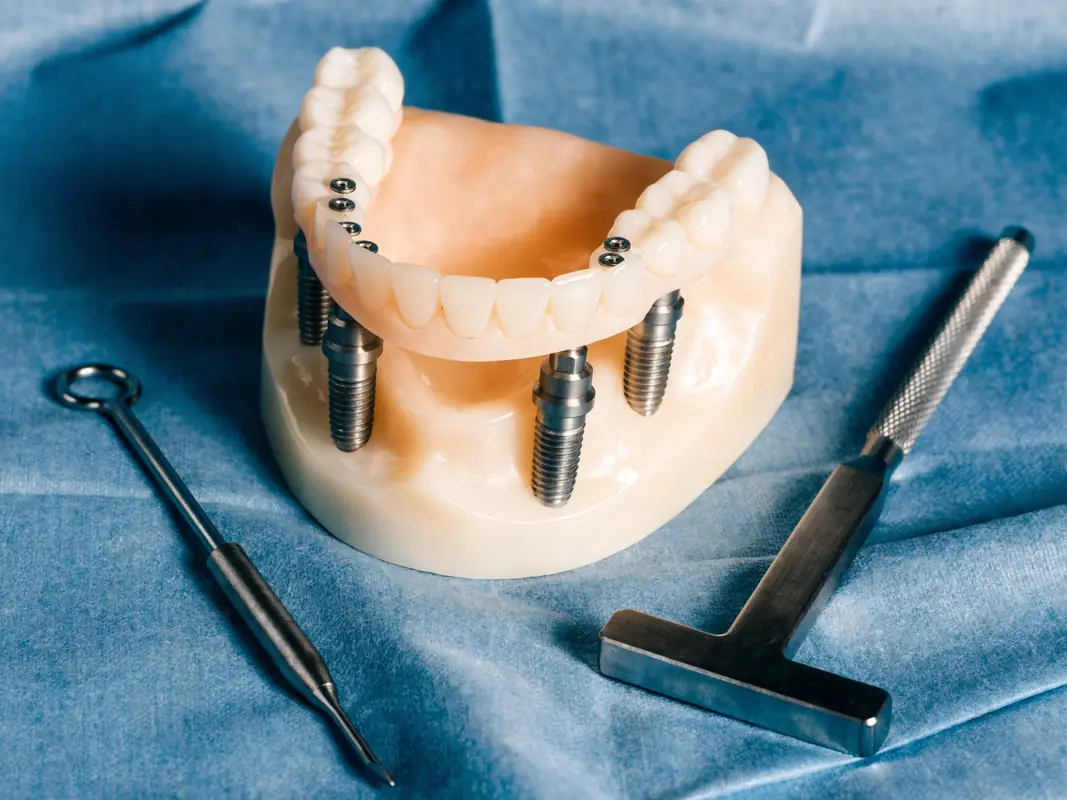
Four implants may support some fixed concepts, but implant count is not decided by the name of a page. The upper and lower arch, bone volume and quality, implant distribution, cantilever, restorative space, opposing dentition, load, hygiene access, surgical options and contingency if an implant cannot be used all influence design.
“All-on-4” is a concept label, not a diagnosis
The term commonly describes a full-arch fixed prosthesis supported on four implants, often with posterior implant angulation intended to use available anatomy and reduce distal cantilever. It does not mean every patient receives the same implant positions, immediate provisional, material, number of teeth or surgical sequence. It also does not prove that grafting is unnecessary or that four implants are preferable to another design.
Ask the team to replace the label with a specific plan:
- which arch is being treated;
- why each tooth is retained or extracted;
- implant number, sites, dimensions and intended angulation;
- restorative tooth positions and prosthetic space;
- cantilever and load strategy;
- fixed or removable design;
- provisional and definitive stages;
- hygiene access and professional-maintenance plan;
- contingency if stability, anatomy or surgery differs from the proposal;
- material and component traceability.
A branded protocol name cannot substitute for these records.
The All-on-4 implant planning guide and dental implant assessment guide explain the underlying surgical and restorative questions. Neither route name determines the treatment for an individual arch.
Medical history and medicines affect surgery and maintenance
Record medical conditions, medicines, allergies, previous surgery or radiotherapy, diabetes history, cardiovascular and respiratory disease, bleeding risk, immune status, smoking or nicotine use, alcohol where relevant, frailty, nutrition, osteoporosis medicines, dry mouth, cognition and ability to attend follow-up. This information does not create a website list of automatic exclusions; it identifies questions for the responsible clinician and, where needed, the medical team.
Age alone does not decide suitability. An older adult with stable health, realistic goals and support may be considered for implant treatment, while a younger person may prefer removable care or be unsuitable for another reason. Frailty, ability to maintain hygiene, manual dexterity, transport, carer support and future dependence can be as important as chronological age.
Do not stop or alter prescribed medicine based on online advice. The treating clinicians must assess interactions, bleeding, healing and prescribing within the applicable standards.
Imaging must answer a clinical question
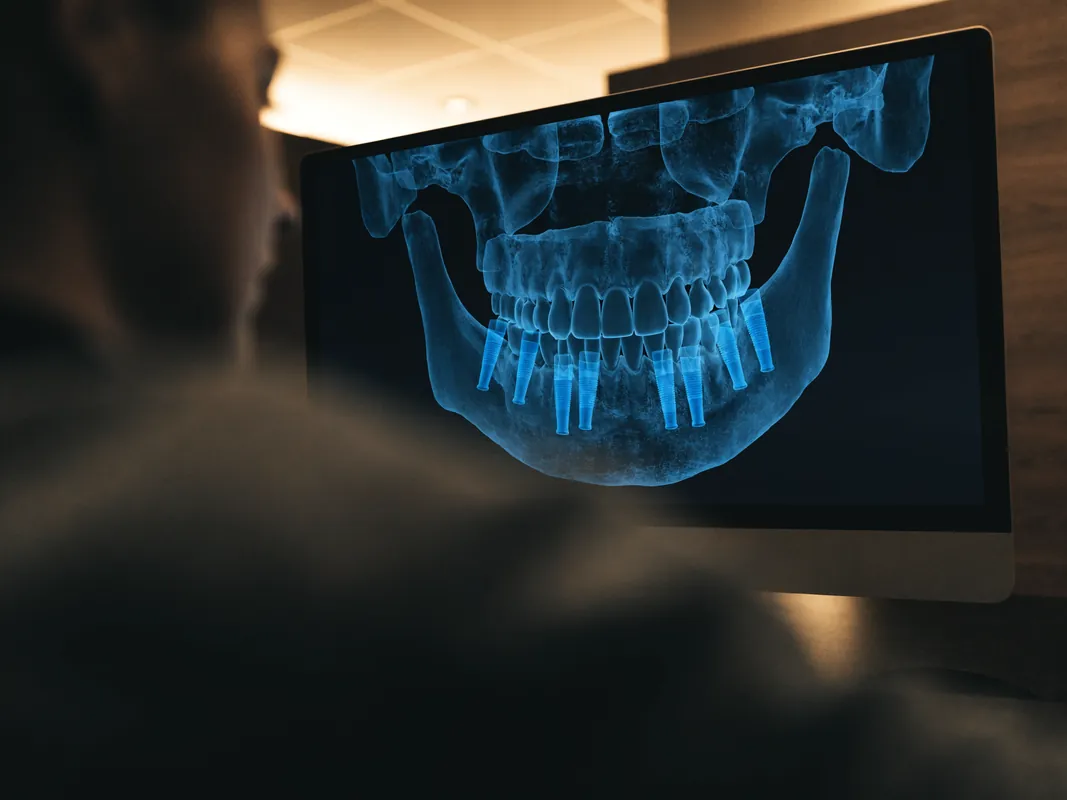
Clinical examination and appropriate imaging may be needed to assess remaining teeth, bone, anatomy, pathology and implant sites. A panoramic radiograph can provide an overview but cannot resolve every three-dimensional question. Cone-beam computed tomography may be justified for implant planning, using an appropriate field of view and interpretation of the captured volume.
Imaging should follow history and examination, not a coordinator’s routine request. Ask who prescribed it, who reports it, what question it answers, whether recent suitable imaging exists and how it changes the plan. A remote image cannot confirm soft-tissue quality, dexterity, speech, gag reflex, occlusion or whether the proposed prosthesis can be cleaned.
Surgical guides and digital planning can transfer an intended position, but they do not remove anatomical uncertainty or guarantee placement, loading or outcome.
Anatomy and prosthetic space can change the concept
Full-arch treatment needs room for teeth, framework or base, restorative material, hygiene access and tissue replacement where required. Too little space can weaken or over-contour a prosthesis. Creating space by removing bone is irreversible and must have a documented prosthetic purpose. Too much tissue loss may require a flange or pink material for lip support and speech.
The smile line can reveal a transition between prosthesis and tissue. Lip support may come from the denture flange in a removable design; replacing it with a fixed convex prosthesis may not reproduce the same support. A fixed option can therefore be less suitable for some facial and tissue relationships despite appearing more premium in marketing.
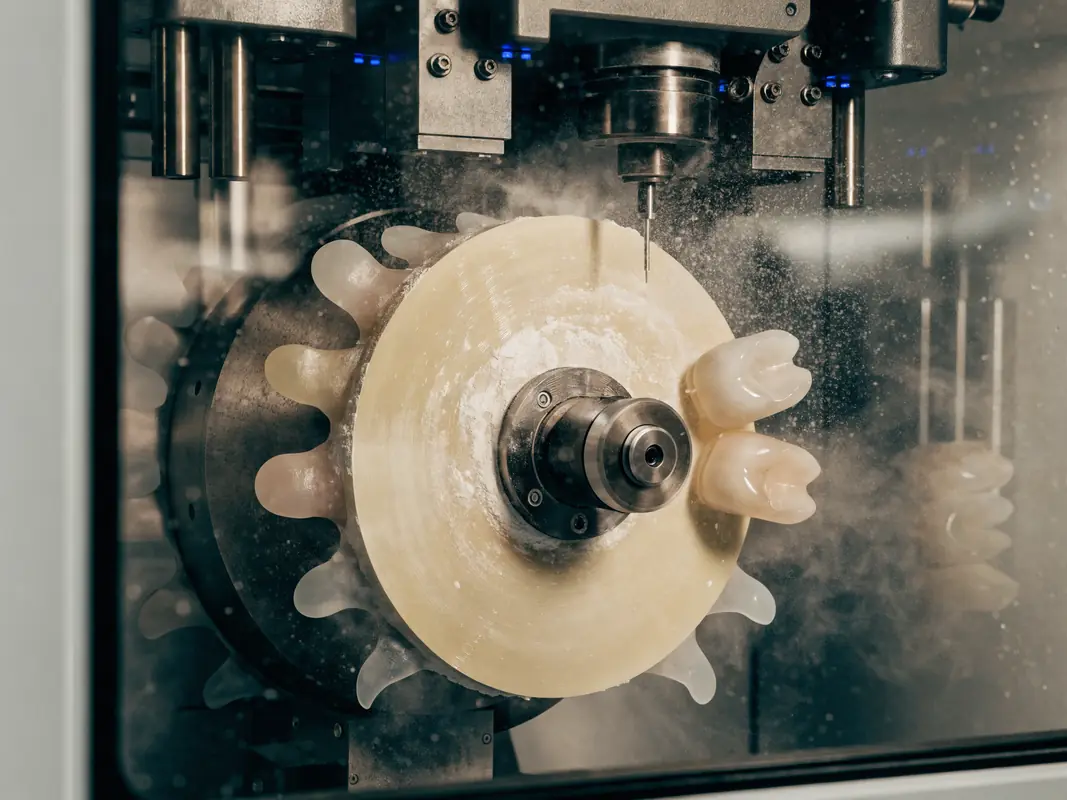
The clinician and laboratory should plan from intended tooth positions backward to implants and tissue, not place implants first and force a bridge onto them later. A trial denture, wax-up or prototype may help test the restorative envelope.
Patient priorities include more than “fixed or removable”
Ask what currently limits daily life. Is the concern movement, pain, food under the denture, gagging, speech, appearance, lip support, chewing, cleaning, social confidence, repeated fracture or fear of surgery? Which problem matters most? Would the patient accept daily removal if it makes cleaning easier? Can they use interdental aids under a fixed bridge? Who will help if dexterity or cognition changes?
Some patients value a fixed experience; others value repairability, lower surgical burden or being able to remove and inspect the prosthesis. A well-made conventional denture may satisfy one person while another remains limited by anatomy. Group averages cannot decide an individual preference.
Use a written priority list and revisit it after the diagnostic prosthesis or prototype. The most expensive concept is not automatically the best match.
Function and chewing cannot be reduced to bite-force percentages
Fixed and implant-retained prostheses may improve stability and selected functional outcomes compared with conventional dentures in studied populations. Yet web tables claiming that one option restores a fixed percentage of “natural bite force” oversimplify methods, food, muscle, anatomy, adaptation and patient experience. Function is not one number.
Assess chewing comfort, food avoidance, bolus control, swallowing, nutrition concerns and opposing dentition. A prosthesis that remains stable can still have an uncomfortable bite, difficult contours or fractured teeth. A removable denture can provide useful function when properly designed and adapted, though limitations should be discussed honestly.
After any major change, diet advice must follow the actual treatment and clinical review. No page should promise steak, nuts or unrestricted chewing on a universal date. A speech and language or dietetic referral may be relevant for selected patients with wider swallowing or nutrition needs.
Speech, taste and palate coverage need a real trial
An upper complete denture often covers part of the palate, while some implant-supported designs may reduce or avoid palatal coverage. This can change tongue space, texture perception, temperature, speech and the patient’s subjective experience. It does not support a blanket claim that dentures eliminate taste or that fixed teeth guarantee natural speech.
Tooth position, flange contour, palatal thickness, vertical dimension and tongue space influence sounds. Fixed prostheses with a tissue-replacement contour can also affect speech and air escape. A prototype, trial denture or provisional can reveal some problems, but adaptation is variable and a fixed timetable cannot be promised.
Record speech concerns before treatment and at trial stages. If the patient cannot accept the tested form, the design should change before definitive processing or bonding.
Appearance and lip support may favour different designs
Both removable and fixed prostheses can be designed to replace teeth and lost tissue. A removable flange can provide substantial lip and cheek support and can be adjusted or replaced more directly. A fixed prosthesis may reduce removable bulk but may need pink restorative material or a convex tissue surface to bridge the tissue deficit.
The smile line, lip mobility, facial profile, tooth display at rest, speech, gingival display and transition line should be recorded. A fixed design that looks attractive in a cropped smile may not support the face as expected. A bulky fixed surface hidden under the lip may be difficult to clean.
Use a trial denture, wax-up, digital design and physical prototype as decision aids. A screen render cannot reproduce lip support, phonetics, food passage, cleansability or tissue response and is not a result guarantee.
Hygiene access can be the deciding factor
Conventional dentures and overdentures are removed for direct cleaning of the prosthesis and underlying tissues. Implant overdentures also require cleaning around abutments, attachments or bars. Fixed full-arch prostheses require brushing plus effective access under the bridge and around each implant with aids selected for the actual contours.
The patient should demonstrate that they can clean the proposed design before it is finalised. Dexterity, vision, tremor, arthritis, gag reflex, cognition and carer support matter. “Brush and floss like natural teeth” is often an inadequate description for a fixed tissue-replacement bridge.
Poor access can contribute to plaque accumulation and peri-implant inflammation. The EFP emphasises home hygiene, professional maintenance and prompt assessment of inflammation. A design that the patient cannot maintain should be reconsidered rather than followed by blame.
Conventional dentures have their own hygiene and tissue-care needs
NHS patient guidance recommends cleaning dentures and caring for the gums, tongue, palate and any remaining teeth. Products and overnight wear advice should follow the clinician and material. Toothpaste can be too abrasive for some denture materials, and hot water can distort some bases. Clean over a water-filled basin or soft surface to reduce damage if dropped.
Leaving a denture out for a period may be advised to rest tissues, but immediate post-extraction and other circumstances can require different instructions. Do not impose one overnight rule without knowing the clinical situation. Sore spots, ulceration, fungal infection, dry mouth and fit problems require assessment rather than self-adjustment.
Denture adhesive may help selected patients when used as directed, but it should not conceal a fractured, unstable or poorly fitting prosthesis. Ask for a fit review if adhesive need changes substantially.
Implant surgery adds biological and procedural risk
Implant-supported options require surgery. Risks can include pain, swelling, bleeding, infection, wound problems, altered sensation, damage to adjacent structures, sinus or nasal complications, implant instability or loss, graft-related complications and medical events. The exact risk depends on the arch, anatomy, health and procedure.
The surgeon should explain whether extractions, bone reduction, grafting or sinus procedures are proposed; who performs them; what anaesthesia or sedation is planned; and what findings could change the sequence. “Graftless” and “minimally invasive” are not guarantees. Angled implants can be useful in a planned concept but do not erase anatomy.
A conventional denture avoids implant surgery but may follow extractions, which have their own risks and healing. The comparison should count every irreversible step, not only implants.
Immediate loading, a provisional and definitive teeth are different
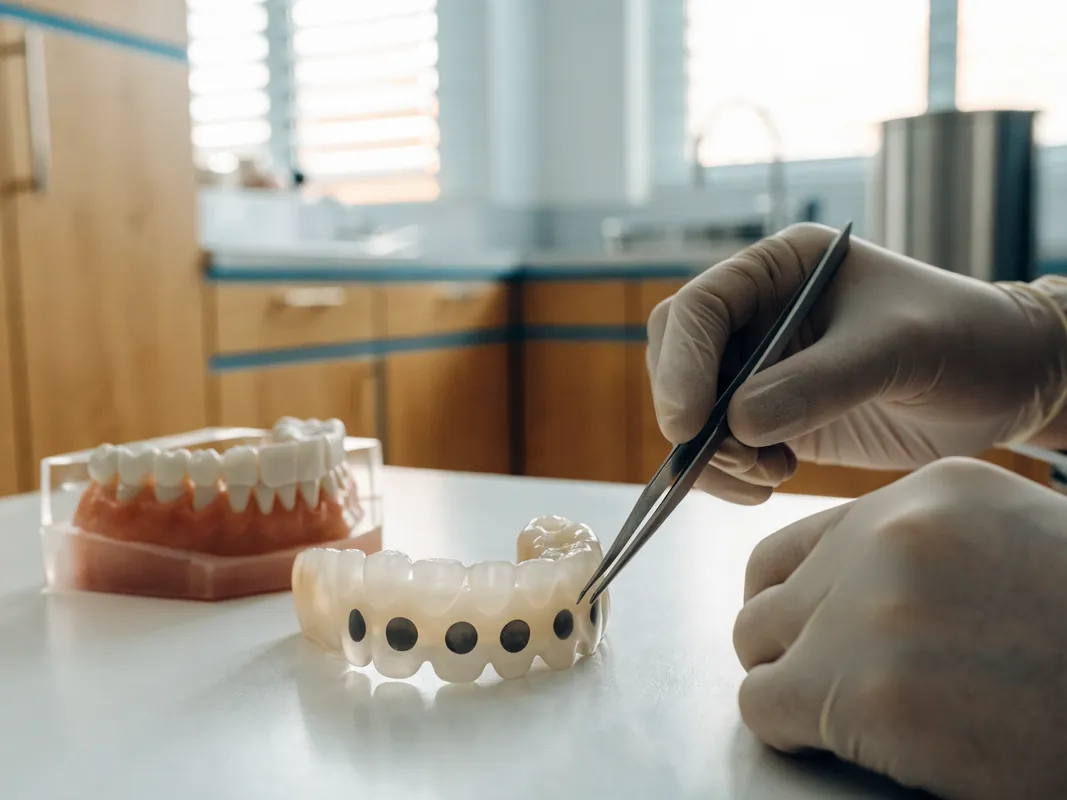
Implant placement, connection of a provisional, functional loading and delivery of a definitive prosthesis are separate events. A fixed provisional may be possible only when the responsible clinician judges implant stability, distribution, occlusion, patient factors and the ability to protect the restoration suitable. “Same-day teeth” does not mean the definitive bridge, normal chewing or guaranteed integration.
The written plan should state what will be attached, whether it is fixed or removable, what material it uses, whether it contacts during function, how it is cleaned, what restrictions apply and what would trigger a change to a removable or unloaded pathway. If loading criteria are not met, the contingency should already be consented and costed.
Healing and review are biological gates, not package dates. The definitive stage should follow the documented criteria for that patient and prosthesis.
Implants do not freeze bone or stop all tissue change
Tooth loss and extraction are followed by tissue remodelling. Implant placement transmits load and may help maintain bone locally, but it does not prevent all ridge, soft-tissue or age-related change. Bone and tissue levels can change around implants, and peri-implant disease can cause further loss. Conventional dentures can become less well fitting as the ridge changes, while fixed prostheses may develop spaces, contour or hygiene issues as tissues change.
Avoid claims that implants “prevent bone loss” absolutely or that dentures directly accelerate a single predictable amount. The patient needs baseline records and follow-up so fit, tissue, bone and function can be reassessed.
Relines, rebases, prosthetic contour changes or remanufacture may be needed in removable care. Fixed care can require professional removal, repair, component replacement or a new prosthesis. Neither option stops biology.
Repairability and service access matter for life after treatment
Conventional dentures can often be adjusted, relined or repaired, though some fractures, worn teeth, fit changes or design problems require remaking. Overdentures add attachment inserts, housings, clips, bars and abutments that may wear, loosen or need replacement. Fixed full-arch prostheses can experience tooth or veneer chipping, base wear, screw or component issues, framework problems, fracture and loss of fit or function.
Different materials and constructions change how a repair is performed, how long the patient may be without the prosthesis and whether a local laboratory can help. A monolithic material, layered material, metal-resin design or another system should not be selected by a “strongest” claim alone.
Before treatment, ask who keeps spare components, whether the prosthesis is retrievable, which tools or systems are needed, what temporary option exists during repair and who pays for travel or remanufacture. A lifetime warranty slogan is not a service plan.
Maintenance is expected for all three concepts
Complete denture reviews can assess fit, tissue health, occlusion, wear, fracture, hygiene and oral lesions. Overdenture reviews also assess implants, attachments, retention, base fit and component wear. Fixed reviews assess peri-implant tissues, hygiene access, occlusion, screws or components, wear, fracture and the prosthesis-tissue interface.
Research shows substantial variation in reported full-arch outcomes and maintenance. A systematic review of implant full-arch studies found heterogeneous success definitions and frequent reporting of technical complications. Another review found insufficient evidence for one universal schedule for professional removal of fixed full-arch prostheses. This supports risk-based follow-up, not a copied annual package.
The provider should give an individual maintenance interval and criteria for clinical and radiographic review. Maintenance fees, professional removal and repairs should be visible in the quote.
Use the full-arch maintenance checklist to structure questions about daily cleaning, professional review and responsibility for repairs; the actual interval remains risk-based.
Opposing teeth and the bite influence complication risk
A full-arch prosthesis functions against natural teeth, a partial dentition, another fixed bridge, an overdenture or a complete denture. The opposing material and support affect load, wear and fracture patterns. Vertical dimension, centric relation, anterior guidance, cantilever, parafunction and neuromuscular control need assessment.
Two arches do not automatically need the same material or design. Replacing both simply to create a matched package can sacrifice restorable teeth. Conversely, a new stable fixed arch opposing an old unstable denture may expose problems in the existing prosthesis. The whole system should be planned and consented.
A protective appliance may be considered for some patients after diagnosis, but it cannot eliminate biological or technical risk and is not automatically included.
Implant number and position should follow the prosthesis and anatomy
There is no universal implant count for every edentulous arch. Research often groups treatments by number, but patient-reported and clinical outcomes are reported with varied methods and risk of bias. The plan should balance prosthetic position, implant distribution, anatomy, bone, load, cantilever, hygiene, repair and contingency.
Ask what happens if one proposed implant cannot be placed or later cannot support the prosthesis. Can the planned provisional or definitive design still function? Would an additional implant improve redundancy or make hygiene harder? Does the removable plan depend on splinted or unsplinted attachments? These are case-specific decisions.
The phrase “two implants for an overdenture” or “four implants for fixed teeth” should not be treated as a remote prescription. Maxillary and mandibular evidence, designs and risks differ.
Material choice must be traceable and linked to repair strategy
Full-arch teeth and bases may use acrylic, composite, ceramic, zirconia, metal frameworks, polymers or combinations. Attachment and implant components add further systems. Each has thickness, wear, fracture, repair, weight, sound, optical and laboratory implications. No material is universally permanent, unbreakable or best.
The written record should identify the implant manufacturer, system, model, dimensions, sites and lot or batch; abutments, screws and attachment components; graft or membrane materials if used; framework and tooth materials; laboratory name and manufacture location; retention method; and applicable device documentation.
Avoid vague promises such as “permanent zirconia,” “premium hybrid” or “original protocol” without exact records. A local dentist needs component identity to investigate or repair problems.
Informed consent must cover the real alternatives and extraction
Valid consent is ongoing communication. GDC Principle 3 describes explaining reasonable options and possible costs and checking that consent remains valid at each stage. These are useful safety questions even where another jurisdiction governs care.
Before extraction or surgery, the patient should understand:
- the tooth-by-tooth prognosis and preservation alternatives;
- conventional denture, overdenture and fixed options where reasonable;
- the difference between removable, patient-removable and clinician-removable;
- surgical, biological and prosthetic risks;
- what the provisional and definitive stages mean;
- hygiene demands and whether the patient can meet them;
- speech, appearance and lip-support uncertainty;
- retention and attachment maintenance;
- material and repair pathways;
- costs, exclusions and changed-plan contingencies;
- local aftercare, complaints and emergency access;
- the right to pause, decline or seek a second opinion.
Consent to extraction should precede sedation or irreversible preparation and should not be inferred from payment. A flight, deposit or expiring offer must not become pressure to clear an arch.
Diagnostic dentures and prototypes are decision tools
An existing denture can reveal what the patient likes and dislikes about tooth position, support, speech, occlusion and hygiene. A new diagnostic denture, wax-up, virtual design or prototype can test changes before the definitive full-arch prosthesis. It may also help determine whether a fixed design can provide acceptable support without an excessive or uncleanable tissue surface.
A digital preview does not test tissue loading, gag reflex, salivary effects, chewing or long-term maintenance. A provisional fixed bridge does not guarantee the definitive result. Record the tested tooth position, vertical dimension, midline, smile, speech and patient feedback.
If the trial exposes a problem, revise the design. Do not remove additional bone or teeth merely to make a pre-sold digital concept fit.
Records should make every component and decision auditable
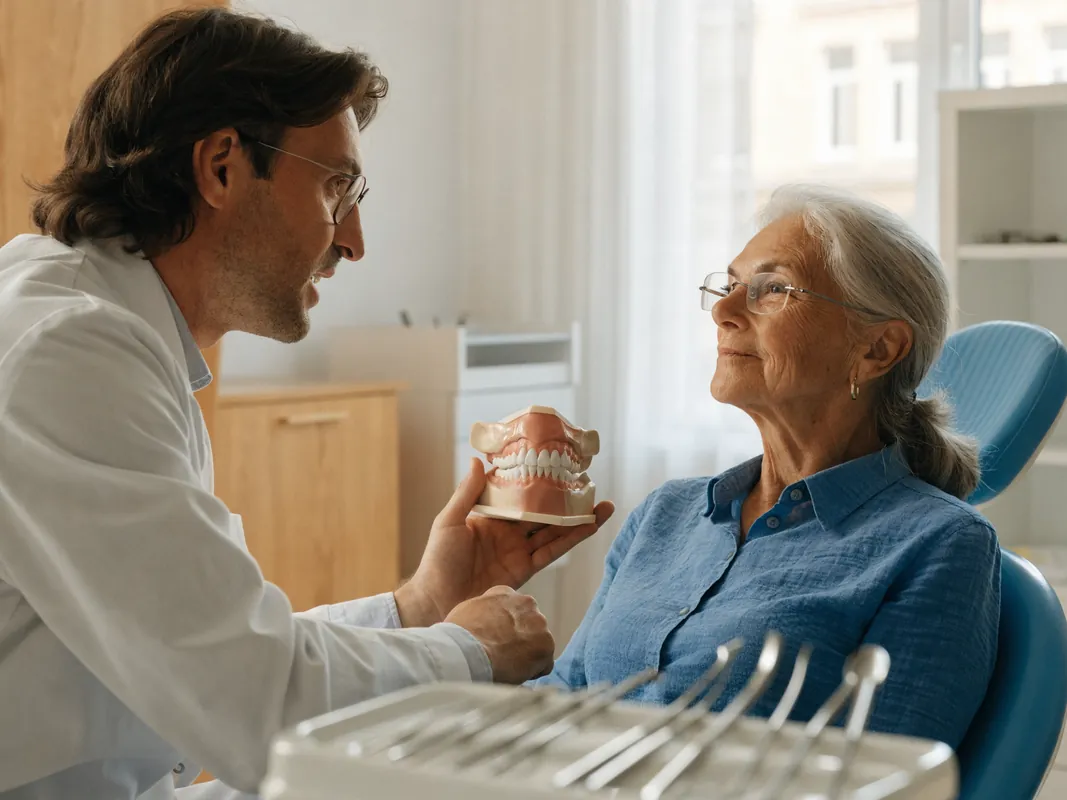
GDC Principle 4 describes complete clinical records including history, findings, radiographs, photographs, models or scans, consent, prescriptions and device statements where applicable. A full-arch record should include:
- medical and medication history;
- tooth-by-tooth diagnosis and prognosis;
- periodontal, restorative, occlusal and tissue findings;
- imaging prescription, report and planning;
- discussed alternatives and second opinions;
- extraction and surgery records;
- implant and graft component identifiers;
- torque or stability records where clinically relevant;
- prosthetic design, material and laboratory prescription;
- provisional status and loading instructions;
- hygiene demonstration and patient ability;
- final occlusion, fit, photographs and radiographs where indicated;
- maintenance, repairs, complications and changes;
- consent, quote, complaints and communication.
The patient should receive a portable summary and component passport. “All-on-4” on an invoice is not enough for future service.
Compare itemised quotations, not headline package prices
A useful quotation separates:
- examination, diagnostic prosthesis and imaging;
- treatment to preserve or stabilise remaining teeth;
- each extraction and surgical contingency;
- implant number, components and surgery;
- grafting or bone modification only where indicated;
- conventional denture, overdenture or fixed provisional;
- attachments, bar, framework and definitive prosthesis;
- laboratory stages and remakes;
- sedation or anaesthesia where separately appropriate;
- reviews, hygiene training and maintenance;
- relines, attachment insert replacement, repairs and professional removal;
- records and device documentation;
- changed-plan, cancellation, refund and complaint terms;
- travel, accommodation and transfers as separate non-clinical items if purchased.
Ask what remains provisional until examination and surgery. The lowest initial figure may omit the definitive prosthesis, attachments, graft contingencies, maintenance or repair. A higher figure does not prove quality. Compare scope, responsibility, evidence and long-term service.
Remote estimates cannot decide extraction or fixed suitability
A remote review can collect medical history, photographs, denture complaints, existing records and imaging. It can explain the three concepts and identify missing information. It cannot palpate tissues, test teeth, measure periodontal support, assess dexterity, reproduce speech, examine a denture fit, verify vertical dimension or determine whether a fixed bridge will be cleanable.
Any extraction list, implant count, loading plan, material and quote must remain provisional until the responsible clinicians examine the patient and review appropriate imaging. Before sending health data, identify the legal recipient, privacy notice, purpose, access and retention.
If the in-person diagnosis supports preserving teeth or using a removable option, a remote package should not control the clinical decision.
Cross-border treatment needs contingency, records and local support
The GDC patient guidance on treatment abroad and the NHS treatment-abroad checklist recommend verifying the provider, clinicians, procedures, costs, insurance, follow-up and complaint routes. Full-arch care raises additional questions because it can involve extraction, surgery, a provisional, laboratory work and component-specific repair.
Before booking, obtain:
- legal provider name and treatment address;
- named diagnostic, surgical and restorative clinicians and current registration routes;
- laboratory name and manufacture location;
- provisional sequence and criteria for each next stage;
- contingency if teeth are preserved, implants cannot be used or loading is unsuitable;
- direct clinical emergency contact;
- local dentist willing to review the work;
- component and record-transfer plan;
- insurance, cancellation and complaint terms;
- separate travel arrangements with flexible timing.
Do not let a return flight force extraction, loading or delivery. If tissues, speech, hygiene or the prototype are not acceptable, the clinical stage may need to pause.
Local aftercare is part of the initial choice
Identify a local dentist or prosthodontic service before travelling. Ask whether they can maintain the proposed implant system, attachments and prosthetic material and what records they need. A fixed bridge may require system-specific tools for removal. An overdenture may need inserts or clips not held locally. A conventional denture may need prompt adjustment after tissue change.
Remote photographs can support communication but do not replace examination. Bleeding, swelling, suppuration, pain, mobility, fracture, loss of retention, inability to clean, a changed bite or a non-seating prosthesis needs direct assessment.
Maintenance responsibility and costs should be agreed in writing. If care is split between countries, define who diagnoses, who authorises repair, who holds records and how disagreements are managed.
Warning signs after extraction, implant or prosthetic treatment
Follow the individual instructions and seek prompt clinical advice for uncontrolled or recurrent bleeding, increasing swelling, fever or systemic illness, severe or escalating pain, pus, wound breakdown, new or persistent altered sensation, a mobile implant or prosthesis, fracture, a bite that prevents closure, persistent ulceration, inability to eat or drink adequately, or inability to clean the prosthesis.
Breathing or swallowing difficulty, rapidly increasing facial or neck swelling, collapse, heavy uncontrolled bleeding or another medical emergency requires urgent local emergency care. Do not wait for an overseas message.
Conventional denture sore spots should be adjusted professionally. Do not grind the base at home. A loose overdenture attachment or fixed screw problem should not be forced into place without identifying the cause.
Red flags in a full-arch proposal
Pause and seek an independent opinion if you encounter:
- every remaining tooth condemned from a photograph or panoramic image;
- no tooth-by-tooth prognosis;
- “All-on-4” presented as the only option;
- exactly four implants prescribed for every arch;
- fixed bite-force, lifespan or success percentages;
- unrestricted eating promised on a package date;
- bone loss described as completely prevented;
- immediate fixed teeth guaranteed before surgery;
- a named implant or material presented as universally best;
- no conventional or overdenture comparison;
- hygiene reduced to “brush like natural teeth”;
- no prototype, speech or lip-support assessment;
- no contingency if an implant cannot be used;
- an open-ended coverage slogan without clear repair, travel and biological exclusions;
- no laboratory or component records;
- an unitemised clinical and hotel package;
- no local maintenance or emergency route;
- pressure to extract because travel or a discount is booked.
Questions to ask the named clinicians
- Which teeth can be preserved, and what evidence supports each prognosis?
- What happens if I keep selected teeth?
- Is one arch different from the other?
- Can my existing denture be improved or used diagnostically?
- Is a new conventional complete denture reasonable?
- What would an implant overdenture change?
- What would a fixed full-arch prosthesis change?
- Why is this removable or fixed design proposed?
- Why this implant number and distribution?
- What anatomy limits the options?
- Is grafting or bone reduction proposed, and why?
- What can the prototype reveal about lip support and speech?
- Can I clean under the proposed design?
- How will you test my ability to maintain it?
- What provisional will I have after extraction or surgery?
- What criteria permit loading?
- What happens if those criteria are not met?
- What can I eat, and who changes that advice?
- Which technical and biological complications should I understand?
- How is each option repaired or relined?
- Which components may need routine replacement?
- Which material and laboratory are proposed?
- What implant and device records will I receive?
- What maintenance and imaging are planned?
- Who can remove or repair the prosthesis locally?
- What exactly is included and excluded in the quote?
- What happens if the in-person plan is less or more extensive?
- Who is responsible for complications and complaints?
- Can I take the records for a second opinion?
- Can I pause before extraction or definitive delivery?
A patient decision checklist
Before agreeing to full-arch treatment, confirm:
- Every remaining tooth has an evidence-based prognosis.
- I understand that extraction is irreversible.
- Each arch has been assessed separately.
- I have compared conventional denture, overdenture and fixed concepts where reasonable.
- I understand patient-removable and clinician-removable are different.
- My medical history, dexterity, cognition and support were considered.
- The intended tooth position, lip support, speech and hygiene access were tested.
- I know the proposed implant sites and contingency if the plan changes.
- Immediate loading is conditional, not guaranteed.
- I know how the provisional differs from the definitive prosthesis.
- I can demonstrate cleaning of the proposed design.
- I understand repairs, relines, attachment wear and professional maintenance.
- Materials, components and laboratory are traceable.
- The quote is itemised and travel is separate.
- Local aftercare and urgent-care routes are arranged.
- I can stop, decline or obtain a second opinion before irreversible care.
Evidence and further reading
These sources inform the framework. They do not diagnose an individual, prescribe an implant count or promise an outcome.
- Guy’s and St Thomas’ NHS Foundation Trust, Dentures, accessed 29 August 2026: denture adjustment, cleaning, tissue care and storage. https://www.guysandstthomas.nhs.uk/health-information/dentures
- European Federation of Periodontology, Peri-implant disease prevention, accessed 29 August 2026: home hygiene, professional review and prompt assessment of inflammation. https://www.efp.org/for-patients/dental-implants/peri-implant-disease-prevention/
- EFP clinical guideline infographic on prevention and therapy of peri-implant diseases, accessed 29 August 2026: diagnosis, risk communication, alternatives, hygiene and prosthesis-contour considerations. https://www.efp.org/fileadmin/uploads/efp/Documents/Other_publications/Clinical_guidelines/peri-implantitis-guideline-01-prevention.pdf
- Systematic review comparing conventional complete dentures with mandibular implant-retained overdentures, accessed 29 August 2026: patient-reported, function and evidence-scope considerations. https://pubmed.ncbi.nlm.nih.gov/28666845/
- Systematic review and meta-analysis of quality of life and satisfaction with complete dentures versus mandibular overdentures, accessed 29 August 2026: improvements in selected domains and hygiene trade-offs. https://pubmed.ncbi.nlm.nih.gov/33205918/
- Systematic review of full-arch fixed and removable implant rehabilitation outcomes and reporting, accessed 29 August 2026: heterogeneous definitions, technical complications and patient-reported measures. https://pubmed.ncbi.nlm.nih.gov/35815423/
- Systematic review of fixed versus removable modalities for complete edentulism, accessed 29 August 2026: functional, patient-reported, hygiene and technical trade-offs with heterogeneous evidence. https://pubmed.ncbi.nlm.nih.gov/41669595/
- Systematic review of overdenture maintenance requirements, accessed 29 August 2026: attachment and prosthetic maintenance rather than a maintenance-free promise. https://pubmed.ncbi.nlm.nih.gov/20209199/
- Systematic review of mandibular implant-overdenture maintenance, accessed 29 August 2026: varied complications and insufficient evidence for one superior universal attachment design. https://pubmed.ncbi.nlm.nih.gov/28385441/
- Systematic review of peri-implant diseases with full-arch restorations, accessed 29 August 2026: disease risk in fixed and removable implant-supported care. https://pubmed.ncbi.nlm.nih.gov/33571325/
- Systematic review of professional removal and supportive care for fixed full-arch prostheses, accessed 29 August 2026: limited evidence for a universal removal frequency and need for individual maintenance. https://pubmed.ncbi.nlm.nih.gov/38501398/
- General Dental Council Principle 3, Obtain valid consent, accessed 29 August 2026: options, costs, ongoing consent and documentation. https://standards.gdc-uk.org/pages/principle3/principle3
- General Dental Council Principle 4, Maintain and protect patients’ information, accessed 29 August 2026: clinical, imaging, consent, laboratory and device records. https://standards.gdc-uk.org/pages/principle4/principle4
- General Dental Council, Going abroad for dental treatment, accessed 29 August 2026: provider verification, costs, records, aftercare and complaints. https://www.gdc-uk.org/standards-guidance/information-for-patients-public/going-abroad-for-dental-treatment
- NHS, Treatment abroad checklist, accessed 29 August 2026: provider, travel, insurance, follow-up and contingency questions. https://www.nhs.uk/using-the-nhs/healthcare-abroad/going-abroad-for-treatment/treatment-abroad-checklist/
- NHS, How to find an NHS dentist in an emergency, accessed 29 August 2026: urgent dental access and emergency boundaries. https://www.nhs.uk/nhs-services/dentists/how-to-find-an-nhs-dentist-in-an-emergency/
The evidence supports preserving restorable teeth, comparing conventional complete dentures, implant overdentures and fixed full-arch prostheses, testing function and hygiene, and planning lifelong maintenance. It does not support a universal implant count, fixed bite-force or lifespan percentages, guaranteed immediate loading, maintenance-free implants, an automatic extraction package or one option for every patient.