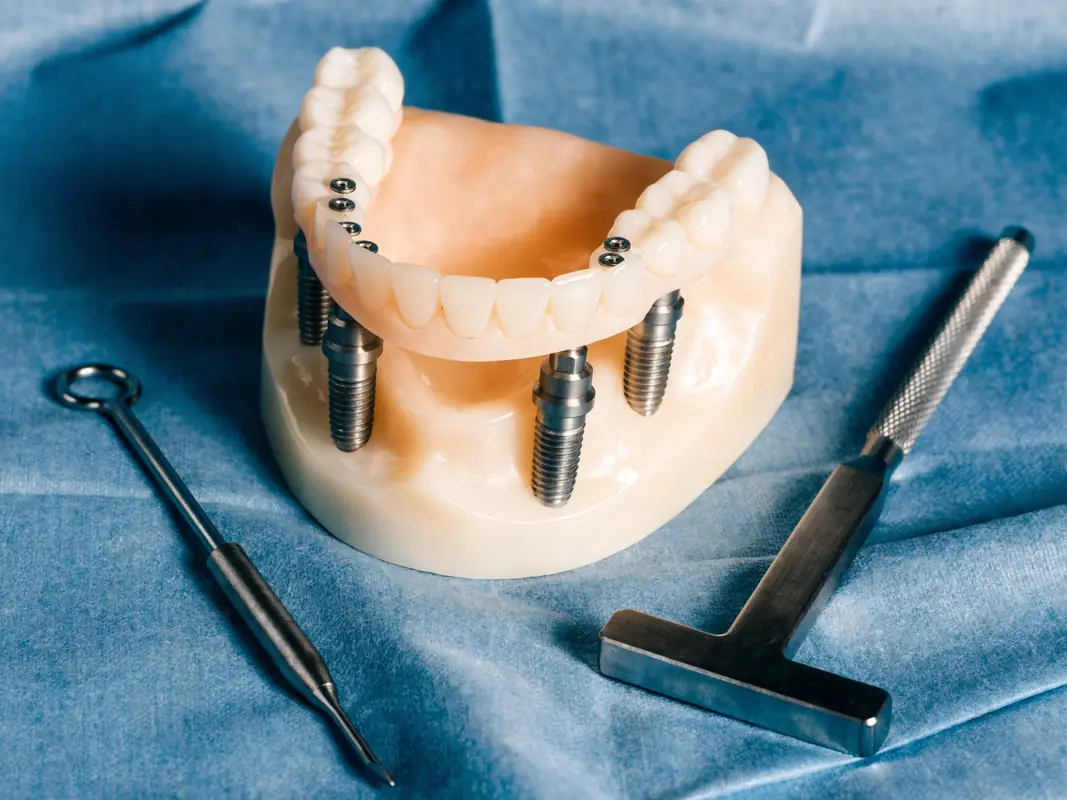
A dental trip from the Netherlands to Antalya is two visits with a healing gap in the middle, not a holiday with a filling attached. For implants you fly out for three or four nights, spend roughly three to four months at home while the bone integrates, then fly back for three or four nights to have the final crown fitted. Crowns and veneers are usually one trip of six to eight days. Direct flights from Schiphol run about four hours in season and thin out sharply in winter. Budget €900–€2,200 for the travel across both trips. And before you book anything: adult dental care sits largely outside the basisverzekering, so what you get back depends on your aanvullende tandartsverzekering — and you need that answer in writing first.
The Dutch journey end to end, stage by stage
Here is the whole thing on one screen. Timings assume a straightforward implant case; crown and veneer cases collapse stages five to eight into a single trip.
| Stage | Where you are | Typical duration | What actually happens |
|---|---|---|---|
| Ask your insurer | Home | 1–3 weeks | Written question to your zorgverzekeraar about treatment abroad, before any deposit leaves your account. |
| Remote assessment | Home | 1–3 days | You send an OPG (röntgenfoto, panoramic X-ray) or clear photos; the clinic replies with findings, options and a provisional plan. |
| Written behandelplan and quote | Home | Same week | Line-item quote, named materials, number of trips, number of clinic days. |
| Booking and dates | Home | 2–8 weeks ahead | Deposit paid, surgical dates fixed, flights booked around the clinic diary — not the other way round. |
| Arrival day | Antalya | Half a day | Transfer, hotel check-in, rest. No treatment on arrival day for surgical cases. |
| Consultation and CBCT | Antalya | Day 1 | 3D scan, clinical exam, the plan confirmed or revised in front of you before anything starts. |
| Treatment days | Antalya | Days 2–5 | Surgery or preparation, with review appointments in between rather than one marathon session. |
| Discharge and fly home | Antalya | Day 5–8 | Documentation pack, radiographs, medication, the date of the second trip agreed. |
| Healing gap | Home, Netherlands | 3–4 months (implants) | You chew on the other side, keep the hygiene appointments, send photos if anything worries you. |
| Second trip | Antalya | 3–5 nights | Final crown, bridge or prosthesis fitted and adjusted. |
| Year one at home | Netherlands | 12 months | Mondhygiënist visits, a review radiograph, the occasional small adjustment. |
The single most useful thing to understand is that the clinic diary comes first and the insurer question comes before even that. Patients who pay a deposit and then ask their insurer what happens next are asking the question in the wrong order, and by then the answer cannot change anything.
Step one: the remote assessment from an OPG or photos
Every serious plan starts with imaging. A Dutch patient has three routes to it. The cleanest is to ask your own practice for a copy of a recent röntgenfoto — you have a right of access to your own medical record under the AVG, and most practices will send a JPEG or a DICOM file, sometimes for a small administrative fee. The second is to pay for a fresh panoramic at a practice or an imaging centre, which in the Netherlands is a published, NZa-capped item and typically costs somewhere in the region of €70–€120. The third, least useful but better than nothing, is a set of clear photographs: teeth together, teeth apart, upper arch, lower arch, and a relaxed smile, taken in daylight with the phone camera steady.
What a remote assessment can honestly establish: how many teeth are missing or failing, whether the case is broadly implant, bridge or crown territory, roughly how many trips and clinic days it needs, and a price band. What it cannot establish: bone volume in three dimensions, sinus proximity, nerve position, gum health under existing margins, and the true condition of teeth that look acceptable on a flat image. That is what the CBCT on day one is for, and it is also why a remote quote is a starting point rather than a contract. Any plan that cannot change after the 3D scan was never a clinical plan.
Ask for the behandelplan in writing, with the number of clinic days spelled out. "Seven days in Antalya" tells you nothing. "Day one CBCT and consultation, day two extractions and implant placement, day four suture check, day six temporary fit" tells you whether you will also see Kaleiçi and Perge or whether you will be in a chair all week. It also tells your insurer what they are being asked about, which matters more than most people expect.
Flying from Schiphol, Eindhoven and Rotterdam to Antalya
Antalya (AYT) is the practical airport for the Turkish Mediterranean coast, roughly 2,600 km from Amsterdam. It is heavily served by leisure carriers between April and October and thins out badly in winter, which is the single biggest planning constraint on a two-trip case.
| From | Direct season | Direct flight time | Winter alternative |
|---|---|---|---|
| Amsterdam Schiphol (AMS) | Year-round, but sparse Nov–Mar | 3h 45m – 4h 10m | Istanbul (IST) then 1h 20m domestic, 7–9h door to door |
| Eindhoven (EIN) | Late April – late October | 3h 40m – 4h 05m | Reposition to Schiphol, or Istanbul via AMS |
| Rotterdam The Hague (RTM) | May – October, thin | 3h 45m – 4h 10m | Schiphol or Brussels |
| Groningen / Maastricht | Charter only, summer | 3h 40m – 4h 15m | Schiphol or Düsseldorf |
| Brussels (BRU) — for Zeeland and Brabant | April – October | 3h 30m – 3h 55m | Istanbul connection |
| Düsseldorf (DUS) — for Limburg and Twente | Year-round, better winter frequency | 3h 25m – 3h 50m | Often the best winter option by car |
Four practical notes. First, if your first trip falls in September and the second in January, those are two entirely different journeys: the January leg is likely to be an Istanbul connection with a bag drop, a domestic transfer and most of a day gone in each direction. Price and plan the return leg at the moment you book the first one, not four months later. Second, for readers in Limburg, Twente and Zeeland, Düsseldorf and Brussels frequently beat Schiphol on both fare and winter frequency, and the drive is shorter than the Randstad assumes. Third, Turkish Airlines and Pegasus both run frequent Istanbul–Antalya domestic rotations, so a missed connection is an inconvenience rather than a lost day — but leave at least two hours in Istanbul, and more if you are changing between Istanbul Airport and Sabiha Gökçen, which are on opposite sides of the Bosphorus and are not interchangeable. Fourth, book flexible or changeable fares for the second trip. Healing does not run to a timetable, and the cheapest non-changeable ticket becomes expensive the moment the clinic asks you to come three weeks later.
When to fly relative to surgery
Do not fly on the day of surgery. In the first twelve to twenty-four hours after implant placement or extractions you may still be oozing, the anaesthetic is wearing off, swelling is climbing towards its peak, and you are on medication that does not combine well with dehydration and a cramped cabin. Arrive at least one full night before day one. After routine implant placement or simple extractions, allow at least one clear night; most patients fly comfortably at 24 to 48 hours. After a sinus lift, allow considerably longer — pressure changes across a recently lifted sinus floor are a genuine concern and most surgeons ask for one to two weeks before flying, which is why that procedure is scheduled at the start of a trip rather than the end.
Swelling peaks around 48 to 72 hours after surgery, not on the day. Patients who book a two-night trip for a multi-implant case fly home at the exact moment they feel worst, and then remember the whole experience as brutal. Add the extra night.
Best months to travel, and the July–August problem
Antalya in July and August routinely sits between 34 and 40°C with high humidity. That matters more after oral surgery than people expect: you cannot swim for the first week, sun on a swollen face is miserable, dehydration makes post-operative pain worse, and the whole city is at its most expensive and most crowded. Dutch school holidays fall squarely in that window, which is exactly why so many people default to it — and exactly why it is the wrong choice for a treatment trip.
| Period | Weather | Flights from NL | Verdict for treatment |
|---|---|---|---|
| March – early May | 18–27°C, mild | Direct routes returning, moderate fares | Best overall window |
| Late May – June | 27–33°C | Plentiful, prices climbing | Good, book early |
| July – August | 34–40°C, humid | Peak fares, full aircraft | Workable but genuinely uncomfortable after surgery |
| September – October | 26–32°C, sea still warm | Direct routes running, fares falling | Best overall window |
| November – early December | 15–20°C, some rain | Seasonal routes ending | Quiet clinics, connection likely |
| January – February | 10–16°C, wettest | Istanbul connection or Düsseldorf | Cheapest, hardest travel, and a policy-year trap |
Two closure periods move with the lunar calendar and must be checked every year: Ramazan Bayramı (Eid al-Fitr) and Kurban Bayramı (Eid al-Adha). Turkish public holidays around these run three to four days and can be extended to nine, and domestic travel in that week is chaotic. Also check 29 October (Republic Day) and 1 January. Clinics stay contactable, but laboratories, imaging centres and couriers do not run normally, and a crown that needs a remake will simply wait.
The reimbursement question, honestly
This is why most Dutch readers arrive on this page, so here is the framework as plainly as it can be put. This section describes how the Dutch system is generally structured. It is not a promise, it is not advice about your policy, and none of it substitutes for a written answer from your own zorgverzekeraar.
In the Netherlands, dental care for adults sits largely outside the basisverzekering. There are limited exceptions rather than a general entitlement — some specialist surgical care, typically carried out or supervised by a kaakchirurg, can fall inside the basic package under referral and indication rules; so can certain cases treated under bijzondere tandheelkunde; and a full denture is treated differently again, with its own contribution rules. None of those exceptions is a route to funding elective implant, crown or veneer work abroad, and nobody should plan around one without a written indication from a Dutch clinician.
Because of that, most adults who get anything back at all get it from a voluntary aanvullende tandartsverzekering. Those policies share a shape: they reimburse a percentage of the cost, up to a fixed annual ceiling in euros, and both the percentage and the ceiling are set by the individual policy and can change with the policy year. We deliberately do not print a number here, because the only number that matters is the one in your own polisvoorwaarden.
| Element | Where it generally sits | What that means in practice |
|---|---|---|
| Routine adult dental care | Outside the basisverzekering | Self-funded, or partly met by an aanvullende tandartsverzekering if you hold one |
| Care by a kaakchirurg | Can fall inside the basic package | Referral and indication rules apply, and the eigen risico is engaged |
| Bijzondere tandheelkunde | Can fall inside the basic package | Specific medical indication and prior approval required |
| Full denture (volledige gebitsprothese) | Partly inside the basic package | Subject to its own eigen bijdrage |
| Aanvullende tandartsverzekering | Separate, voluntary | Percentage of cost up to an annual ceiling, both set by your policy |
| Treatment outside the Netherlands | Depends entirely on the policy | Commonly reimbursed only up to the Dutch NZa tariff for each item, and often only with prior written approval |
Three consequences follow from that last row, and they are the ones that catch people out.
The NZa ceiling cuts both ways. The NZa publishes maximum tariffs for dental procedures in the Netherlands, and insurers commonly reimburse foreign treatment only up to the equivalent Dutch tariff for the same item. Where Turkish prices sit below the Dutch tariff, that ceiling is not the binding constraint — your policy percentage and annual maximum are. Where a policy pays only a fraction of the tariff, the arithmetic can be modest even on a large invoice. Work it out on your own numbers before you travel, not afterwards.
Prior written approval is common, and retroactive approval usually is not. Many policies require toestemming vooraf for care obtained abroad, or above a certain amount, or from a non-contracted provider. An insurer that would have said yes in October can legitimately say no in March for the sole reason that nobody asked. Ask in the insurer's own portal or by email so there is a record, and keep the reply.
Your invoice has to be declarable. Dutch insurers process dental claims against Dutch procedure codes. A foreign invoice reading "implant treatment, €X" is difficult to process; an itemised invoice, in English, listing each procedure, each tooth in FDI notation, the material used and the price per item can be mapped onto the Dutch coding. Ask the clinic for that format explicitly, before treatment rather than at the airport, and ask your insurer which format they accept.
There is one more Dutch-specific trap worth naming, because it is invisible until it bites. A two-trip case can straddle two policy years. Dutch policies run to the calendar year and most people can change insurer or supplementary cover in the switching window each December. A case with trip one in November and trip two in February therefore falls into two annual ceilings — which can be helpful — but it also means the cover you relied on in November may not be the cover you hold in February, and a new supplementary policy may treat work begun elsewhere differently. If your case spans the turn of the year, ask both about this year and about next.

The five questions to put to your zorgverzekeraar in writing
Send these as one message and keep the reply. It takes ten minutes and it is the highest-value thing on this page.
- Does my aanvullende tandartsverzekering cover treatment by a dentist outside the Netherlands, and specifically outside the EU/EEA?
- Do you require toestemming vooraf for this, in what form, and how long does a decision take?
- Will reimbursement be limited to the Dutch NZa tariff per item, and how do you convert a foreign invoice?
- What invoice format do you accept — itemised, in English, with tooth numbers and materials — and do you need a translation?
- What is my remaining annual maximum for this policy year, and how would a treatment that finishes in the next policy year be handled?
Add a sixth if anything in your plan is surgical: ask whether any part of it would be a kaakchirurg matter inside the basisverzekering, and whether that would engage your eigen risico. And note plainly that the EHIC does nothing here. Turkey is outside the EU/EEA, the card has no effect on planned private dental treatment anywhere, and any arrangement that exists for medically necessary care during a temporary stay is not a route to funding elective work you travelled in order to receive.
Travel insurance is a separate question, and the answer is usually no
Standard Dutch travel policies — including the dental clause bolted onto many of them — almost universally exclude treatment you travelled in order to receive, and many go further and exclude complications arising from it. In the harshest wordings, undeclared medical travel can affect the rest of the trip's cover too. Read the polisvoorwaarden, not the summary page. What you want is a specialist medical-travel policy that knows what you are doing and prices it accordingly, typically €50–€150 for a two-week trip, bought with the purpose of travel declared honestly. Understating the purpose to get a cheaper premium is exactly the thing that voids a claim.
What the trip really costs on top of the Turkish quote
The treatment quote is not the trip cost. Here is a realistic 2026 build-up for one adult travelling from the Netherlands for a single-implant case, both trips combined. Figures are indicative and move with season and airport.
| Item | Trip 1 | Trip 2 | Notes |
|---|---|---|---|
| Return flights | €120–€330 | €120–€380 | Upper figure for winter Istanbul connections |
| Hold luggage and seat selection | €35–€80 | €35–€80 | Skippable if you travel light |
| Nights in Antalya | 4 nights | 3 nights | Often included in a clinic package |
| Hotel if paying separately | €180–€360 | €135–€270 | 4-star, city or Lara |
| Airport transfers | €0–€60 | €0–€60 | Usually included by the clinic |
| Parking or train to the airport | €25–€95 | €25–€95 | Schiphol long-stay adds up quickly |
| Food and incidentals | €100–€180 | €80–€140 | Soft food for the first days |
| Specialist travel insurance | €50–€150 | €50–€150 | Medical-travel cover, not the standard annual policy |
| Time off work | 4–5 days | 3–4 days | The real cost for many patients |
| Travel subtotal | €510–€1,255 | €445–€1,175 | Before any treatment |
Set that against the orientation picture. These are indicative typical totals for the same work, subject to a CBCT scan and to the specifics of your mouth. They are here only so the true comparison is visible — the detailed price anatomy belongs on our implant and veneer cost pages, not this one.
| Treatment | Typical Dutch private total | Typical Turkey total | Travel to add |
|---|---|---|---|
| Single implant with crown | €1,900–€3,000 | €650–€1,600 | €950–€2,400 across two trips |
| Three implants with crowns | €5,400–€8,600 | €1,900–€4,500 | €950–€2,400 across two trips |
| Eight to ten zirconia crowns | €4,800–€9,500 | €2,200–€4,800 | €510–€1,255, one trip |
| All-on-4, single arch | €10,000–€16,000 | €7,000–€10,500 | €950–€2,400 across two trips |
Two conclusions the table makes obvious. The saving on a single tooth is real but it is not life-changing once flights, two days of leave and a night in a hotel are counted — if your case is one crown, do it in Rotterdam. The saving on multi-unit and full-arch work is what makes the journey rational, and it is large enough to survive a pessimistic reimbursement outcome. Build the arithmetic on the assumption that you get nothing back. If money then arrives from your aanvullende tandartsverzekering, treat it as a rebate rather than a plan.
What to bring home: the documentation pack
This is the section patients skip and later regret. A Dutch tandarts reviewing overseas work is being asked to take clinical responsibility for something they did not plan, place or fit, and what they can do depends almost entirely on the paperwork you hand them. Ask for all of it as one PDF pack, emailed before you leave the clinic, and keep a copy somewhere that is not only your phone.
- Behandelplan and treatment record — teeth in FDI notation, procedures performed, dates, materials, and the name of the treating clinician.
- Röntgenfoto's — pre-operative and post-operative, ideally including the CBCT, as DICOM files on a USB stick or emailed, not photographed off a screen.
- Implantaatpaspoort — manufacturer, implant system, exact model line, diameter, length and lot- or batchnummer for every fixture placed. Without it a Dutch dentist cannot order the matching driver or abutment, and will not open a screw channel blind.
- Materiaalspecificatie — crown or bridge material (monolithic zirconia, layered zirconia, lithium disilicate), whether the restoration is cemented or screw-retained, torque values, and the shade.
- Garantiebewijs — what is covered, for how long, what triggers it, who pays for what, and what voids it. A verbal promise is worth nothing at a Dutch reception desk.
- Medication and post-operative instructions — with generic drug names, because brand names differ between Turkey and the Netherlands.
- Itemised invoice and signed consent — the declarable invoice described above, plus the consent form, for your insurer and for your own records.
A Dutch tandarts will want most of that before touching the work, and the implantaatpaspoort in particular is not optional. It is the difference between a twenty-minute appointment and a refusal.
Aftercare in the Netherlands
Getting the treatment done in Antalya is the easy half. Being looked after in the Netherlands for the following decade is the half that decides whether you are glad you went.
Start with the uncomfortable structural fact: in much of the country it is currently hard to register with a dental practice at all. Patiëntenstop notices are common in the Randstad and in parts of the north and east, and "I will find a tandarts when I get back" is not a plan. Arrange this before you fly. Phone two or three practices within reach and ask a direct question: I am having implant treatment abroad — will you take me on for reviews and hygiene afterwards, and does anyone in the practice place implants? A practice with an implantoloog on the team says yes far more often, because they already hold components and torque drivers and can read a CBCT. Expect some refusals. That is information, not a verdict on your plan.
Check registration while you are at it. Every practising tandarts in the Netherlands must be listed in the BIG-register, which is public and free to search, and it takes about a minute to confirm a name and see whether any measure is recorded against it. Do that for the practice you are trusting with the follow-up, not only for the clinic abroad.
| Aftercare item in the Netherlands | Indicative cost | How often |
|---|---|---|
| Intake or extended consult with a new practice | €45–€95 | Once, ideally before you travel |
| Periodieke controle (routine check) | €25–€55 | Every 6 months |
| Mondhygiënist visit, implant maintenance | €95–€165 | Every 3–6 months in year one |
| Small periapical röntgenfoto | €18–€35 | As clinically indicated |
| Review OPG at 12 months | €70–€125 | Usually once in year one |
| Re-cementing a debonded crown or veneer | €90–€220 | If it happens |
| Retightening or replacing an implant screw | €120–€350 | If it happens, and only with documentation |
| Out-of-hours spoedhulp appointment | €60–€180 | Emergencies only, evening and weekend surcharges apply |
Dutch dental tariffs are capped by the NZa and published annually, so these are ranges around published maximums rather than free-market prices — but laboratory work, materials and out-of-hours surcharges sit on top, which is why the ranges are wide. Budget €250–€450 a year for proper maintenance of implant work. That is not a hidden cost of going to Turkey; it is the cost of owning implants anywhere. It simply has to sit in the arithmetic next to the saving.
When something goes wrong at nine in the evening in Utrecht
It happens. A temporary crown comes off eating bread. A screw loosens at eight months and the tooth feels faintly mobile. A veneer debonds cleanly. Here is the order of operations, worth keeping on your phone.
Facial swelling, fever, difficulty swallowing, or swelling spreading towards the eye or under the jaw is not a dental-tourism question, it is a medical emergency. Contact the huisartsenpost or call 112 depending on severity, immediately. Spreading dental infection is time-critical and where the work was done changes nothing about that.
A crown or veneer off with no pain: keep the piece, do not glue it, do not try to reseat it, avoid chewing on that side. Photograph the site and the piece and send both to the clinic the same evening — they hold your materiaalspecificatie and can tell your Dutch dentist exactly which cement and which protocol to use. Then get to your practice within a few days for a re-cement.
A screw-retained tooth that feels loose: stop chewing on it and have it seen quickly, but do not let anyone open the access hole without the implantaatpaspoort. Wrong driver, wrong torque, a stripped screw head — that is how a manageable half-hour appointment becomes an implant that has to be surgically removed. This is precisely what the passport exists for.
Pain without swelling: the regional tandartsspoedpraktijk or your practice's out-of-hours number for relief tonight, your own tandarts in the morning, and the clinic informed with photographs either way.
Who should not make this trip
It is better to confront this before booking than discover it in month four.
If you need the reimbursement and have not got it in writing. If the plan only works financially when your aanvullende tandartsverzekering pays out, and you have a phone call rather than a written confirmation, you do not have a plan — you have a hope. Get the answer in the portal or by email first. If it comes back negative and the numbers no longer work, that is the system doing you a favour early.
If you cannot realistically make a second trip. Implant cases need two journeys. If your job, caring responsibilities, finances or health make a second four-or-five-day absence unlikely, do not begin a plan that depends on one. Ask specifically whether your case can honestly be finished in a single trip; for many multi-implant cases it cannot, whatever anyone promises.
If you are mid-course in parodontitis treatment. A Dutch paro course runs as staged care — initial treatment, a herbeoordeling some weeks later, then structured nazorg — precisely because unstable periodontal tissue needs repeated review over months. Compressing that into a week abroad is how a technically sound implant ends up in a mouth that cannot keep it. Finish the paro course at home with the practice that started it, then travel.
If you could not self-fund remedial work. A warranty covers clinical remakes; it does not cover your flights, your hotel, your leave, or the Dutch dentist who stabilises things in the meantime. If an unplanned €1,200 eighteen months from now would be a crisis, either build a contingency in from the start or treat at home, where remedial work is a bike ride away.
If no practice near you will take you on. Ring around before you book. If everything within reach has a patiëntenstop and nobody will commit to reviewing implant work, that genuinely changes the calculation, and it is far better to learn it in March than in November.
If the case needs unhurried staged review. Full-mouth rehabilitations that change your bite, cases with jaw-joint symptoms, heavy grinders needing progressive adjustment, and aesthetic redesigns from scratch all benefit from being seen repeatedly over months. Some of that can be compressed responsibly and some of it cannot. A clinic that never says "this part is better done slowly" is not being straight with you.
What a clinic 2,600 km away can and cannot do
Do not infer any of that support from a website. Before paying, require the named provider to confirm in writing whether remote review is available, when the CBCT can change the plan, which clinician is responsible, which records and component details will be supplied, how communication with a Dutch tandarts works, and the exact terms and exclusions of any garantiebewijs. If a service is not in the dated written plan and quotation, treat it as not included.
Distance still costs two flights, roughly a week of leave across the year, the effort of finding a Dutch practice that will review the work, and a real annual maintenance budget once you are home. For one small crown the arithmetic may not work. Multi-unit and full-arch cases should be compared only after treatment, travel, maintenance and possible remedial travel are placed beside a dated home-country quotation.
So do these three things, in this order. Email your zorgverzekeraar the five questions above and keep the reply. Ring two local practices and ask whether they will review overseas implant work. Then send your OPG or a clear photograph and ask for the behandelplan in writing, with the number of clinic days and the number of trips stated. Decide after that, with everything in front of you.